
A county fusion center debates Atomic-style technique libraries versus a full multi-stage campaign plan for purple-team validation. What distinction should the lead emphasize?
Select an answer to reveal the explanation.
Short Explanation
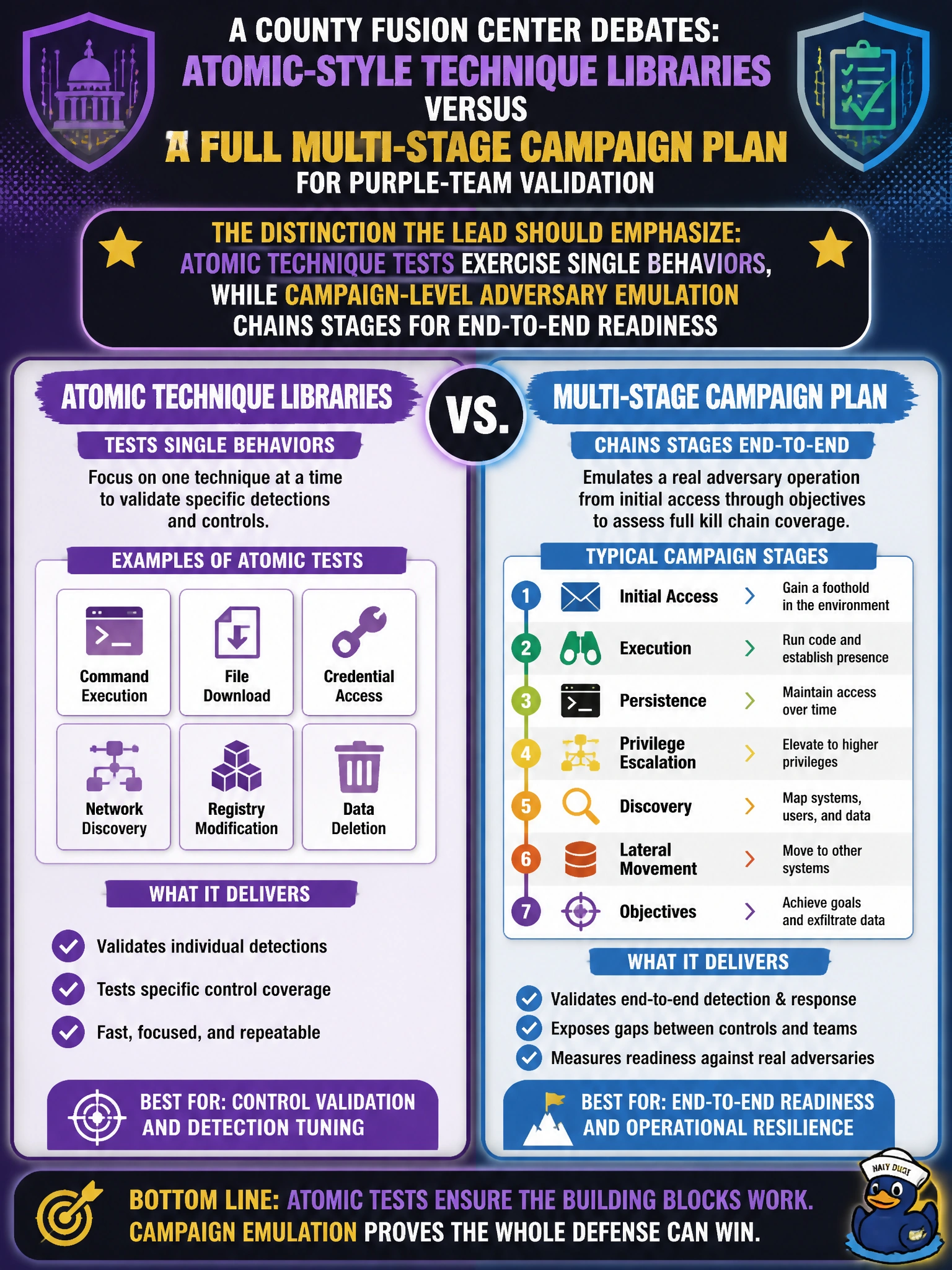
Think single fire-drill versus a whole week of multi-site exercises. Atomic tests poke one technique; a campaign plan walks initial access through discovery so the fusion center sees the full path defenders must catch. You'll see campaigns chain stages for end-to-end readiness, so they're not for compliance audit readiness, asset criticality scoring, or isolated control tuning.
Full Explanation
A county fusion center comparing Atomic-style technique libraries with full multi-stage campaign plans should emphasize that atomic tests exercise single behaviors, while campaign-level adversary emulation chains stages for end-to-end readiness. Atomic libraries are strong for regressing one detection or control after a change; campaign plans show whether municipal identity, telemetry, and response hold together from initial access through later ATT&CK stages. The lead’s distinction keeps both tools in the purple-team toolbox with clear civic purposes. While atomic tests do exercise single behaviors, campaign-level adversary emulation does not chain stages for compliance audit readiness; it chains adversary stages to validate end-to-end detection and response. While atomic tests do exercise single behaviors, campaign-level adversary emulation does not chain stages for asset criticality scoring; it chains adversary stages to validate end-to-end detection and response. While atomic tests do exercise single behaviors, campaign-level adversary emulation does not chain stages for isolated control tuning; atomic tests isolate single behaviors for control tuning while campaigns chain stages to emulate multi-stage intrusions for end-to-end readiness. Exam caveat: atomic success does not prove campaign readiness, and a campaign without atomic regression can hide single-control drift after patches. Operational check: for each fusion-center validation cycle, document which runs are atomic regressions versus multi-stage campaigns, map both to ATT&CK IDs, and verify SOC correlation across chained stages when campaign mode is used.
Prefer to study offline? Printable PDF study book + test engine ($7.50, unofficial). These questions stay free here.