
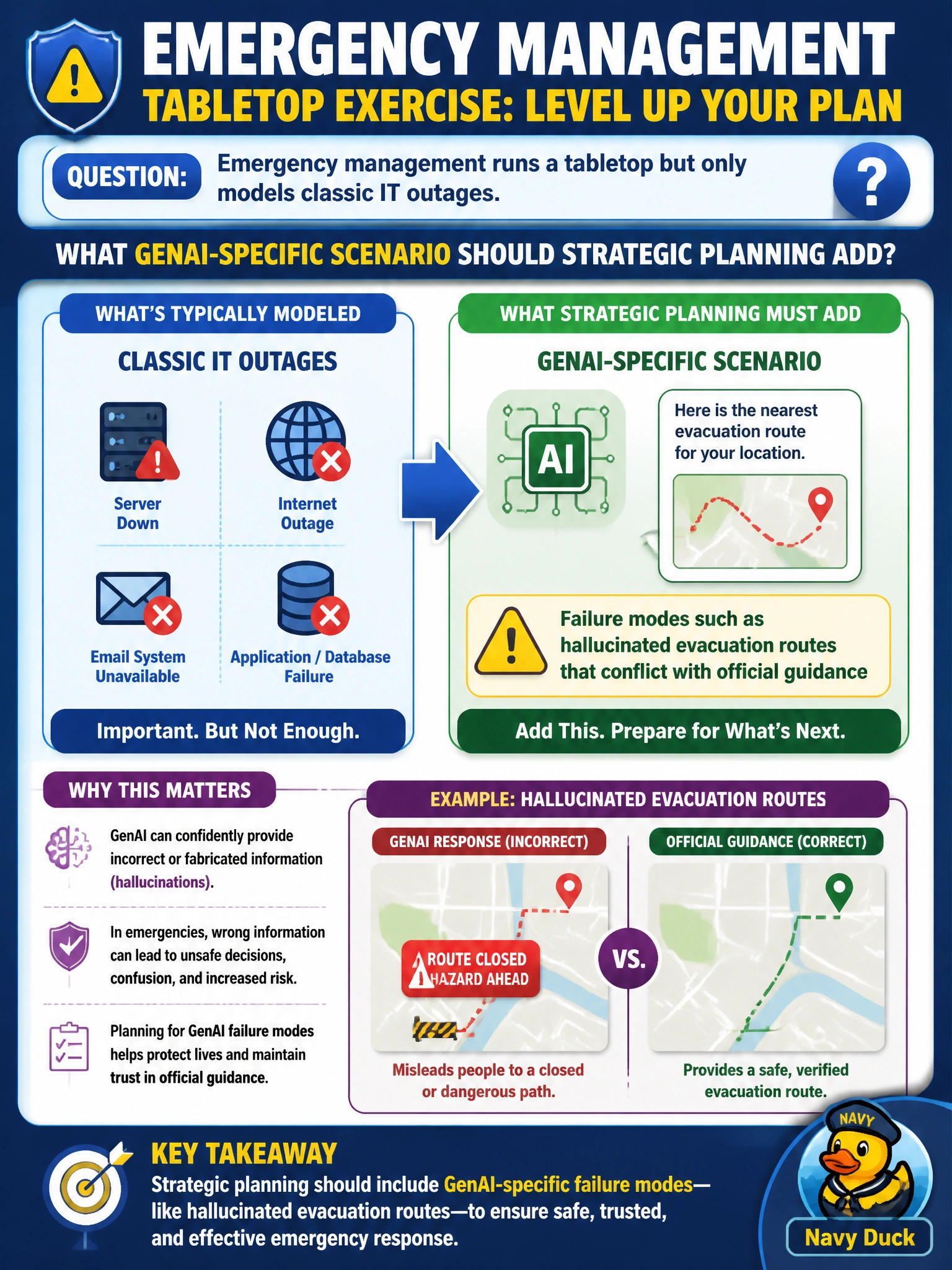
Emergency management runs a tabletop but only models classic IT outages. What GenAI-specific scenario should strategic planning add?
Select an answer to reveal the explanation.
Short Explanation
Continuity drills that ignore AI are like fire drills that skip the exits people actually use. Add GenAI failure modes—like made-up evacuation routes that fight the real plan. Menu colors and lawn schedules are not AI risk scenarios.
Full Explanation
Strategic continuity and emergency planning for GenAI must include AI-specific failure modes, not only classic IT outages. For emergency management, that includes hallucinated or conflicting evacuation routes, fabricated shelter status, prompt-injection-driven misdirection, retrieval of stale guidance, and unsafe tool actions that contradict the official Incident Action Plan. Tabletop exercises that add these scenarios train operators to detect divergence, escalate to human command, and fall back to authoritative channels.
Whether cafeteria menus print in color during an outage, whether lawn-mowing is delayed one day, or whether Wi-Fi passwords need seasonal rotation themes are peripheral or unrelated continuity topics that do not exercise GenAI failure modes affecting public safety messaging. Focusing drills only on classic IT outages leaves a blind spot where the system is “up” but producing dangerous guidance.
Exam caveat: GenAI continuity is not only model availability; incorrect-but-confident output during an emergency can be worse than silence if operators over-trust it. Operational check: add at least one GenAI conflict scenario to the next emergency tabletop—e.g., chatbot route conflicts with IAP—document expected escalation, and verify operators know the authoritative source of truth.