
A school-district board wants metrics for responsible GenAI use that go beyond uptime SLAs. Which metric set best fits strategic AI risk oversight?
Select an answer to reveal the explanation.
Short Explanation
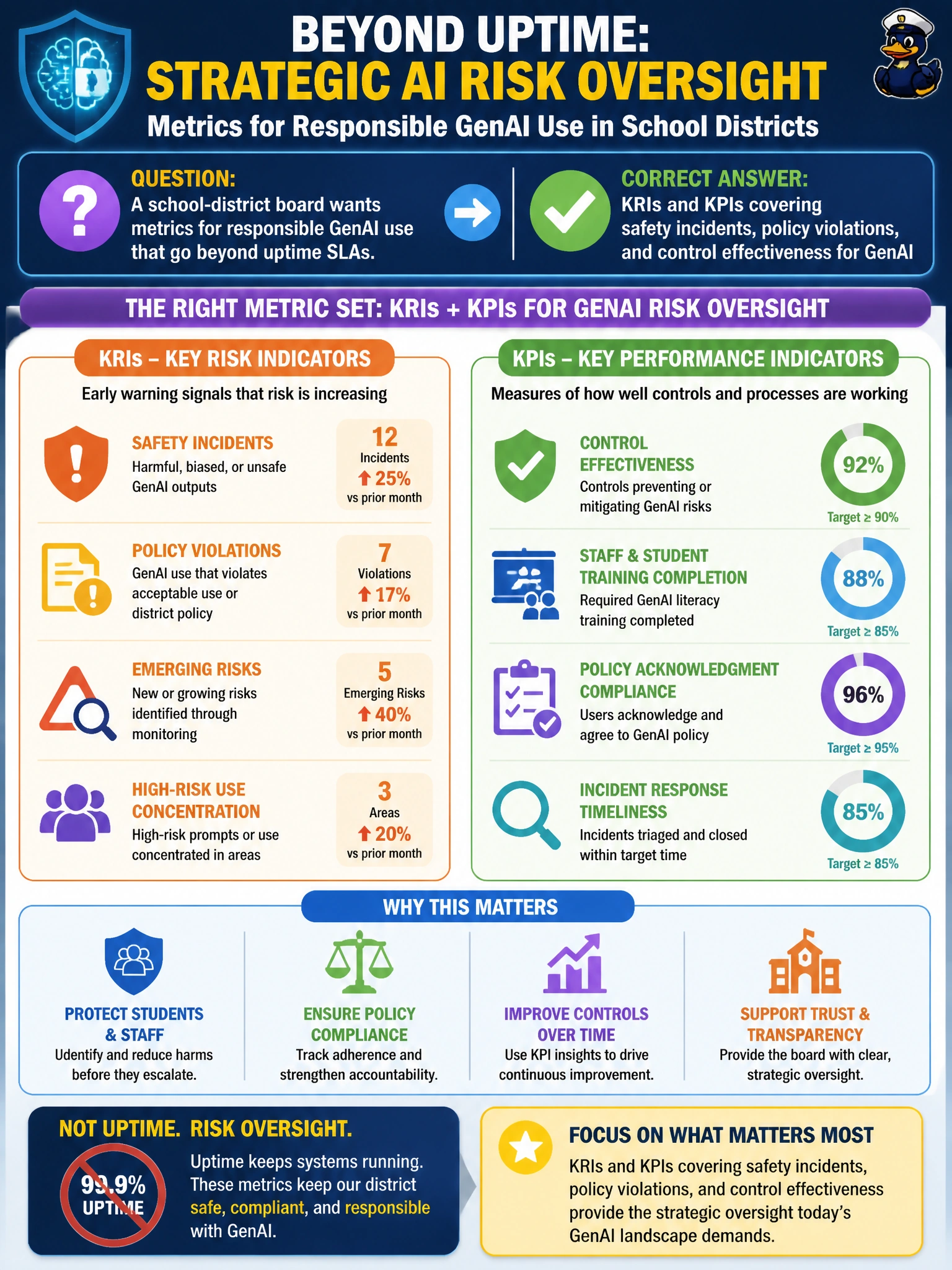
Uptime tells you the lights are on; responsible AI needs safety and control gauges too. Track KRIs/KPIs for incidents, policy breaks, and control health. Latency-only boards, one-time open counts, and social engagement scores miss the risk story.
Full Explanation
Strategic oversight of responsible GenAI use requires KRIs and KPIs that measure safety incidents, policy violations, and control effectiveness—not only availability. For a school district, that means tracking blocked or escalated unsafe outputs, shadow-AI policy breaches, access-control exceptions, evaluation failure rates, and evidence that mitigations work over time. Those metrics give the board visibility into whether GenAI is being used responsibly toward students and staff, complementary to—but distinct from—uptime SLAs.
Dashboards limited to average token latency and GPU utilization describe performance and capacity, not responsible-AI risk. A single metric counting students who opened the chatbot once measures curiosity or rollout reach, not harm, fairness, or control health, and can incentivize exposure without safety. Marketing engagement scores for the superintendent’s social posts are communications metrics unrelated to GenAI platform risk or educational duty of care.
Exam caveat: KRIs emphasize risk thresholds and early warning; KPIs may include operational performance—boards need both, with safety and control measures explicitly in scope for GenAI. Operational check: present a quarterly GenAI oversight pack that includes incident and policy-violation KRIs, control-effectiveness indicators, residual-risk status, and owners—not merely latency or vanity open counts.