
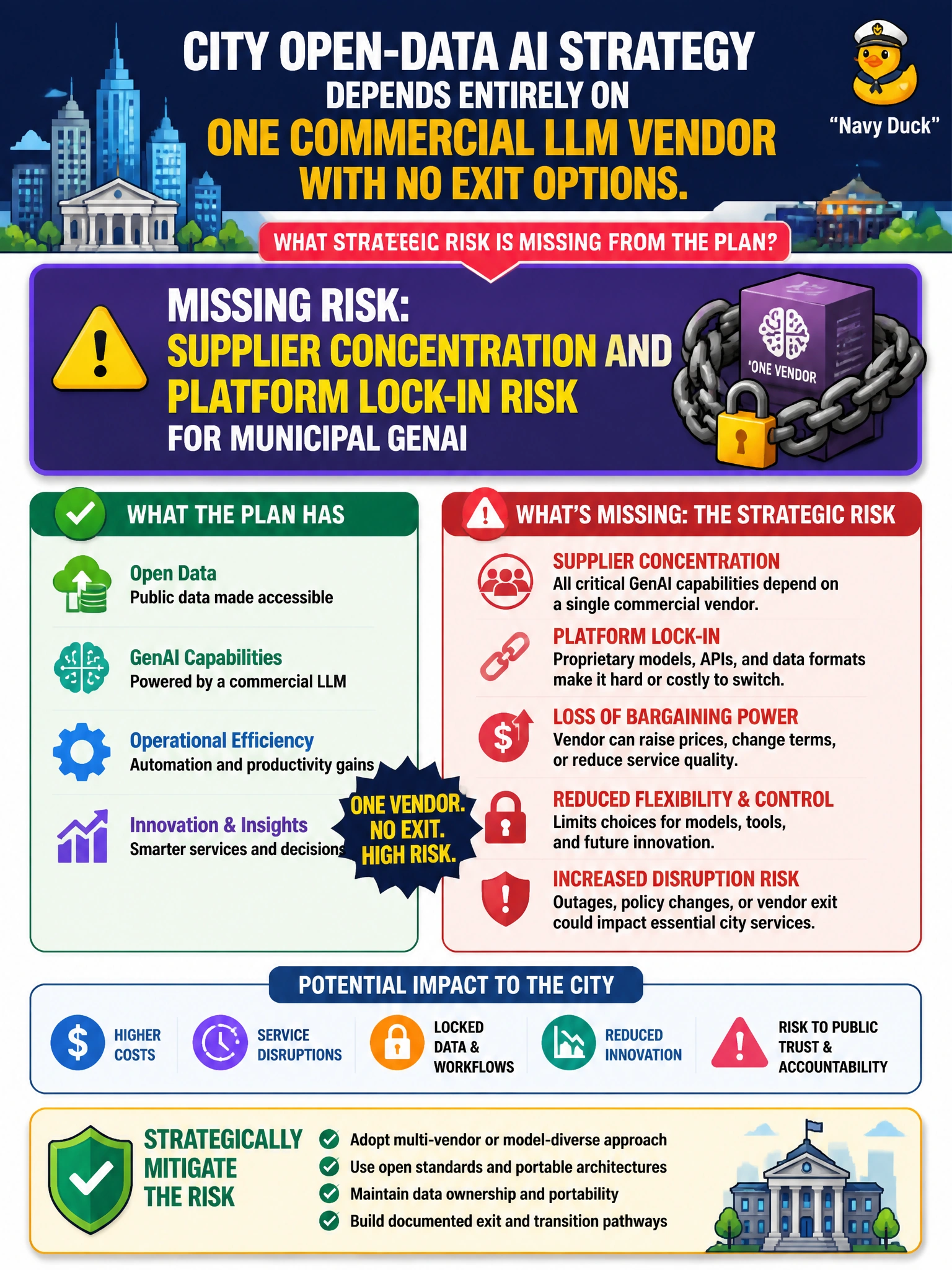
A city open-data AI strategy depends entirely on one commercial LLM vendor with no exit options. What strategic risk is missing from the plan?
Select an answer to reveal the explanation.
Short Explanation
One vendor as the only brain in town is concentration risk—if they stumble, so does the city. Strategic plans need exit and diversification thinking. Logo colors, dark mode, and gift cards are not supply-chain strategy.
Full Explanation
When a city’s open-data AI strategy depends entirely on one commercial LLM vendor with no exit options, the missing strategic risk is supplier concentration and platform lock-in. Concentration risk means pricing shocks, outages, policy changes, geographic or data-residency shifts, or abrupt feature deprecation can halt municipal GenAI capability. Lock-in appears in proprietary embeddings, non-portable prompts and agents, exclusive tooling, and contracts without export, escrow, or multi-vendor pathways. Strategic plans must include diversification, portability requirements, and exit runbooks.
Whether the vendor’s logo matches the brand palette, whether staff prefer dark mode, or whether the cafeteria accepts vendor gift cards are aesthetic or fringe concerns that do not address continuity of civic AI services. Treating them as strategic risks distracts from concentration and exit planning.
Exam caveat: single-vendor use can be acceptable short-term if residual concentration risk is explicit, accepted, and paired with exit criteria—silence on lock-in is the planning failure. Operational check: require an exit/portability assessment for the open-data LLM dependency covering data export, alternative model paths, contract termination assistance, and a tested failover or degrade mode for critical resident-facing features.