
County IT considers GPU cloud spot instances for batch GenAI summarization against a strict data-residency policy. What hosting alignment check matters most?
Select an answer to reveal the explanation.
Short Explanation
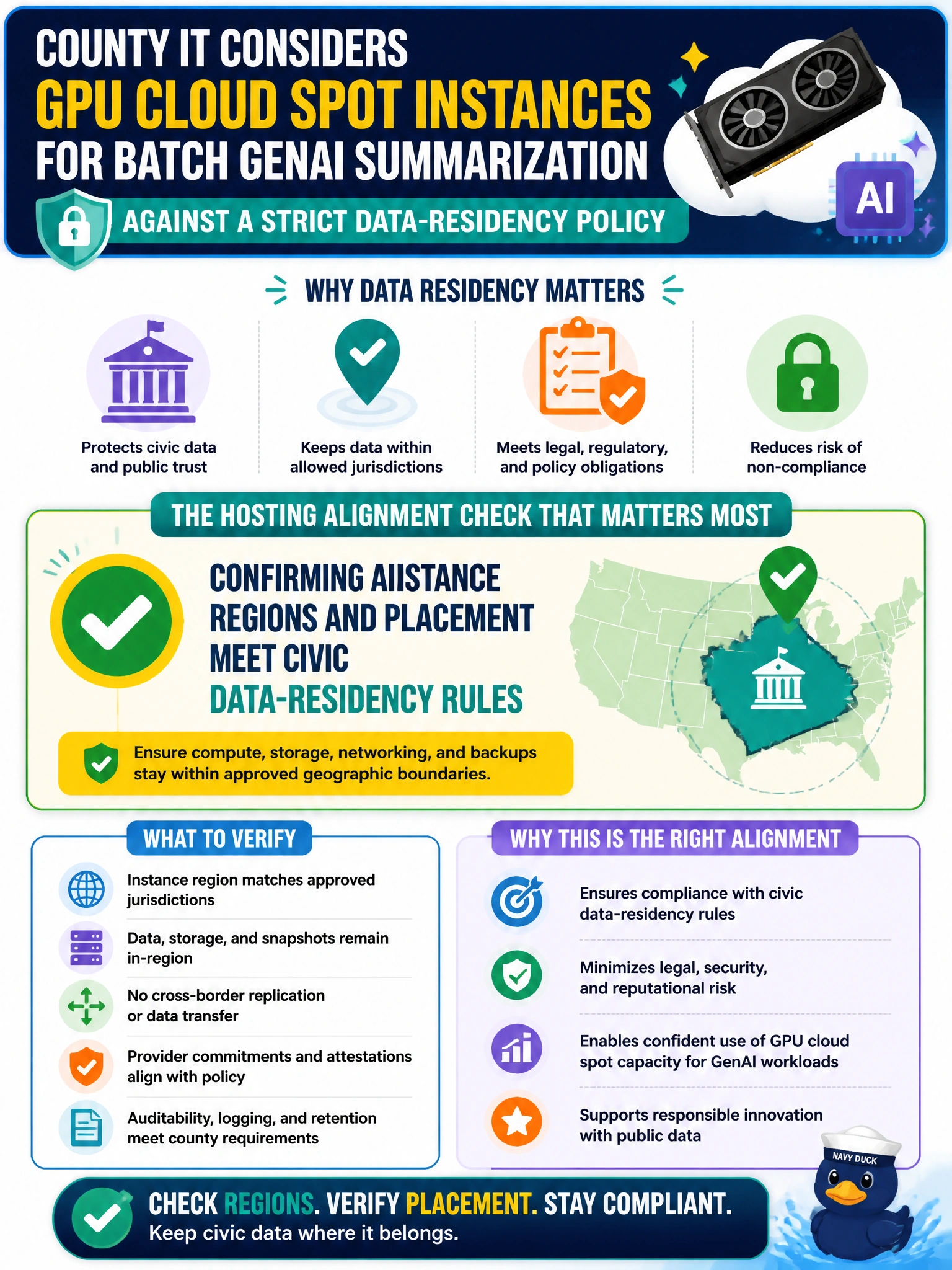
Cheap GPU spots are fine only if the county’s data still sleeps in the right ZIP code. Check region and residency first. Spot discounts, short jobs, and Creative Commons cards do not rewrite residency policy.
Full Explanation
County IT considering GPU cloud spot instances for batch GenAI summarization under a strict data-residency policy must first confirm instance regions and placement meet civic data-residency rules. Spot capacity is a pricing and availability mechanism; it does not relocate legal or policy constraints on where municipal data may be processed. Hosting alignment means verifying region, placement options, and any replication the batch pipeline might trigger before resident or county data touches those GPUs.
Assuming spot pricing automatically keeps data inside county borders confuses cost optimization with geography and sovereignty. Ignoring residency because jobs finish quickly treats compliance as a race against auditors rather than a durable control. Creative Commons model cards address license terms for weights, not where civic inputs and outputs may be processed or stored.
Exam caveat: some spot markets are already region-scoped—still verify the selected region and that capacity fallback does not spill into disallowed regions during scarcity. Operational check: pin batch GenAI jobs to approved regions in infrastructure-as-code, deny launches outside the residency allowlist via organization policy, and review job logs for actual placement of summarization workers against the county map of allowed regions.