
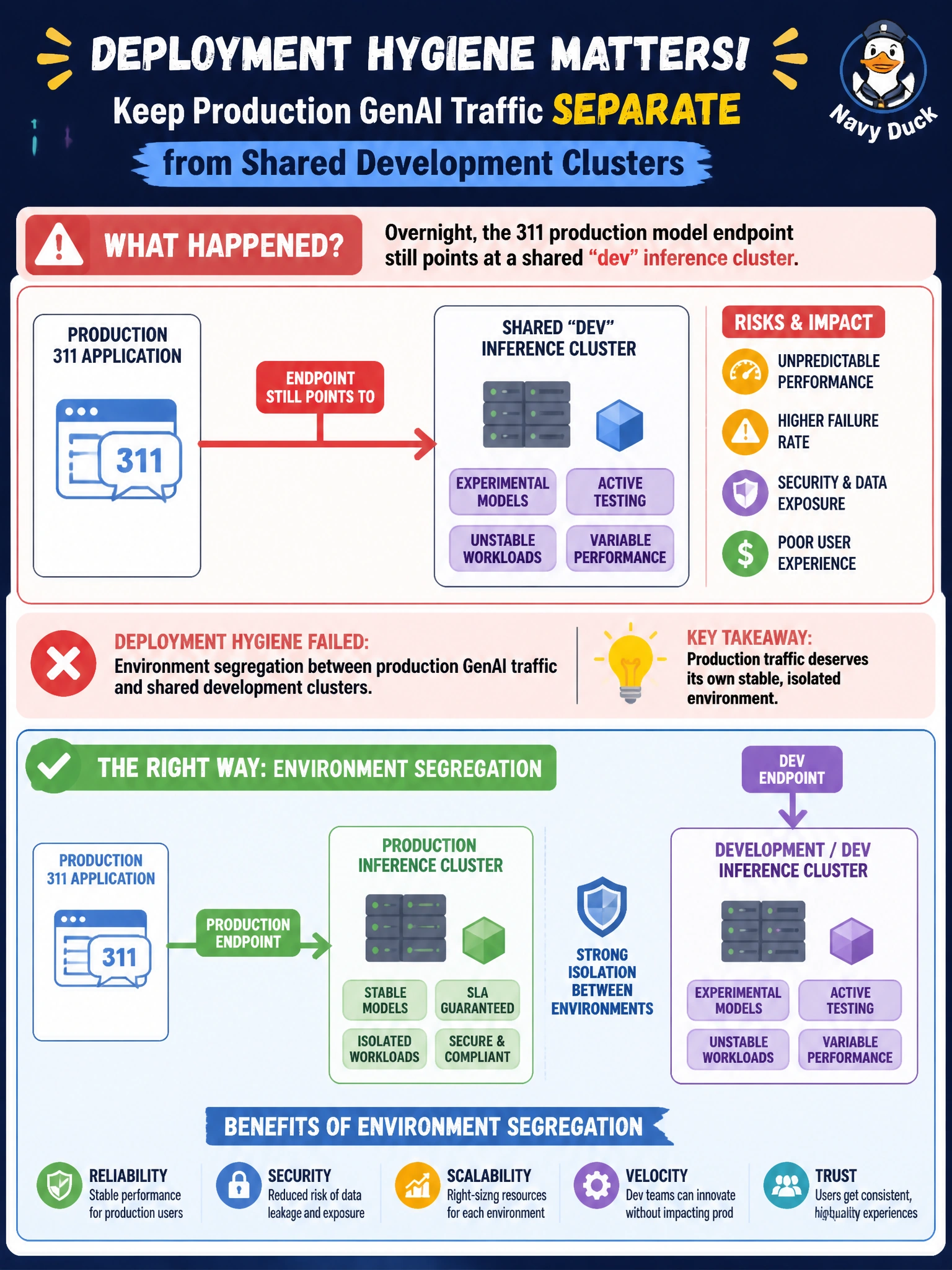
Overnight, the 311 production model endpoint still points at a shared “dev” inference cluster. What deployment hygiene failed?
Select an answer to reveal the explanation.
Short Explanation
You wouldn’t route 311 calls through a shared training radio, and production GenAI traffic needs the same segregation from development. Untested hotfixes, cost-saving quantization, and a wiki label without controls don’t provide it.
Full Explanation
When the 311 production model endpoint still points at a shared “dev” inference cluster overnight, environment segregation failed: production resident traffic must not share unmanaged development inference infrastructure. Municipal GenAI needs distinct production targets, promotion gates, and configuration management so live civic queries do not hit experimental nodes, debug settings, weaker authentication, or shared developer capacity that was never cleared for resident use. Promoting untested nodes straight to residents bypasses change control and increases outage, safety, and privacy risks for 311 callers. Routine model quantization may reduce inference costs, but it does not establish environment segregation; dedicated isolated GPUs for production requests do not make a production endpoint pointing to a shared development cluster safe. Labeling the dev cluster “prod” in a wiki without technical controls is documentation theater and does not isolate environments in DNS, gateways, or identity. Exam caveat: shared platform teams may run multiple environments on one control plane, but serving endpoints, credentials, data mounts, and blast-radius boundaries must still segregate production GenAI traffic from development. Operational check: trace the 311 production DNS or gateway backend pool, confirm it resolves only to production inference, monitor or enforce policy checks for drift to non-production clusters, and require ticketed promotion for endpoint changes.