
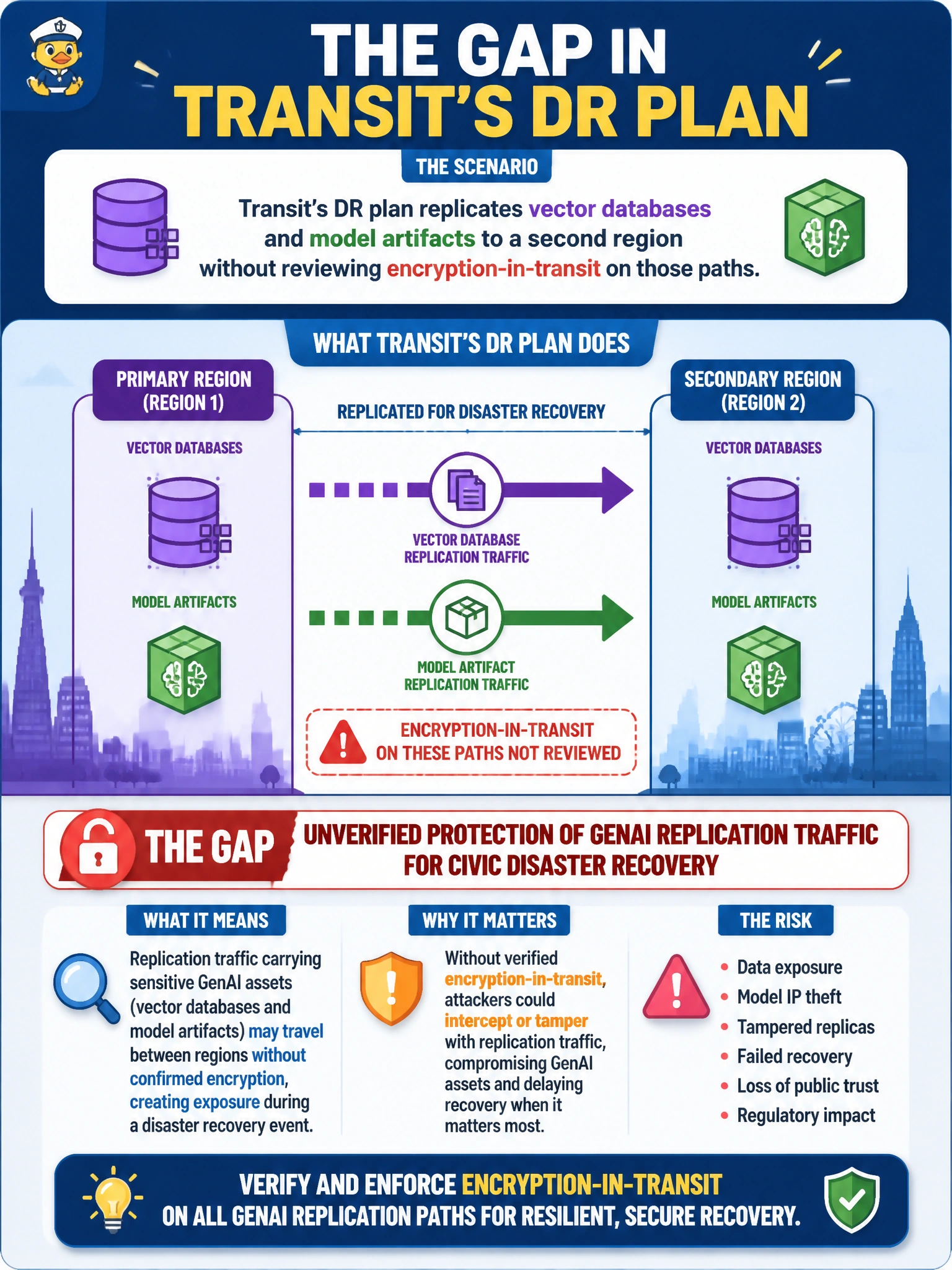
Transit’s DR plan replicates vector databases and model artifacts to a second region without reviewing encryption-in-transit on those paths. What gap exists?
Select an answer to reveal the explanation.
Short Explanation
DR copies of models and vectors are still sensitive cargo on the road — encrypt the trip. “It’s just a copy,” short prompts, and trusted airport Wi-Fi do not verify transit protection.
Full Explanation
Transit’s DR plan that replicates vector databases and model artifacts to a second region without reviewing encryption-in-transit leaves a gap: unverified protection of GenAI replication traffic for civic disaster recovery. Model weights and embeddings can contain sensitive municipal knowledge or reflections of source data; replication paths need reviewed TLS or equivalent path encryption, authenticated replication endpoints, and integrity checks—not an assumption that disaster-recovery copies are safe merely because they are copies.
Replicas still need integrity verification; being a copy does not prove they were not altered or intercepted in transit. Short prompts do not make second-region storage or encrypted transport optional for the artifacts being replicated. Cleartext replication over supposedly trusted airport Wi-Fi or any insufficiently trusted path fails confidentiality for civic GenAI artifacts moving between regions.
Exam caveat: encryption-in-transit for DR must also align with residency and key-management rules for the second region so recovery does not violate the same policy DR is meant to uphold. Operational check: inspect replication channel configuration for TLS, certificate validation, and private connectivity; run a test replication and verify artifacts remain confidential and intact on the DR path with logging of the transport controls used.