
Public-health staff chunk clinic PDFs for RAG without stripping hidden prompt-like instructional text. What ingestion hygiene step is missing?
Select an answer to reveal the explanation.
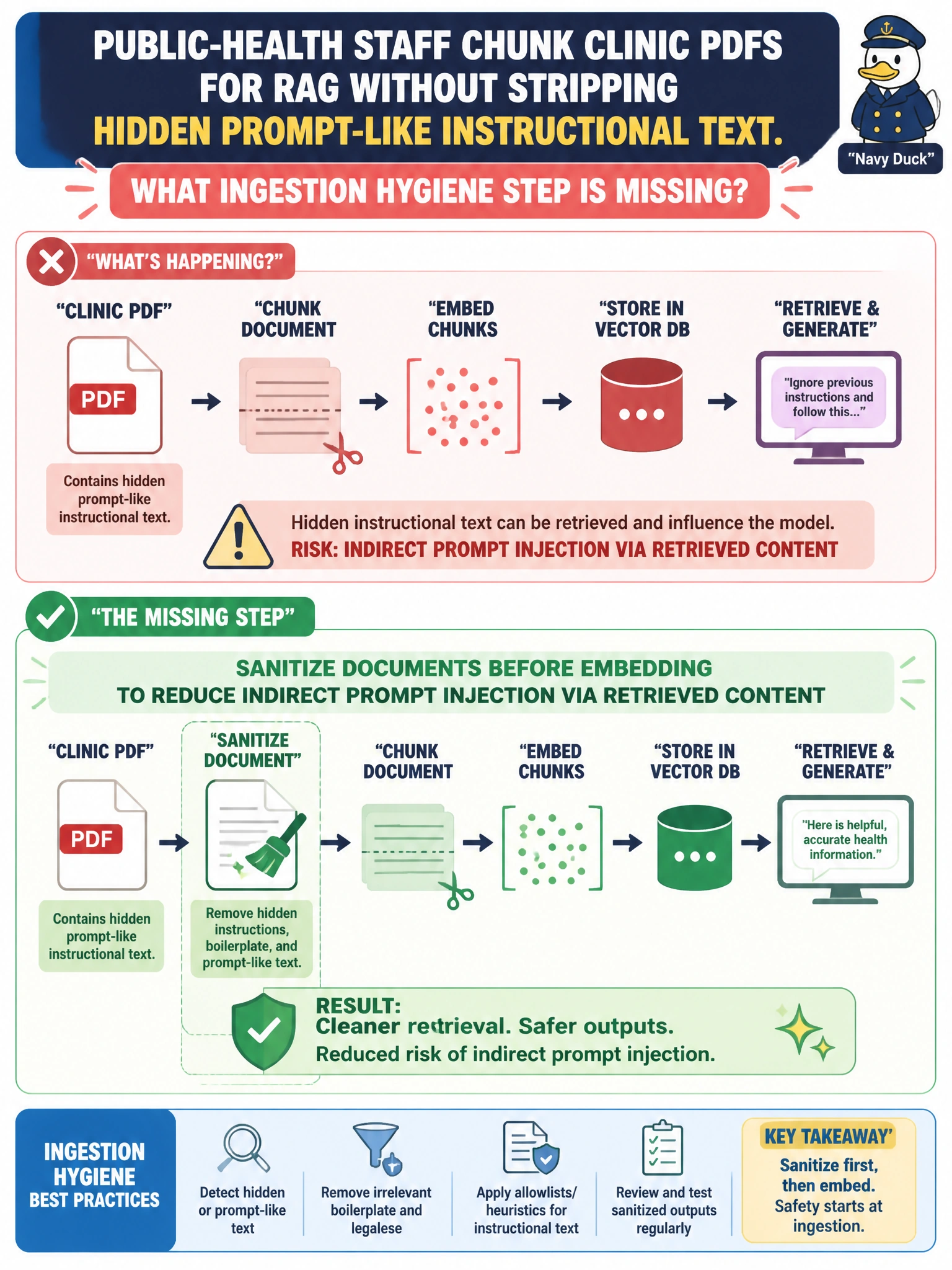
Short Explanation
Hidden text in a PDF can hitch a ride into the prompt when RAG retrieves it—like a sticky note that says 'ignore the privacy rules.' Scrub that junk before you embed, not after the bot already read it.
Full Explanation
Sanitizing documents before embedding to reduce indirect prompt injection via retrieved content is the missing ingestion hygiene step. Clinic PDFs can contain hidden or adversarial instructional text that looks like system orders once concatenated into the RAG prompt. If public-health staff chunk and embed without stripping that material, retrieval becomes a delivery path for indirect prompt injection that can override privacy or clinical-policy instructions. Hygiene at ingest—strip hidden layers, neutralize instruction-like spans, and validate chunk text—closes the path before vectors are stored.
Increasing chunk overlap so hidden instructions are split across more vectors fails by concept: overlap can still retrieve instruction fragments and may even increase the chance pieces reassemble in context. Storing raw PDFs only in the vector DB and never in object storage fails because the injection risk is in retrieved text content, not merely where bytes sit, and vectors still carry the unsafe text. Disabling retrieval filters so every clinic PDF is always in context fails by maximizing exposure to any poisoned or instruction-laden document.
Exam caveat: Indirect prompt injection via retrieved civic documents is a RAG-specific threat. Ingest sanitization is a control, not an optional cleanup after answers look odd.
Operational check: Before embed, run PDF text extraction through sanitizers that remove hidden/instruction-like content, plant a benign test instruction in a fixture PDF and confirm it is stripped, re-index clinic corpora, and verify retrieved chunks no longer contain override-style directives.