
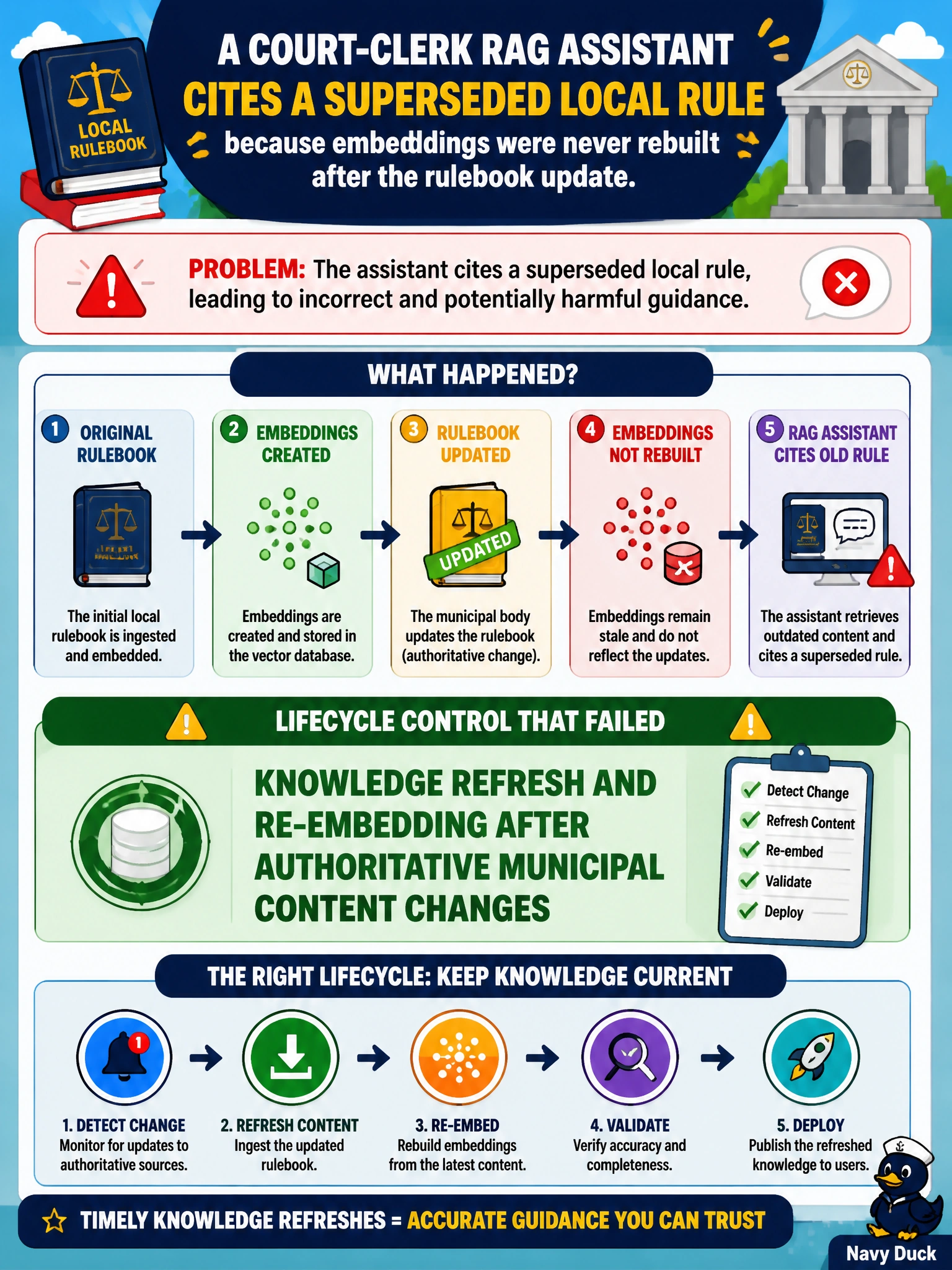
A court-clerk RAG assistant cites a superseded local rule because embeddings were never rebuilt after the rulebook update. What lifecycle control failed?
Select an answer to reveal the explanation.
Short Explanation
If the paper rulebook gets a new edition but the vector shelves still hold last year's pages, the clerk bot will cite ghosts. Reindex when the authoritative source changes—don't just hope the model 'feels' the update.
Full Explanation
Knowledge refresh and re-embedding after authoritative municipal content changes is the lifecycle control that failed. When the court rulebook is updated but embeddings are never rebuilt, the clerk assistant continues to retrieve and cite superseded local rules. Authoritative civic knowledge has versions; the vector index must track those versions through scheduled or event-driven re-ingest so answers and citations match the current rule, not last year’s edition.
Prompt-temperature scheduling for legal-adjacent bots fails by concept: temperature does not refresh stale vectors or align citations with new ordinances. Mandatory fine-tuning whenever any ordinance PDF is edited fails because RAG is meant to ground on current documents without re-baking every edit into model weights; the missing step is index refresh, not constant fine-tunes. Disabling citations so outdated rules cannot be attributed fails by hiding provenance instead of fixing stale knowledge, and the bot can still state the wrong rule without a citation.
Exam caveat: Stale municipal corpora are an operational risk equal to wrong ACLs. Treat re-embedding after authoritative updates as required change control for court and ordinance RAG.
Operational check: On rulebook publish, trigger re-crawl and re-embed, compare nearest neighbors for amended section IDs before and after, confirm citations show new version identifiers, and alert when source documents change without a successful reindex job.