
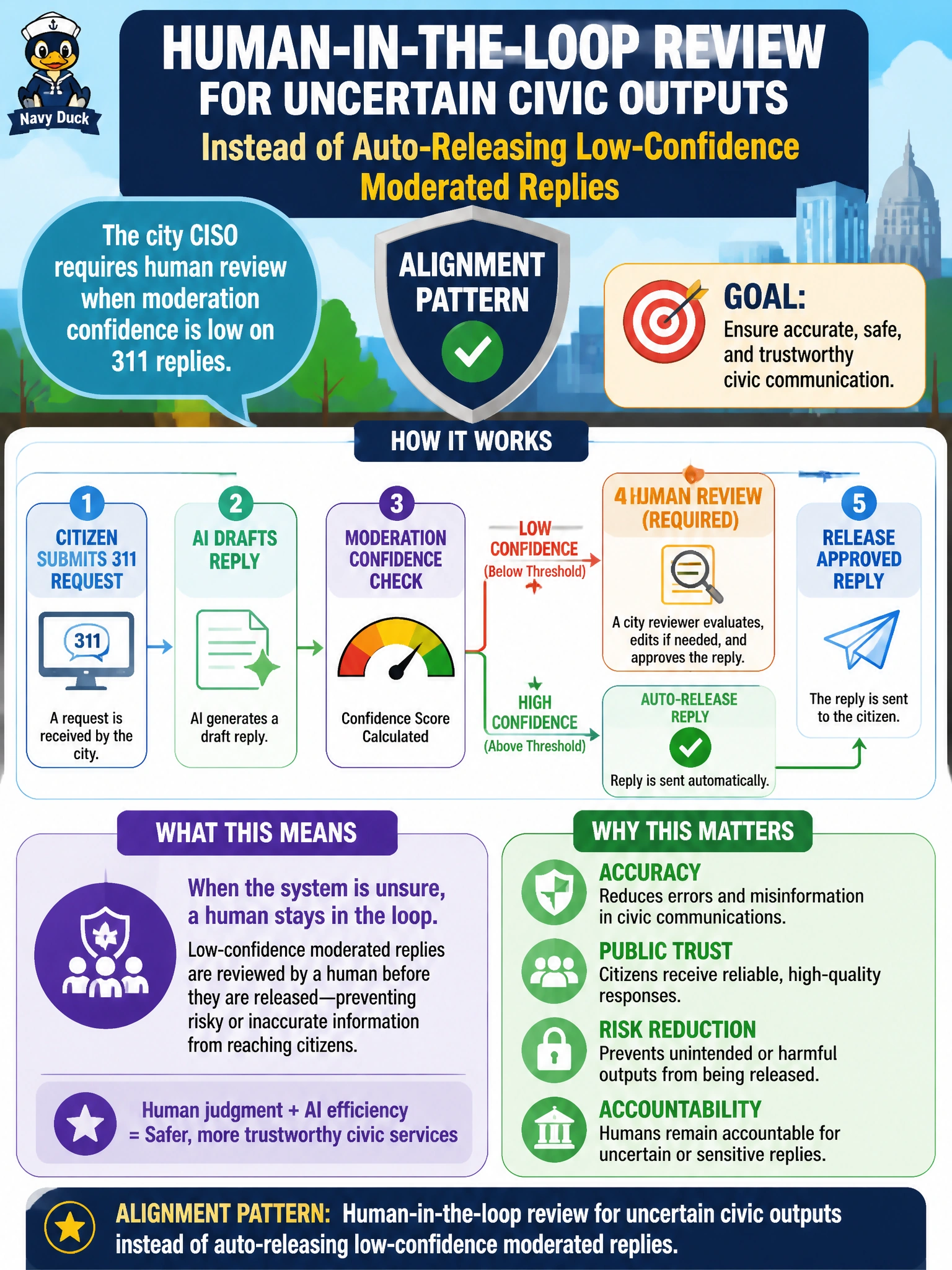
The city CISO requires human review when moderation confidence is low on 311 replies. What alignment pattern does this implement?
Select an answer to reveal the explanation.
Short Explanation
When the moderation meter reads 'not sure,' hand the 311 reply to a human—not the autopilot. Low confidence is the cue for a person to take the wheel.
Full Explanation
Requiring human review when moderation confidence is low on 311 replies implements human-in-the-loop review for uncertain civic outputs instead of auto-releasing low-confidence moderated replies. That pattern keeps residents safer when the automated moderator is unsure, while still allowing high-confidence allow or block decisions to proceed. It is a classic alignment and safety operations control for municipal chat systems.
Fully autonomous release of every reply maximizes throughput at the expense of safety on ambiguous cases. Deleting confidence scores so operators cannot second-guess the model removes the signal needed for selective human review. Routing all low-confidence messages to an anonymous public forum for voting is not an appropriate confidentiality or accountability model for 311 resident data.
Exam caveat: Human-in-the-loop is targeted escalation, not crowd-sourcing resident messages or disabling confidence metrics. Throughput arguments do not override low-confidence civic risk.
Operational check: Define confidence thresholds with 311 operations, queue uncertain replies to a staffed queue with SLA, log human overrides, and measure both false auto-releases and queue backlog. Periodically recalibrate thresholds so humans see truly ambiguous cases rather than drowning in noise or rubber-stamping empty queues.