
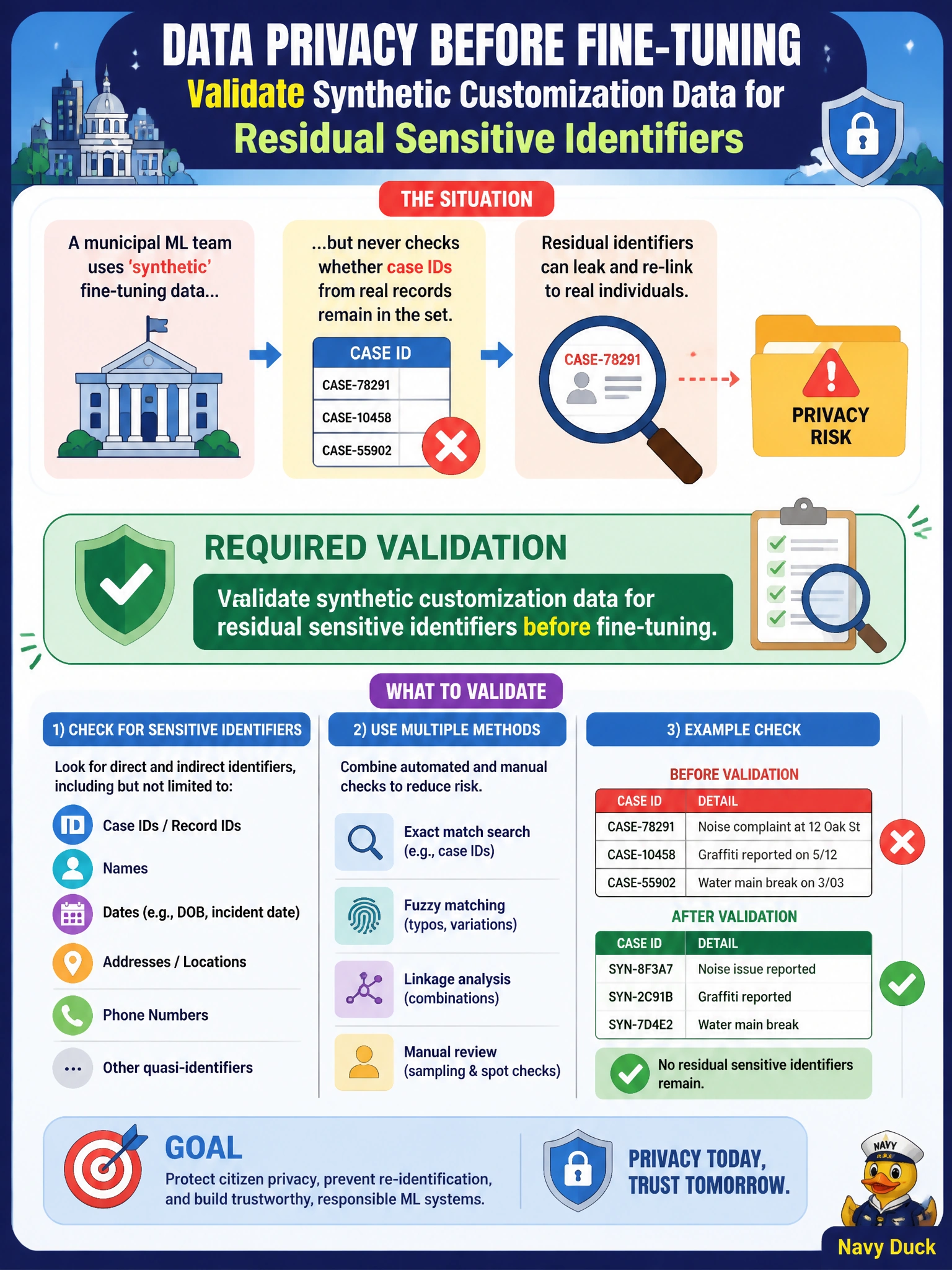
A municipal ML team uses 'synthetic' fine-tuning data but never checks whether case IDs from real records remain in the set. What validation is required?
Select an answer to reveal the explanation.
Short Explanation
Calling data 'synthetic' doesn't scrub leftover case IDs any more than renaming a file 'clean' empties it. Scan the so-called synthetic set for real identifiers before it hits the fine-tune.
Full Explanation
Municipal ML teams using "synthetic" fine-tuning data must still validate that residual sensitive identifiers from real records—such as case IDs—are absent before fine-tuning. Synthetic generation pipelines often start from real seeds, templates, or incomplete scrubbing; the label "synthetic" is not a privacy guarantee. Required validation is explicit scanning and sampling for residual identifiers prior to customization.
Assuming any file labeled synthetic is free of sensitive identifiers is circular trust. Hashing filenames only says nothing about record contents. Skipping validation because data was generated on city-owned laptops confuses device custody with content hygiene.
Exam caveat: Synthetic data still needs privacy validation. Filename tricks and ownership of laptops do not anonymize fields. GAIPS customization hygiene items reward content inspection over naming conventions.
Operational check: Run automated detectors for case IDs, phones, addresses, and account numbers on the synthetic set, manually review a statistical sample, quarantine failing batches, and document attestation in the training ticket. Only then permit the fine-tune job, and re-check a post-tune extraction suite for leaked identifier patterns.