
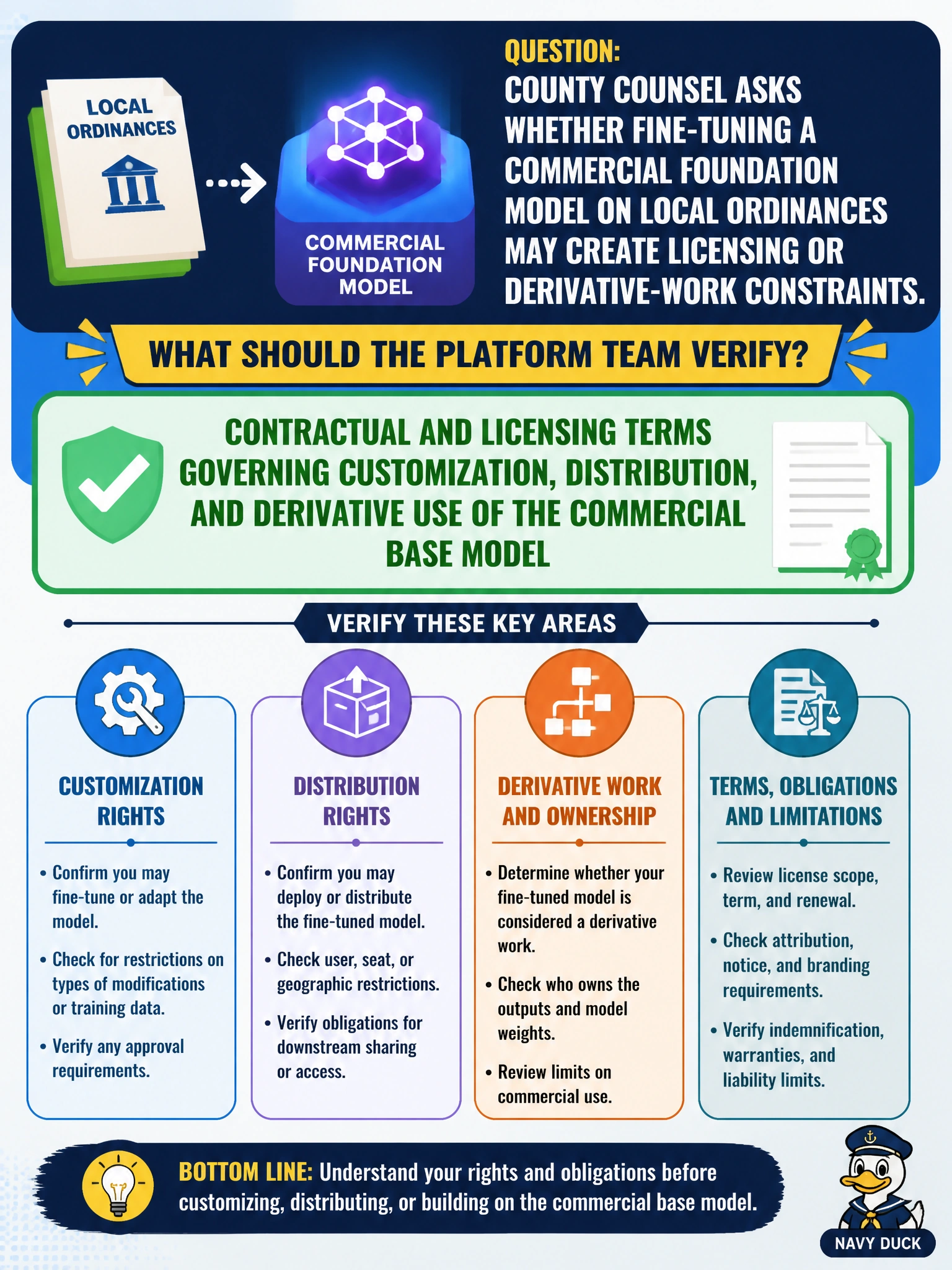
County counsel asks whether fine-tuning a commercial foundation model on local ordinances may create licensing or derivative-work constraints. What should the platform team verify?
Select an answer to reveal the explanation.
Short Explanation
Even if the ordinance text is public, the base model's license still writes the rules of the road for fine-tunes and redistribution. Read the contract before you bake city code into a commercial checkpoint.
Full Explanation
Fine-tuning a commercial foundation model on local ordinances may still be constrained by the vendor's licensing and contractual terms governing customization, distribution, and derivative use—even when the ordinance text itself is public. The platform team should verify those terms before baking city code into a commercial checkpoint that might be redistributed, hosted for other agencies, or published as a derivative model artifact.
Municipal ordinances do not automatically override vendor model licenses worldwide. Fine-tuning on public ordinances does not void all vendor restrictions by magic. GPU brand warranties are irrelevant to the legal question of model customization and redistribution rights.
Exam caveat: Public domain or public-sector content in the corpus does not equal freedom to ignore the base model's license. Separate content rights from model-weight rights. GAIPS procurement and customization items often test this distinction.
Operational check: Have counsel review the commercial model's customization, fine-tune, and derivative-work clauses; document allowed hosting and redistribution boundaries; ensure ordinance fine-tunes stay within permitted use; and record license constraints in the model card so later open-data or inter-agency sharing requests do not violate the contract.