
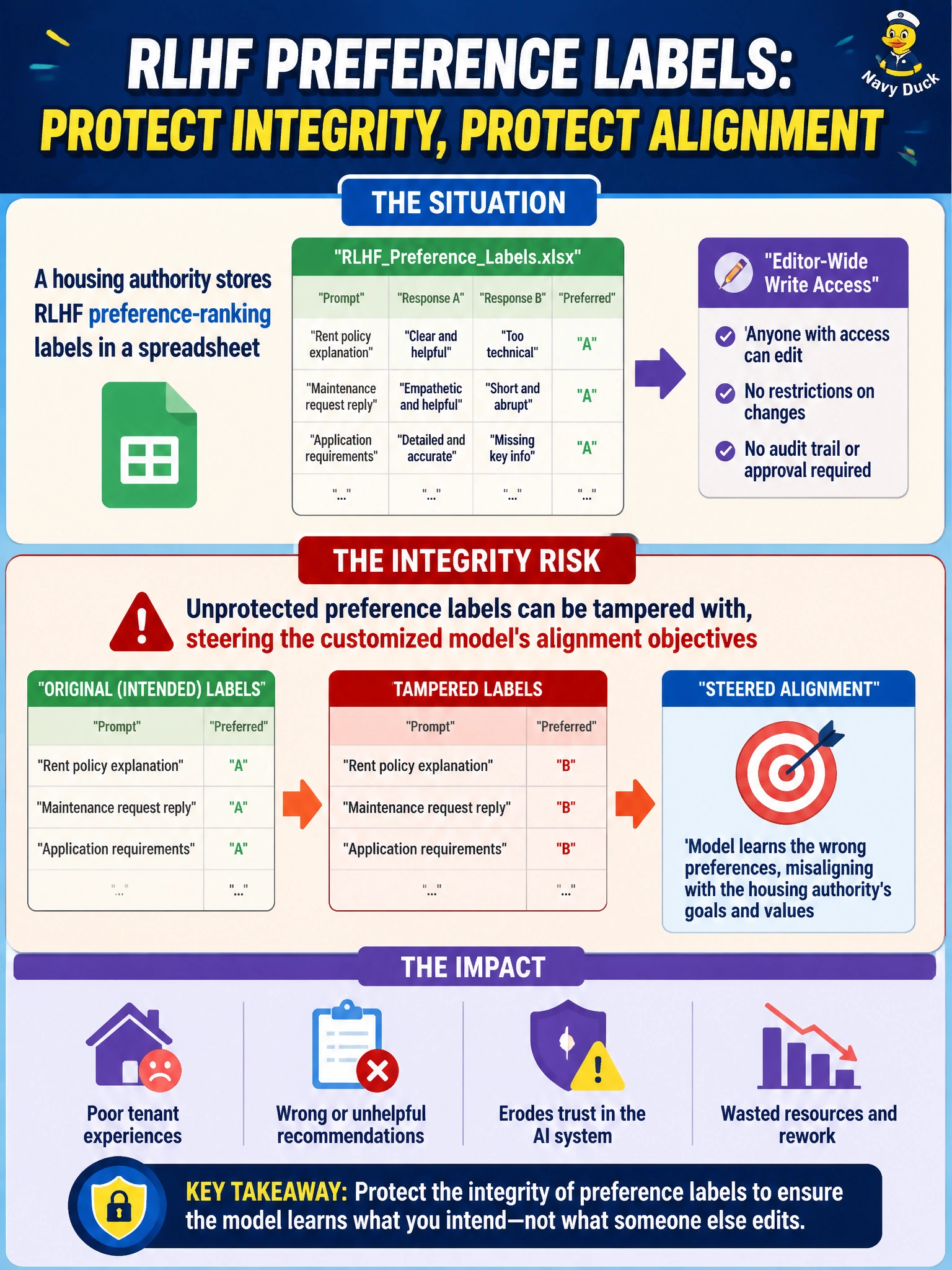
A housing authority stores RLHF preference-ranking labels in a spreadsheet with editor-wide write access. What integrity risk should security address?
Select an answer to reveal the explanation.
Short Explanation
Those preference stars are the steering wheel for the housing bot. If half the office can rewrite the spreadsheet, someone can yank the wheel—lock label integrity down.
Full Explanation
RLHF preference-ranking labels stored in a spreadsheet with editor-wide write access present an integrity risk: anyone with edit rights can tamper with rankings and thereby steer the housing-authority model's alignment objectives. Preference data is an alignment-critical control plane; wide write access turns it into an insider or accidental corruption vector that can mis-train eligibility and tone behavior.
Spreadsheets can influence model behavior long after export if poisoned labels are used in training or if re-exports refresh the reward set—assuming a one-time export ends risk is wrong. Wide write access is not required by open-data transparency laws for internal preference labeling. Preference ranks affect ranking loss and model behavior; they are not UI color settings.
Exam caveat: Protect alignment datasets like you protect production config and signing keys. Open-data mandates do not justify world-writable preference sheets for housing AI. Integrity of labels is as important as confidentiality.
Operational check: Move preference labels into an access-controlled store with change history, least-privilege editors, and approval on export to training. Hash label sets in the training manifest, alert on unexpected diffs, and periodically audit who changed high-impact preference pairs affecting eligibility guidance.