
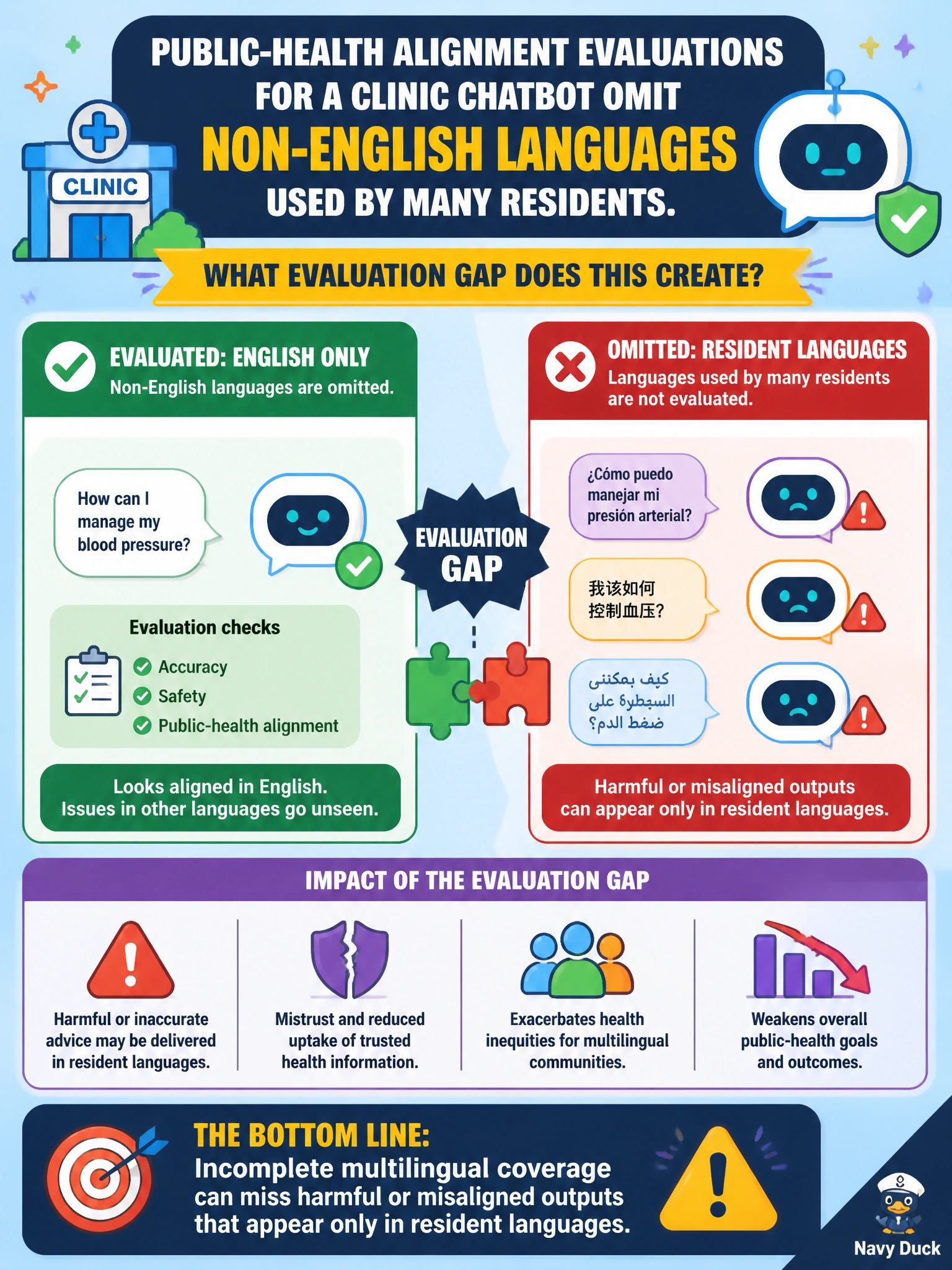
Public-health alignment evaluations for a clinic chatbot omit non-English languages used by many residents. What evaluation gap does this create?
Select an answer to reveal the explanation.
Short Explanation
If you only crash-test the clinic bot in English, Spanish and other resident languages are still driving untested. Alignment evals have to cover the tongues your community actually speaks.
Full Explanation
Public-health alignment evaluations that omit non-English languages used by many residents create incomplete multilingual coverage: harmful, biased, or misaligned outputs may appear only in those languages and escape English-only safety tests. Clinic chatbots serving multilingual communities must evaluate alignment across the languages actually used by residents, not only the language of the model card's primary demos.
English-only safety tests do not fully cover all tokenizers or linguistic risk surfaces in multilingual clinics. Non-English prompts can carry prompt-injection and jailbreak risk; language is not a shield. Alignment evaluations are not optional merely because a model card lists multiple languages—listing support without testing it is another coverage gap.
Exam caveat: Claimed multilingual support without multilingual safety evaluation is a false sense of readiness. GAIPS civic scenarios emphasize equity and risk in the languages the municipality actually serves.
Operational check: Build parallel eval sets in each priority resident language for self-harm, medical overreach, injection, and refusal cases; score the clinic chatbot per language; remediate languages that fail; and include multilingual gates in release criteria. Engage bilingual clinicians or community reviewers for labeling quality, not only automated translation of English tests.