
City open-data staff debate domain-adaptive fine-tuning versus a RAG-only design for ordinance Q&A. From a security perspective, what contrast matters most?
Select an answer to reveal the explanation.
Short Explanation
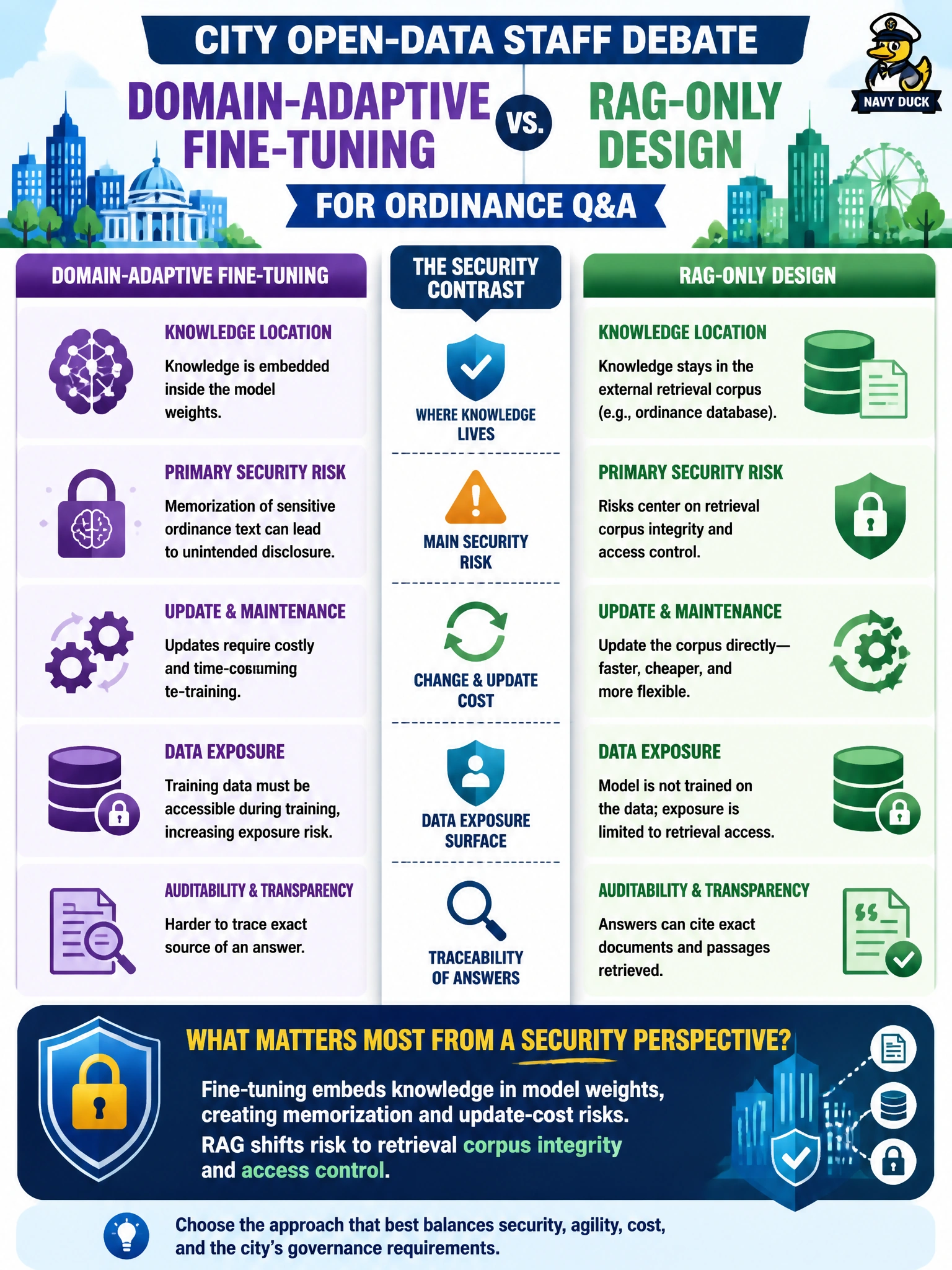
Fine-tuning writes city knowledge into the model's brain; RAG keeps it in a library the bot checks. Different shelves, different break-in paths—weights memorization versus corpus poisoning and ACL gaps.
Full Explanation
From a security perspective, domain-adaptive fine-tuning versus a RAG-only design for ordinance Q&A differs mainly in where knowledge and risk live. Fine-tuning embeds knowledge in weights, bringing memorization, hard-to-unlearn updates, and costly retraining when ordinances change. RAG keeps ordinances in a retrieval corpus, shifting risk to corpus integrity, access control, poisoning, and citation freshness. City open-data staff should choose knowing those distinct attack and governance surfaces—not treat the choice as cosmetic.
RAG does not always store raw Social Security numbers while fine-tuning never can; both patterns can mishandle sensitive data depending on what operators put in corpora or training sets. The attack surfaces are not identical, so the choice is not cosmetic. RAG does not eliminate the need for moderation or alignment controls; retrieved context can still be misused or injected, and generations still need safety layers.
Exam caveat: Do not flatten fine-tune and RAG into one risk profile. Memorization and update cost characterize weight embedding; ACL, integrity, and poisoning characterize retrieval corpora. Moderation remains necessary in both architectures for civic ordinance assistants.
Operational check: If fine-tuning, minimize corpus content, evaluate memorization, and budget for retrain on code changes. If RAG, harden corpus ACLs, signing or hash inventory, retrieval authz, and injection tests. For either path, keep gateway moderation and citation checks so applicants receive current, non-leaky ordinance guidance.