
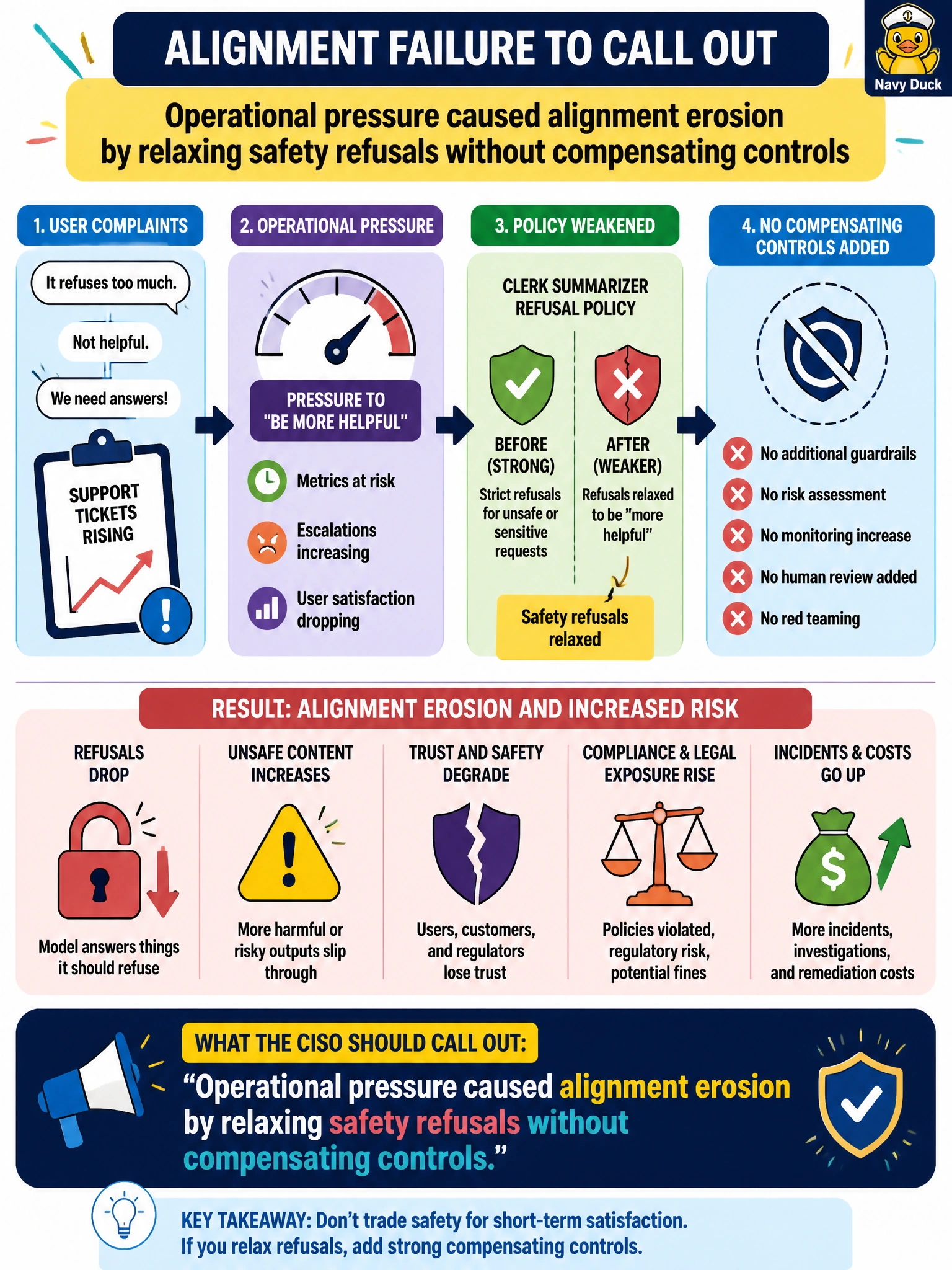
After user complaints, operators weaken a clerk summarizer's refusal policy to 'be more helpful.' What alignment failure should the CISO call out?
Select an answer to reveal the explanation.
Short Explanation
When the help desk shouts 'just make it say yes more,' safety fences quietly come down. That's alignment erosion—pressure winning over the refusals that kept the clerk bot in bounds.
Full Explanation
After user complaints, weakening a clerk summarizer's refusal policy to "be more helpful" is alignment erosion driven by operational pressure: safety refusals are relaxed without compensating controls, evaluations, or scoped exceptions. The CISO should call out that helpfulness pressure can silently expand the model's willingness to overstep clerical bounds, including toward legal advice or sensitive disclosure, unless new tests and guardrails accompany any refusal change.
Improved helpfulness does not automatically strengthen safety evaluations; those metrics often move in opposite directions without careful design. Weakening refusals is not required by municipal accessibility statutes—accessibility and safety are compatible with clear refusals and alternative pathways. Refusal policies change model outputs; they are not merely logging switches.
Exam caveat: Alignment erosion under operational pressure is a recurring GenAI failure mode. Distinguish legitimate UX fixes from unmanaged refusal rollback. GAIPS scenarios reward recognizing missing compensating controls when "be more helpful" becomes the release rationale.
Operational check: Freeze the prior refusal baseline, define which clerk tasks may become more permissive, add regression tests for legal-advice and sensitive-data probes, require security sign-off on the prompt or policy change, and monitor complaint versus incident rates after release. Prefer scoped tool access and clearer UX over blanket refusal removal.