
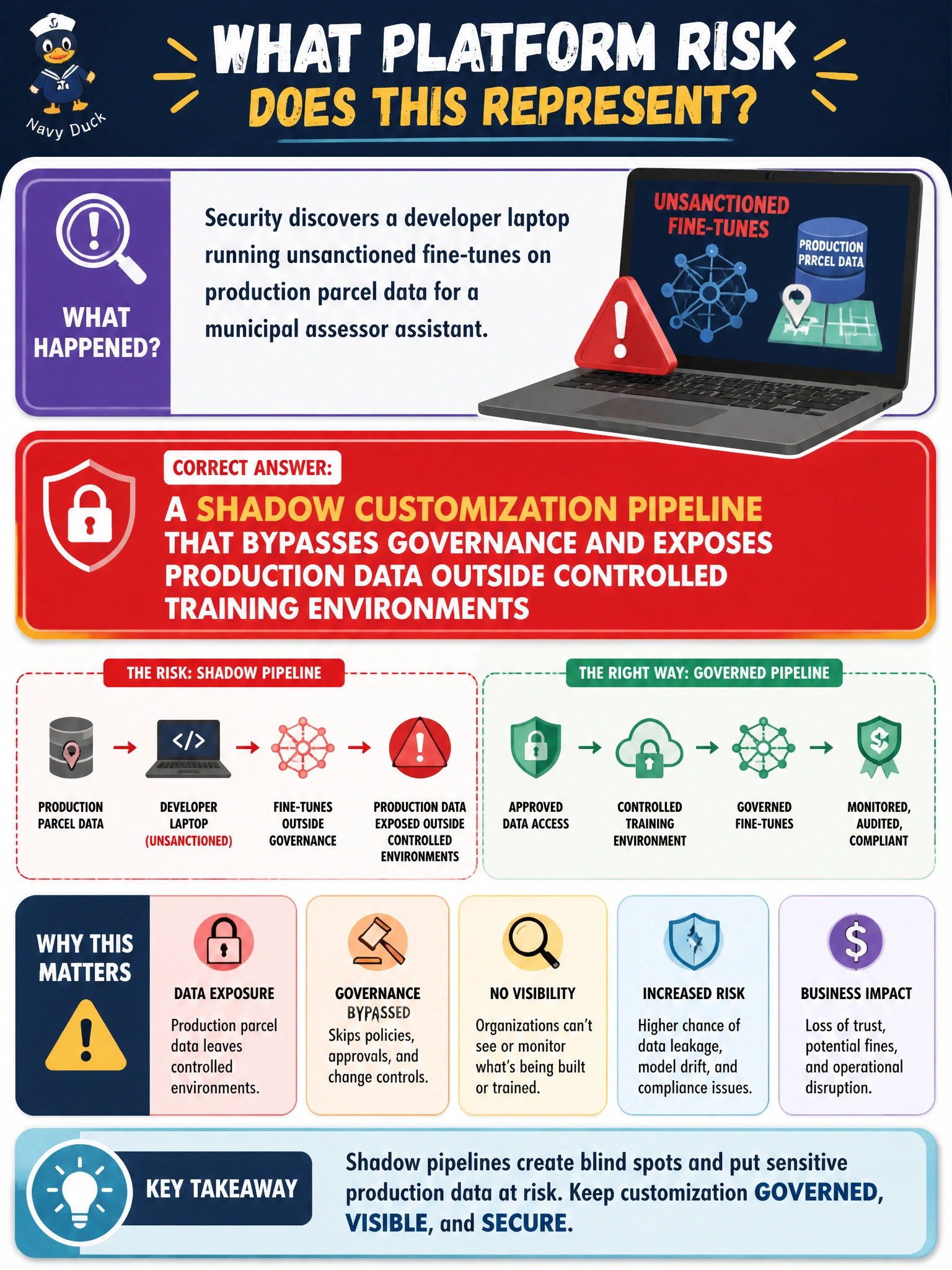
Security discovers a developer laptop running unsanctioned fine-tunes on production parcel data for a municipal assessor assistant. What platform risk does this represent?
Select an answer to reveal the explanation.
Short Explanation
Shadow fine-tunes on a laptop are the alley-shop mechanic working on the city's fleet with no paperwork. Production parcel data walking onto unmanaged gear is a governance and leakage problem, not a clever shortcut.
Full Explanation
A developer laptop running unsanctioned fine-tunes on production parcel data for a municipal assessor assistant is a shadow customization pipeline: it bypasses governance, training-environment controls, and data-handling rules while exposing production assessor data outside controlled systems. That platform risk includes leakage, uncontrolled model artifacts, and unauditable experiments that may later be promoted informally into resident-facing tools.
This is not an approved MLOps promotion that only needs a retrospective ticket; retrospective paperwork does not undo uncontrolled data copies. It is not a recommended pattern for speeding civic experimentation—speed without custody is shadow IT. It is not evidence that parcel data is non-sensitive; production parcel and assessment data often include sensitive or regulated attributes and always require authorized handling.
Exam caveat: Shadow fine-tuning is a governance and data-exfiltration problem, not a productivity tip. Distinguish sanctioned MLOps paths from laptop-side experiments on production extracts. GAIPS platform questions reward identifying bypass of controlled training environments.
Operational check: Quarantine the laptop artifacts, revoke local copies of production parcel extracts, require the work to restart in an approved training environment with DLP and access logging, inventory any checkpoints created, and update policy to detect unsanctioned training jobs. Confirm assessor production systems show no ongoing export to unmanaged endpoints.