
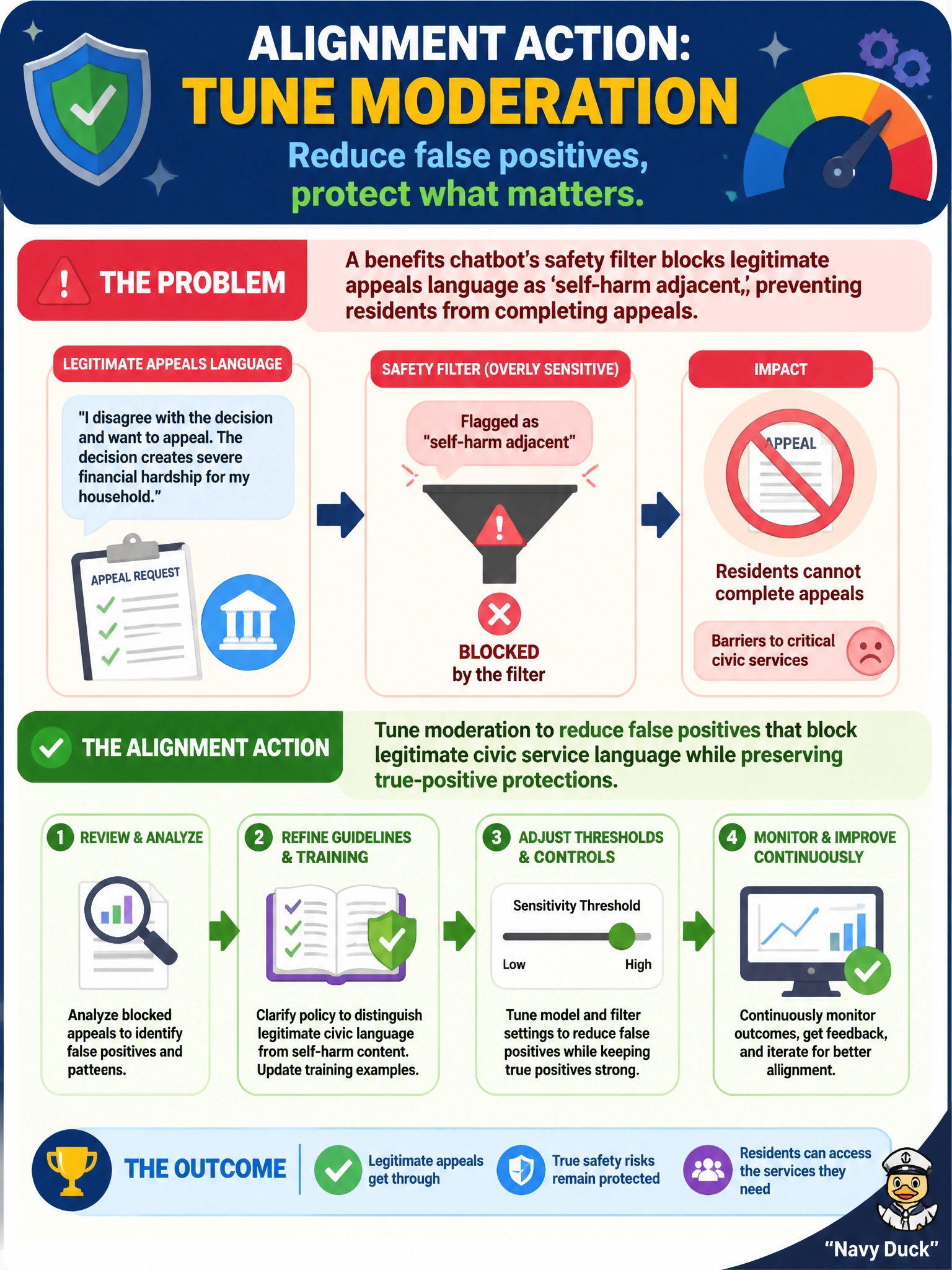
A benefits chatbot's safety filter blocks legitimate appeals language as 'self-harm adjacent,' preventing residents from completing appeals. What alignment action is needed?
Select an answer to reveal the explanation.
Short Explanation
When the safety net snags honest appeals wording, residents bounce off the system. Tune the filter—don't rip it out or hide appeals in the shadows—so real harm stays blocked and real services stay reachable.
Full Explanation
When a benefits chatbot's safety filter blocks legitimate appeals language as "self-harm adjacent," residents cannot complete appeals—a false-positive failure that harms access to municipal services. The needed alignment action is to tune moderation to reduce false positives on legitimate civic service language while preserving true-positive protections against actual self-harm and related abuse. Calibration, allow-lists for appeals vocabulary, and human review of edge cases restore service without abandoning safety.
Disabling the safety filter entirely for all benefits traffic removes true-positive protection and is disproportionate. Replacing appeals vocabulary with random tokens breaks usability and accessibility for residents and staff. Moving appeals to an unlogged SMS channel outside the AI platform sacrifices auditability and may create parallel shadow processes that security cannot oversee.
Exam caveat: Safety tuning is a precision-recall problem in civic language domains. Over-blocking appeals is not fixed by removing safety or by obscuring channels. GAIPS items often contrast calibration with "turn it off" distractors.
Operational check: Collect blocked appeals utterances, label true versus false positives with benefits and crisis-response stakeholders, adjust category thresholds or civic allow-lists, retest self-harm true positives to confirm protection remains, and monitor false-positive rates after release. Keep human-in-the-loop for low-confidence moderation on appeals traffic until metrics stabilize.