
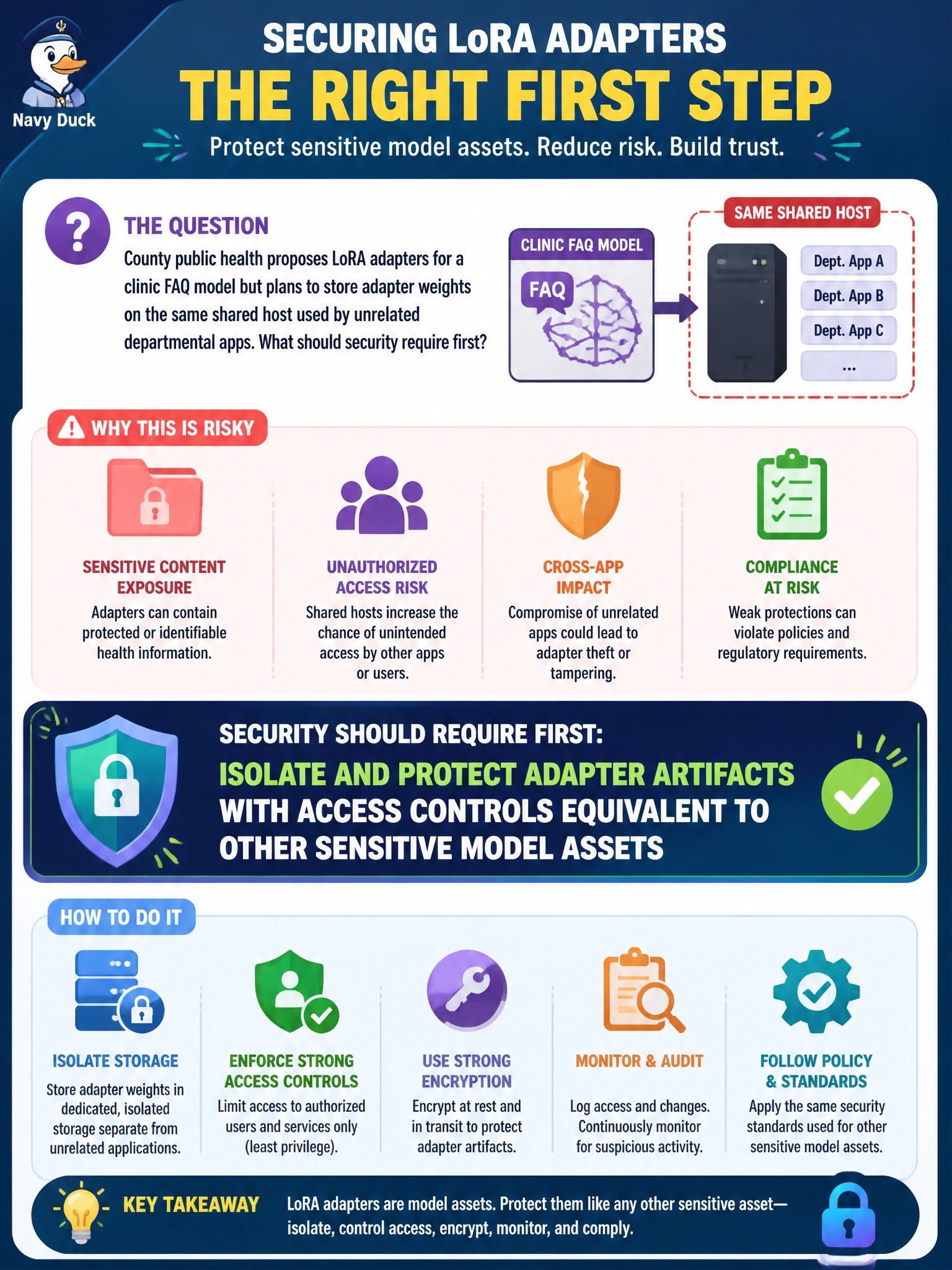
County public health proposes LoRA adapters for a clinic FAQ model but plans to store adapter weights on the same shared host used by unrelated departmental apps. What should security require first?
Select an answer to reveal the explanation.
Short Explanation
LoRA adapters are like specialty recipe cards taped onto a shared kitchen binder—if anyone in the building can grab them, your clinic FAQ secret sauce walks out. Lock those adapter files down like the rest of the model crown jewels.
Full Explanation
LoRA adapter weights for a county clinic FAQ model are sensitive customization artifacts: they encode departmental behavior, possibly domain knowledge from clinical FAQ corpora, and can be swapped onto a compatible base model elsewhere. Storing them on a shared host used by unrelated apps without equivalent protection allows unauthorized read, copy, or substitution. Security should therefore isolate and protect adapter files with access controls, encryption, and inventory practices comparable to other sensitive model assets before clinic staff rely on them in production.
Publishing adapters to an anonymous object bucket maximizes exposure and fails confidentiality and integrity goals for health-adjacent civic assistants. Merging adapters into the base model and deleting host access logs destroys provenance and auditability rather than securing the customization path. Disabling encryption at rest to speed evening loads trades away a basic control for latency that is rarely the true bottleneck and is inappropriate for clinic FAQ intellectual property and any residual sensitive content in adapters.
Exam caveat: Parameter-efficient fine-tuning does not make artifacts "small therefore unimportant." Adapters, soft prompts, and preference checkpoints remain model assets under the same governance as full checkpoints. Shared municipal hosts used by multiple departments are a classic lateral-movement and data-spill environment; treating LoRA files as disposable config is a common exam trap.
Operational check: Place adapters in a controlled model registry or locked storage account with least-privilege identities for training and inference services, enable encryption at rest and access logging, separate clinic adapters from unrelated departmental shares, and verify that a non-authorized departmental principal cannot list or download the adapter package. Record version hashes so unauthorized substitution can be detected during incident review.