
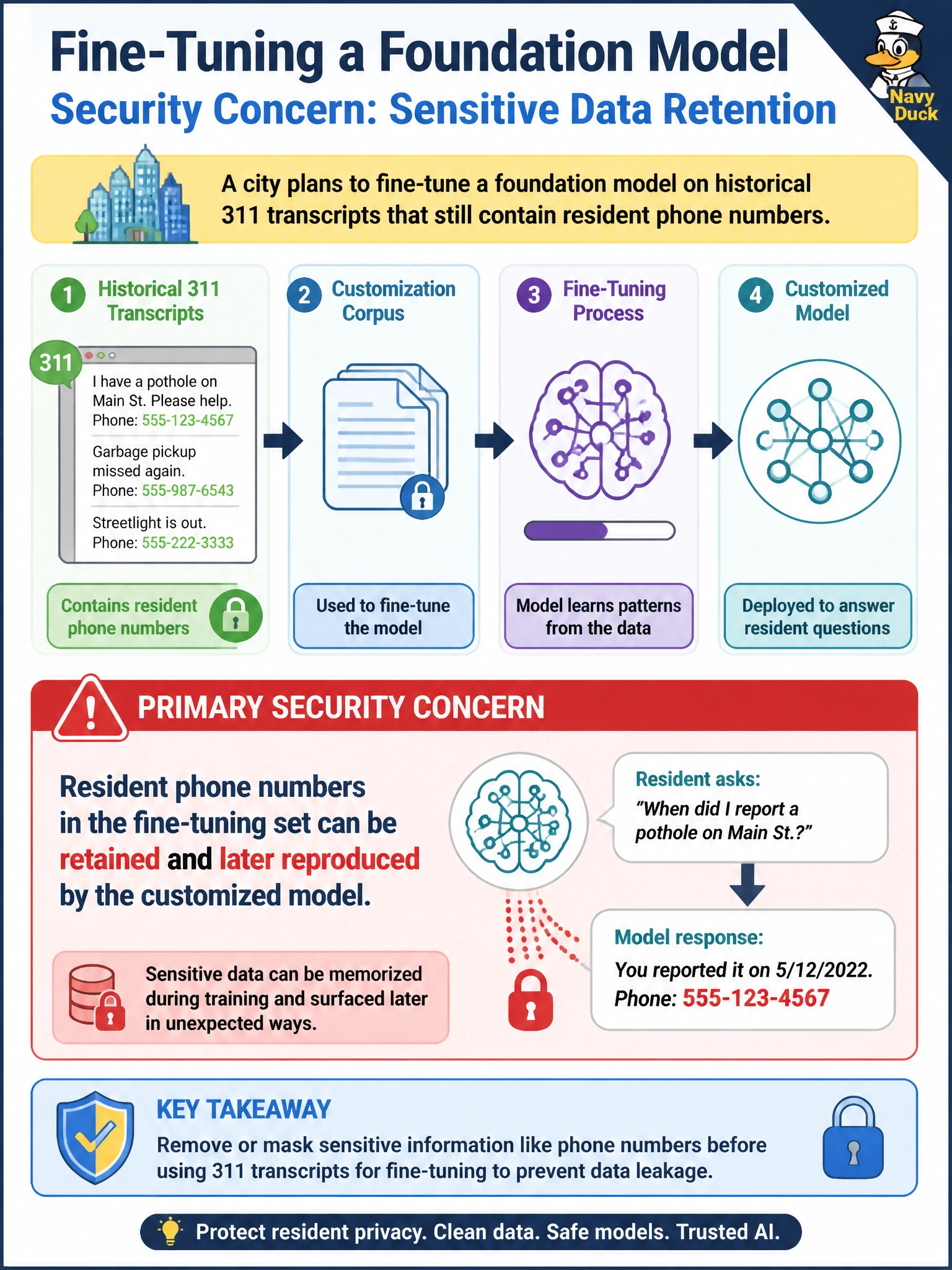
A city plans to fine-tune a foundation model on historical 311 transcripts that still contain resident phone numbers. What is the primary security concern for the customization corpus?
Select an answer to reveal the explanation.
Short Explanation
Think of fine-tuning like teaching a clerk from old call logs: if you leave phone numbers in those logs, the clerk may repeat them later. You face the same privacy risk with a customized municipal model, because identifiers in the corpus can be retained and reproduced.
Full Explanation
Resident phone numbers left in a municipal 311 fine-tuning corpus create a memorization and reproduction risk: during weight updates, the customized model can absorb those identifiers and later emit them. That is the primary security concern for the customization corpus. Treat contact fields in historical service transcripts as sensitive personal data, and minimize or redact them before fine-tuning; once identifiers are encoded in model parameters, deleting them from the source share does not reliably remove them from model behavior. The claim that tokenizers cannot handle phone-number strings confuses tokenization with privacy: phone numbers can be tokenized and trained on, and their inclusion does not inherently prevent convergence. The claim that phone numbers improve retrieval precision confuses generative fine-tuning with retrieval design; retaining PII in training rows expands the leakage surface rather than providing a sound reason to include it. Fine-tuning also does not automatically anonymize contact fields: weight-update jobs scrub them only if operators deliberately build and verify that stage. Exam caveat: the concern here is sensitive training-data retention and possible reproduction, not a technical failure to process phone-number strings or an automatic privacy safeguard. Practical check: run PII discovery on the transcript extract, redact or tokenize phone numbers and other resident identifiers, keep a minimization record, and test the candidate model with targeted prompts for residual reproduction before production promotion.