
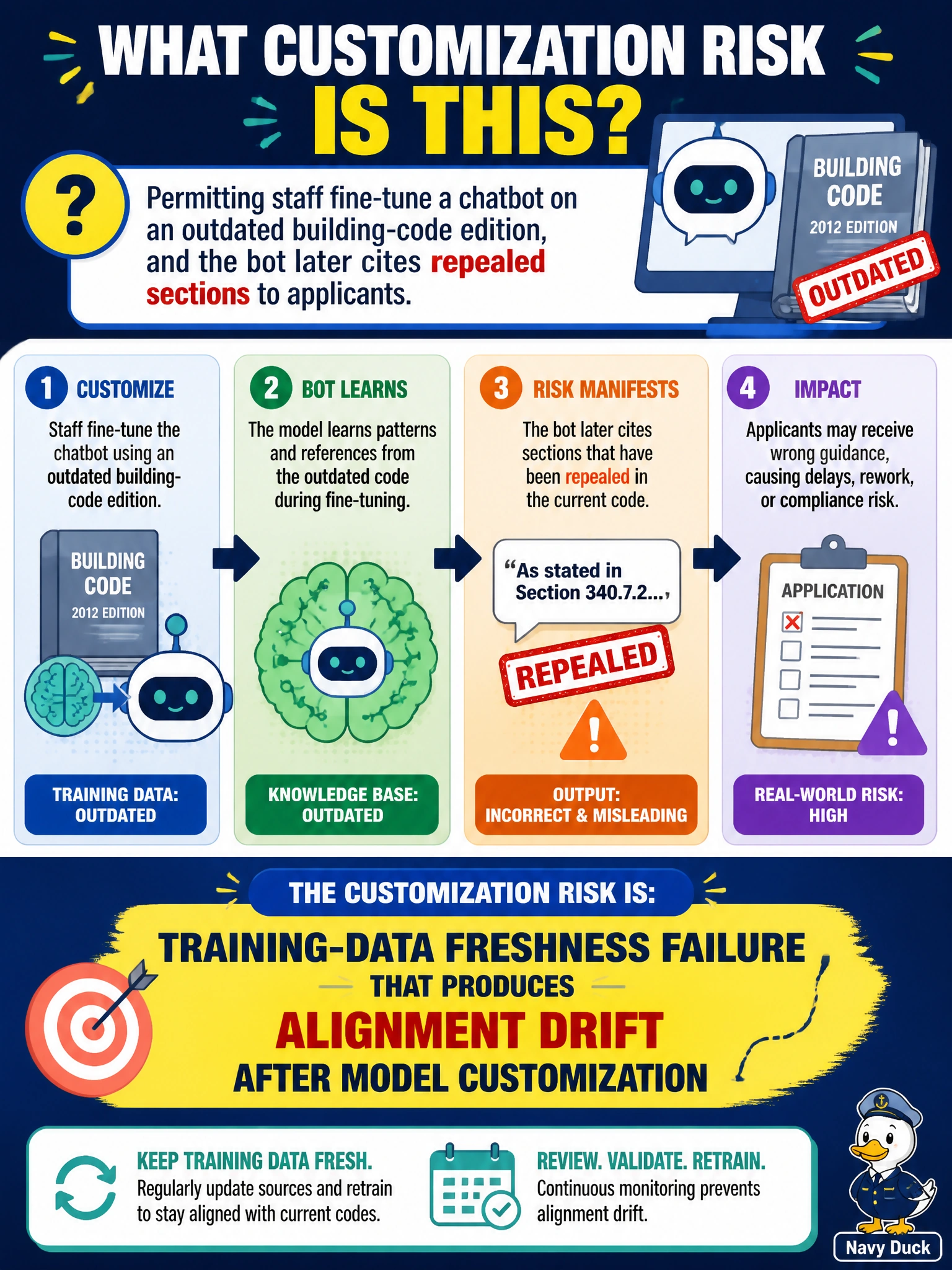
Permitting staff fine-tune a chatbot on an outdated building-code edition, and the bot later cites repealed sections to applicants. What customization risk does this illustrate?
Select an answer to reveal the explanation.
Short Explanation
Fine-tuning on last year's code book is like drilling a new inspector with an expired binder—they'll confidently quote rules that no longer exist. Stale municipal corpora drift the model away from current ordinance truth.
Full Explanation
Fine-tuning a permitting chatbot on an outdated building-code edition illustrates a training-data freshness failure that produces alignment drift after customization: the model learns repealed sections as authoritative and later cites them confidently to applicants. In municipal permitting, stale legal corpora are not a cosmetic content problem—they drive incorrect public guidance, appeals risk, and eroded trust. Customization locks in whatever edition is in the corpus unless teams enforce freshness, version pinning, and post-tune evaluation against current code.
A vector-database ACL misconfiguration is a RAG retrieval control issue and does not explain wrong citations that originate from weights updated on a stale fine-tune set. An agent-to-agent MCP handshake error is an orchestration or protocol failure unrelated to corpus edition. A GPU firmware bug inventing ordinance numbers is not a realistic root cause for systematic citation of repealed sections after intentional training on an old edition.
Exam caveat: Distinguish corpus freshness and alignment drift from retrieval ranking, agent protocol, and hardware faults. GAIPS customization questions often mix RAG and fine-tune distractors; here the stem states the bot was fine-tuned on an outdated edition, so the failure mode is training-data currency, not ACL or MCP.
Operational check: Pin the building-code source version in the training manifest, schedule corpus refresh when ordinances change, and run regression evaluations that include known repealed versus current section pairs before releasing the permitting bot. After go-live, sample applicant-facing answers for section citations and compare them to the live municipal code library; roll back the checkpoint if drift reappears.