
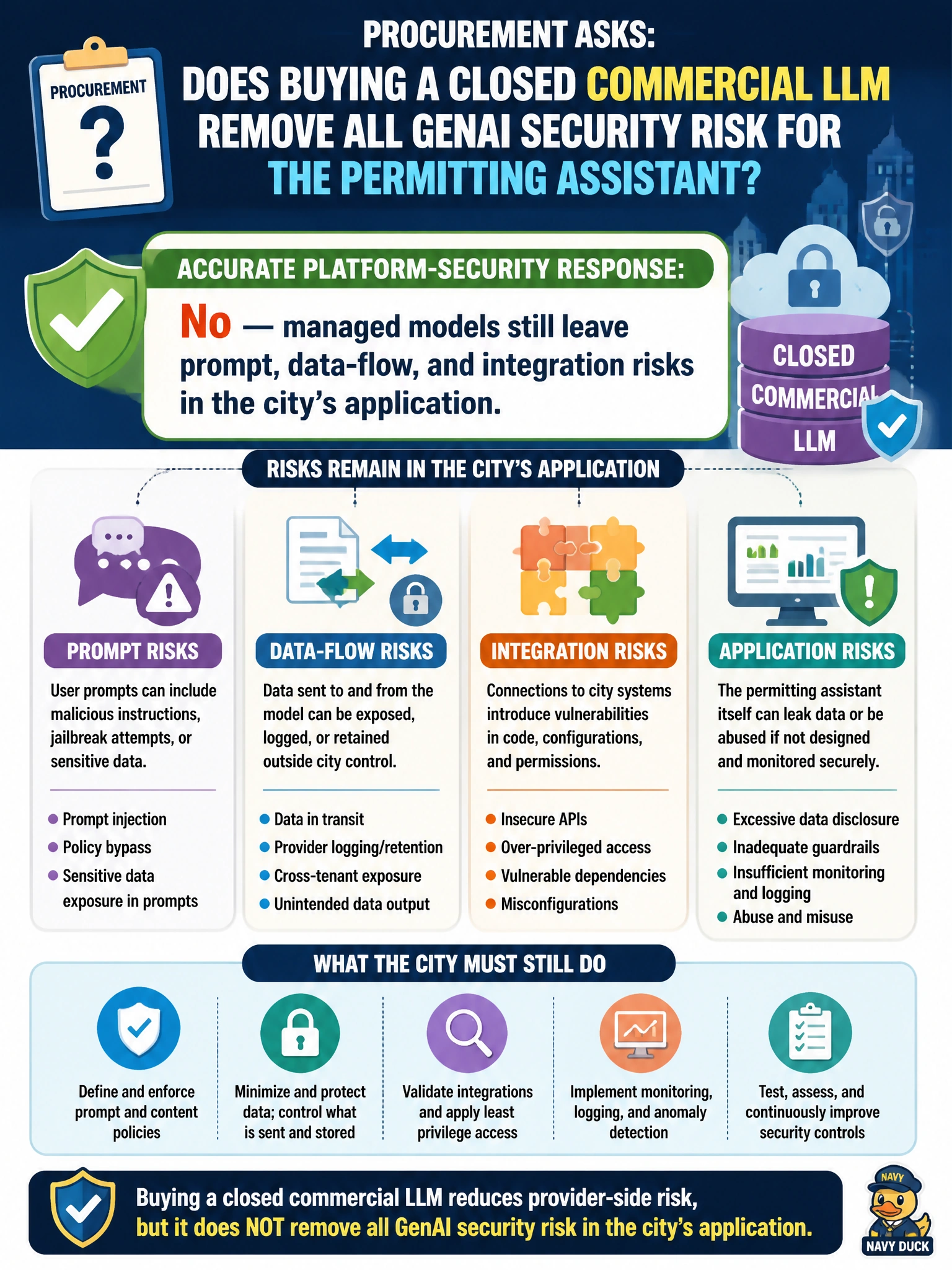
Procurement asks whether buying a closed commercial LLM removes all GenAI security risk for the permitting assistant. What is the accurate platform-security response?
Select an answer to reveal the explanation.
Short Explanation
Paying for a closed model is like leasing a locked truck — you still decide what you load, who drives, and which roads you take. Prompt injection, messy integrations, and bad data flows stay on the city. Managed does not mean risk-free.
Full Explanation
Buying a closed commercial LLM reduces some hosting and weight-management burdens but does not remove application-layer GenAI risk for a permitting assistant. Prompt injection, sensitive data flows, logging, tool integrations, RAG poisoning, and hallucinated guidance remain the city's responsibility in how the application assembles prompts and acts on outputs. The accurate platform-security response is that managed models still leave prompt, data-flow, and integration risks in the municipal application.
Closed models do have application-layer attack surface once embedded in city apps—secrecy of weights is not absence of prompt risk. Vendor hosting does not eliminate prompt injection by contract; contracts allocate liability, they do not rewrite input handling. Commercial models can still hallucinate under municipal workloads; procurement marketing does not repeal generative uncertainty.
Exam caveat: shared-responsibility models differ by SaaS versus self-hosted endpoints, but the application owner nearly always owns prompt construction and downstream actions (approve, email, write to systems). "Closed" is not "on-prem," and "on-prem" is not "safe without app controls."
Operational check: map data flows to the vendor; enforce DLP and redaction before prompts; keep permit decisions outside the LLM; test injection regardless of model brand; review subprocessors; and document residual risk for counsel and procurement. Treat vendor choice as one control among many, not a silver bullet that ends the GenAI security program.