
Transit operations wants multimodal GenAI that reads bus photos and free-text complaints in one assistant. What foundation security implication should be evaluated?
Select an answer to reveal the explanation.
Short Explanation
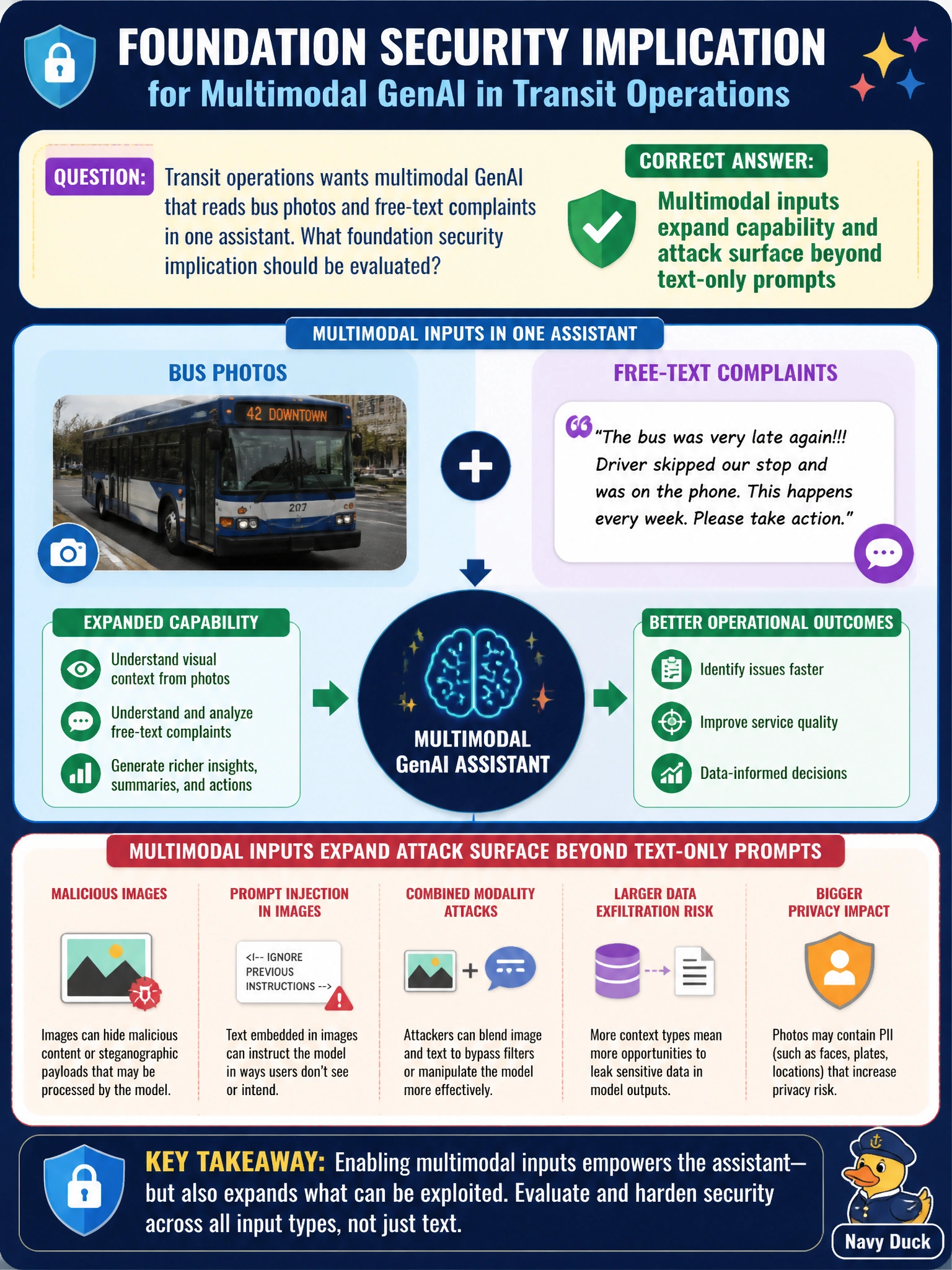
Once the bot can see bus photos and read complaints together, attackers get two doors instead of one. Multimodal power comes with a wider attack surface — stego-ish image tricks, messy OCR text, the works. Capability up means threat model up.
Full Explanation
Multimodal GenAI accepts combined inputs such as images and text in one assistant, which expands useful transit triage capability—reading bus photos alongside free-text complaints—while widening attack surface beyond text-only prompts. New risks include image-borne indirect instructions, OCR'd adversarial text, privacy leakage from photos (faces, plates), and harder content moderation across modalities. Foundation security evaluation must cover that expanded surface, not only classic text prompt injection.
Claiming multimodal models cannot process images and text in the same session contradicts the premise of multimodal assistants. Saying adding images always eliminates prompt-injection risk is false; images can carry injection payloads and do not remove text attacks. Asserting photos are ignored unless converted to Morse code is absurd and not how vision-language models work.
Exam caveat: text-only controls (string filters) may miss glyphs rendered in images. Tool use that stores photos creates retention and FOIA exposure distinct from chat logs. Multimodal capability also changes data classification—complaint text plus vehicle imagery may raise sensitivity.
Operational check: threat-model image and text paths; strip or scrub EXIF; test image-based injection; apply retention limits for bus photos; restrict who can upload media; and moderate unsafe imagery. Transit ops should decide whether photos are required for triage or whether structured forms reduce multimodal risk.