
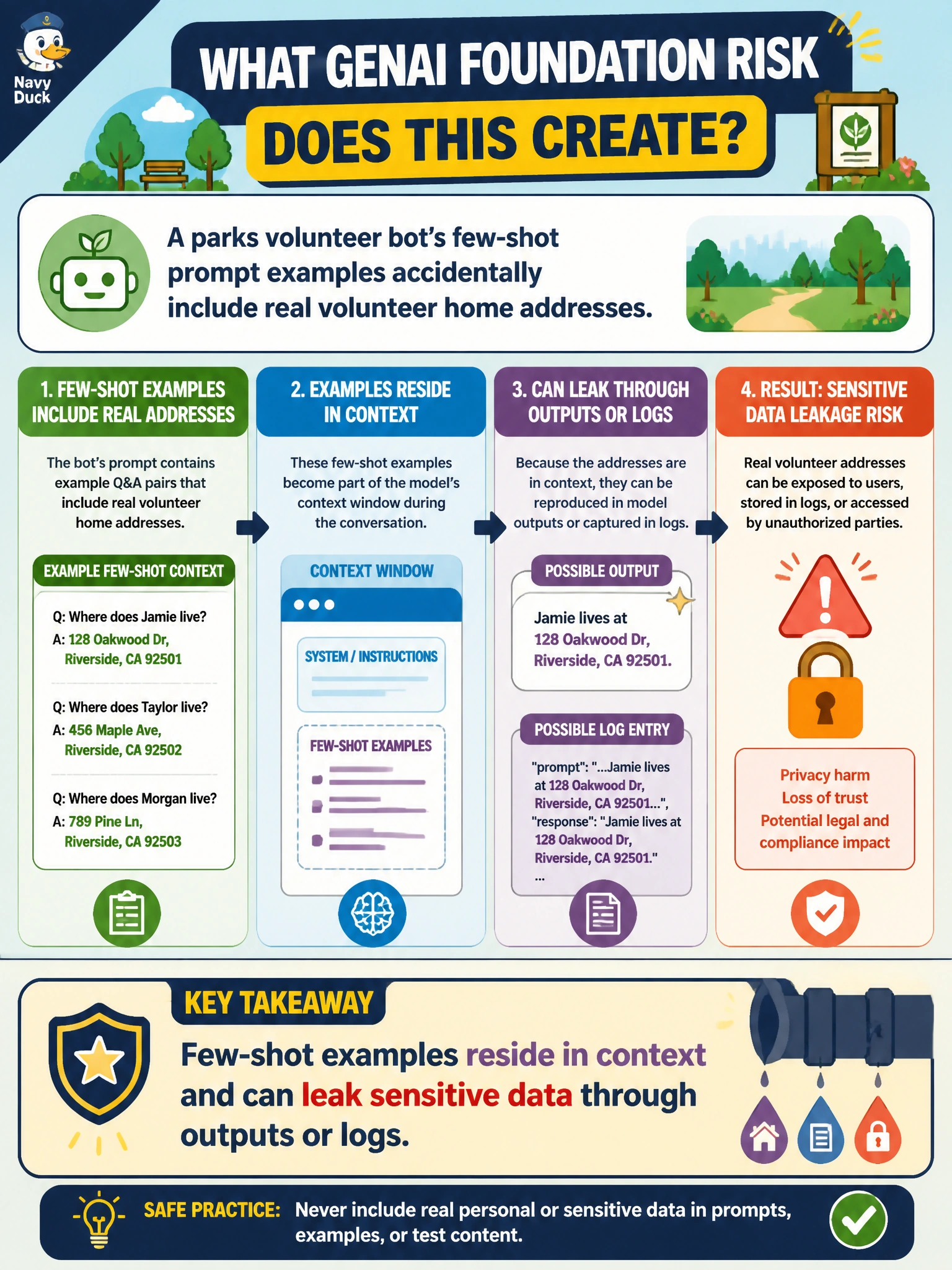
A parks volunteer bot’s few-shot prompt examples accidentally include real volunteer home addresses. What GenAI foundation risk does this create?
Select an answer to reveal the explanation.
Short Explanation
Those 'helpful examples' sitting in the prompt are live sticky notes the model can read — and repeat. Real volunteer addresses do not belong in few-shot demos. Sanitize examples the same way you sanitize production data.
Full Explanation
Few-shot prompting places example content into the active context window to steer format and behavior. If those examples include real volunteer home addresses, the sensitive data resides in prompts where it can be regurgitated to users, captured in logs, retained by gateways, or leaked through support tooling—even when the model is not "training" on the fly. The foundation risk is sensitive few-shot content in context, not magical weight rewriting on every request.
Few-shot examples do not permanently rewrite model weights on every request; in-context learning is ephemeral to the session/prompt unless a separate fine-tuning pipeline is used. Home addresses in prompts do not disable the city's firewall. Few-shot learning does not require breaking TLS to function; examples are ordinary prompt text over normal HTTPS APIs.
Exam caveat: synthetic or fully fictional examples avoid this leak class. Fine-tuning on real addresses is a different, often worse, memorization risk. Also remember system prompts and tool schemas can contain few-shot-like exemplars that need the same hygiene.
Operational check: sanitize few-shot libraries; use fake addresses and synthetic personas; scan prompt templates for PII; restrict who can edit exemplars; and redact logs. Parks volunteer bots should demonstrate formats without exposing real household locations of volunteers.