
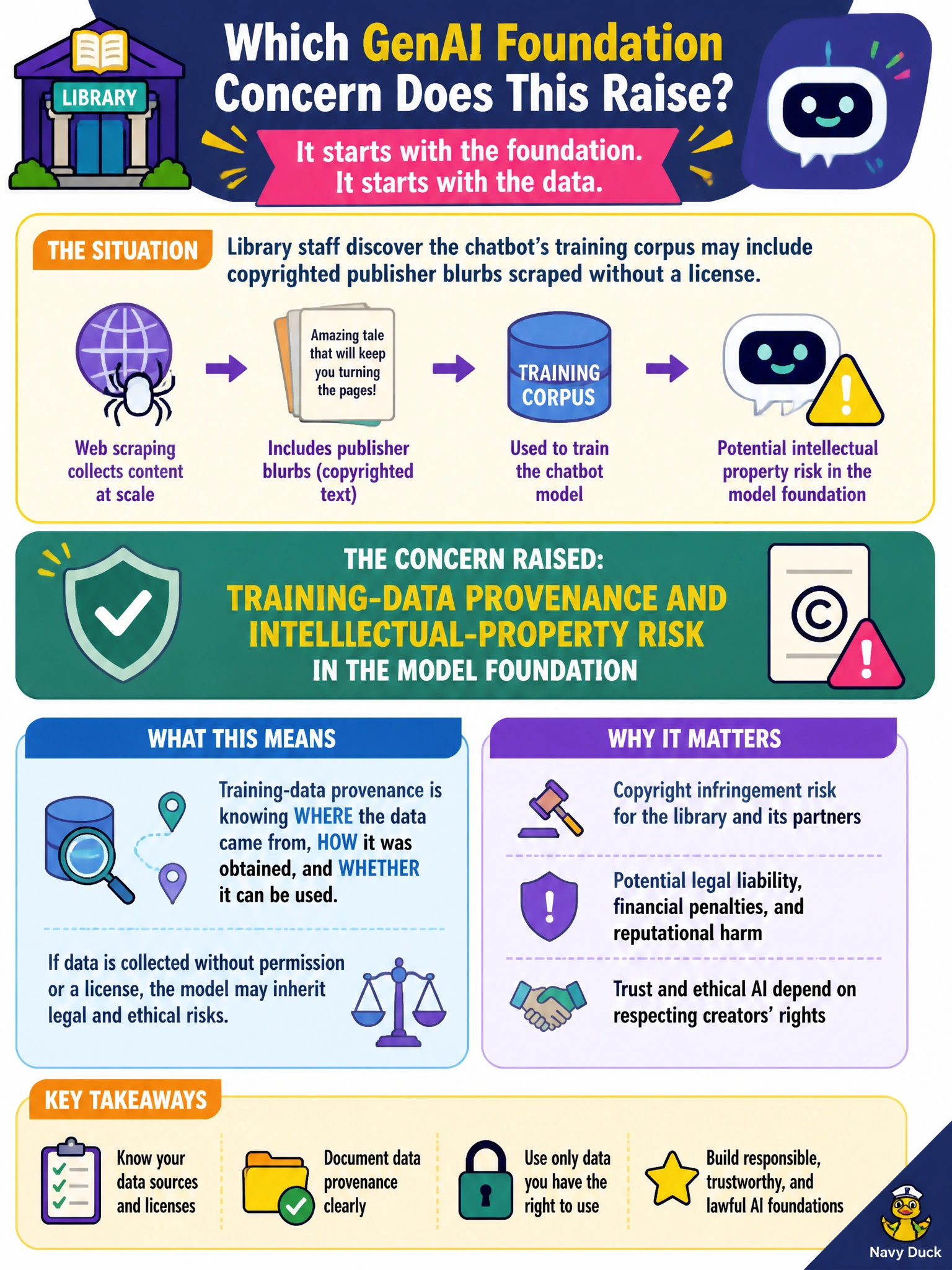
Library staff discover the chatbot’s training corpus may include copyrighted publisher blurbs scraped without a license. Which GenAI foundation concern does this raise?
Select an answer to reveal the explanation.
Short Explanation
When you find unlicensed publisher blurbs in a chatbot’s training corpus, you’ve uncovered a provenance and intellectual-property concern in the model foundation—not a Wi-Fi encryption problem. Clean data origins matter more than hoping nobody notices fluent borrowed blurbs.
Full Explanation
Training-data provenance and intellectual-property risk arise when a model’s foundation corpus may include copyrighted material scraped without a license, such as publisher blurbs in a library chatbot’s training data. The concern involves the lawful basis for using the material, licensing, and supplier attestations; it is a GenAI foundation supply-chain issue for procurement and counsel to address. NTP drift between branch library clocks can skew timestamps and complicate log correlation, but it does not create copyright exposure in training corpora. Missing WPA3 on public reading-room Wi-Fi is a wireless encryption and authentication gap for local clients, unrelated to training-data licensing. Branch desktop PCs needing more memory could affect how smoothly the chatbot runs during busy hours, but that is a local hardware-capacity issue, not a model-corpus provenance concern. Exam caveat: inference-time quoting from a licensed library catalog differs from model weights that have memorized copyrighted blurbs. Also distinguish city-built RAG over licensed content, which is controllable, from opaque foundation pretraining, which is vendor-dependent; fair-use claims are legal determinations, not something the model can assert for itself. Practical check: require vendor training-data and license attestations, prefer RAG over municipal-licensed holdings for blurbs, block reproduction of lengthy copyrighted text, involve counsel on complaints, and document model provenance in the AI inventory.