
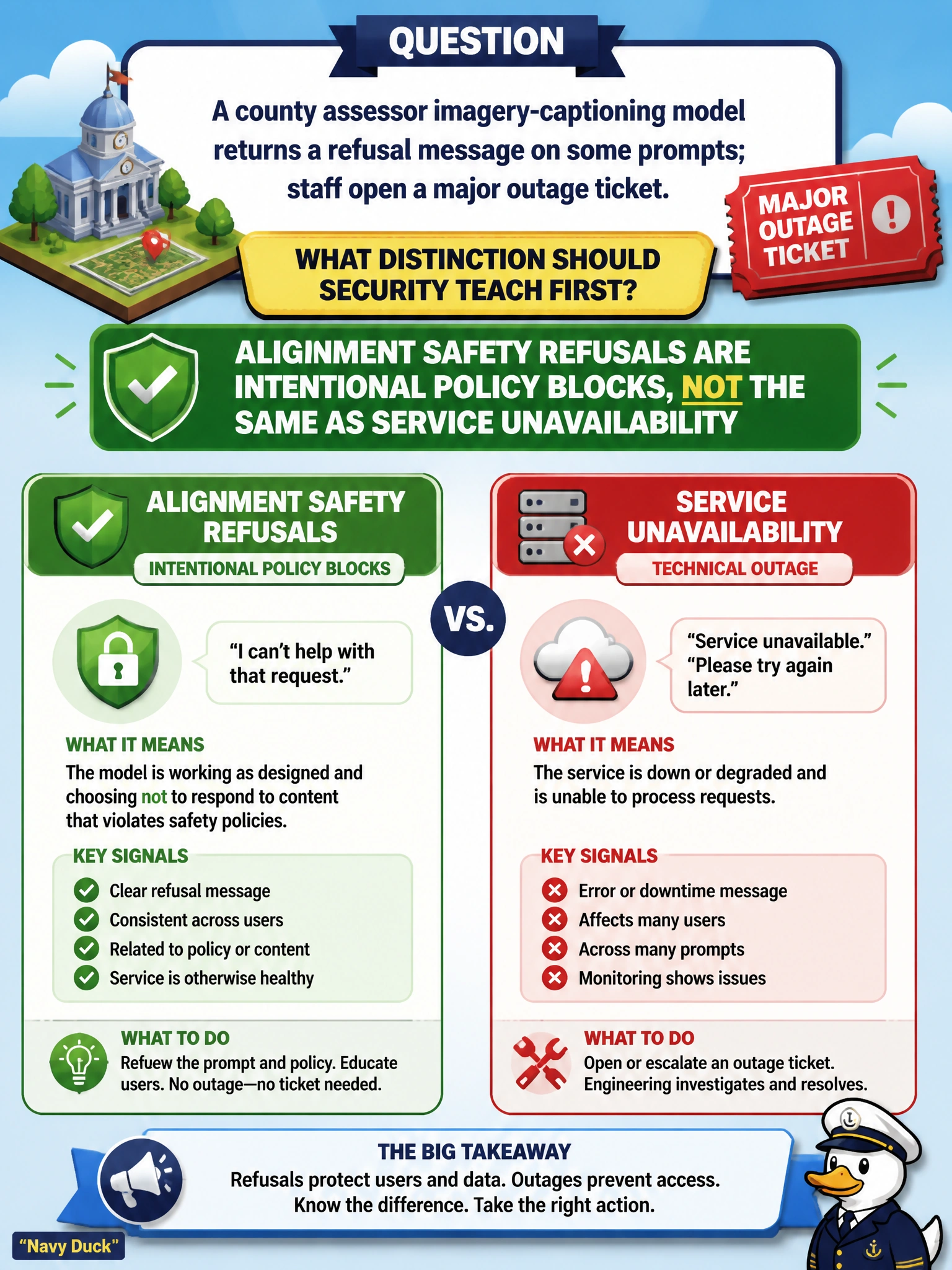
A county assessor imagery-captioning model returns a refusal message on some prompts; staff open a major outage ticket. What distinction should security teach first?
Select an answer to reveal the explanation.
Short Explanation
A polite 'I won't do that' is the model’s seatbelt clicking — not the whole car dying on the shoulder. Safety refusals are alignment working, not an outage. Teach staff to separate policy blocks from true availability failures before paging half the county.
Full Explanation
Alignment safety refusals are intentional policy blocks when a model declines certain prompts according to safety or content rules. They are not the same as service unavailability: the endpoint is up, inference works, and the system returns a refusal message by design. Teaching county assessor staff this distinction prevents major-outage tickets for expected safety behavior of an imagery-captioning model and keeps incident response focused on true availability failures.
Refusals do not prove the GPU cluster has lost power; powered-down infrastructure yields timeouts, connection errors, or health-check failures—not policy refusal text. Refusals do not mean an object-storage bucket policy was deleted; missing buckets cause storage API errors, not alignment messages. BGP withdrawing an anycast prefix would impair routing reachability, again a network availability symptom, not a content policy refusal.
Exam caveat: a buggy gateway that maps all errors to a refusal-looking string can hide real outages—correlate with latency, error codes, and infrastructure health. Over-refusing on benign assessor prompts is a product/policy tuning issue, still distinct from downtime. Under-refusing on disallowed content is a safety failure of a different kind.
Operational check: document expected refusal classes for the captioning service; train service desks on refusal versus outage triage; monitor refusal rates as a quality signal; provide allowlisted assessor workflows for legitimate imagery tasks; and keep separate SLOs for availability versus policy block rates. Security should ensure refusals cannot be bypassed via trivial rephrasing when policy requires the block.