
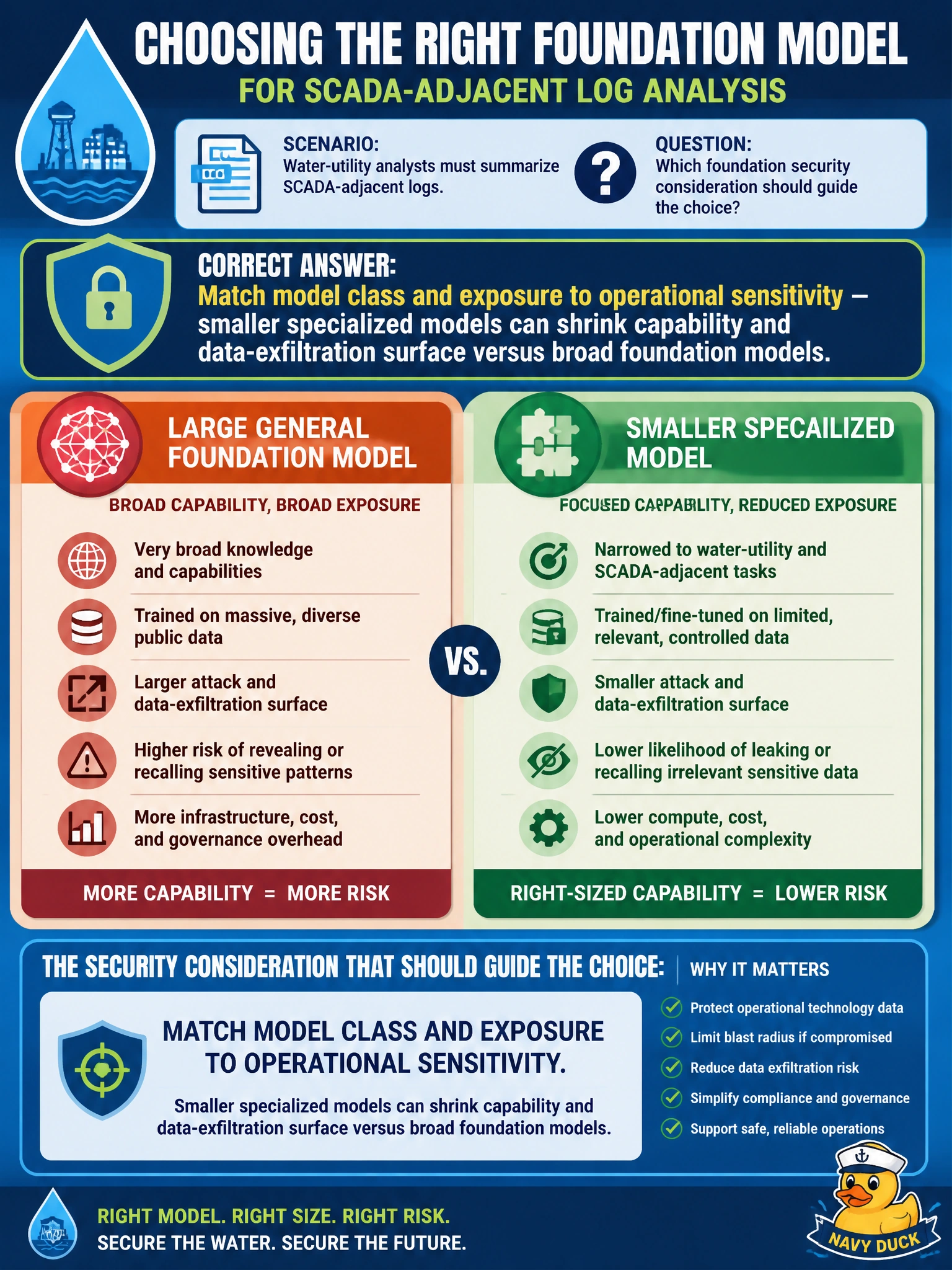
Water-utility analysts must summarize SCADA-adjacent logs and are choosing between a large general foundation model and a smaller specialized model. Which foundation security consideration should guide the choice?
Select an answer to reveal the explanation.
Short Explanation
For water-plant log summaries, a giant general model is a big sponge that might soak up and spit back sensitive ops detail. A smaller specialized tool can be enough brain with less blast radius. Fit the model class to OT-adjacent sensitivity — bigger is not automatically safer.
Full Explanation
Model choice for water-utility analysts summarizing SCADA-adjacent logs should match capability and exposure to operational sensitivity. Broad general foundation models may be powerful but can increase the blast radius of prompt leakage, verbose regurgitation, and unintended capability; smaller specialized models can shrink some capability and data-exfiltration surface when they are sufficient for the summarization task. The foundation security consideration is risk-aligned model class selection—not maximal size by default.
Always picking the largest foundation model because bigger models "cannot leak" is false; larger models can be more capable at sensitive reconstruction and still leak prompt content through outputs or logs. Claiming only foundation models can summarize logs while specialized models cannot read timestamps is incorrect capability folklore. Asserting specialized models are immune to prompt injection by design is wrong; injection is largely an application/prompt-assembly problem that can affect many model sizes.
Exam caveat: "smaller" is not automatically "safer" if the small model is fine-tuned on sensitive SCADA text or hosted with weaker controls. Exposure includes where inference runs, what is logged, and whether outputs leave the OT-aware enclave. Also separate IT log summarization from true OT control-plane access—summarizing exported logs is different from commanding SCADA.
Operational check: classify log sensitivity; prefer least-capability models that meet accuracy bars; keep inference in approved environments; redact identifiers before prompting; ban training on raw SCADA dumps without review; and evaluate exfiltration via verbose summaries. Utility security should document why a given model class was chosen for OT-adjacent text.