
A financial services company sets an agent's autonomy level to 'full auto' for all operations, including generating and submitting regulatory compliance reports to external authorities. During an audit, it is discovered that several reports were submitted with errors, and the company cannot demonstrate that any human reviewed and authorized these submissions. Which two issues does this create?
Select an answer to reveal the explanation.
Short Explanation and Infographic
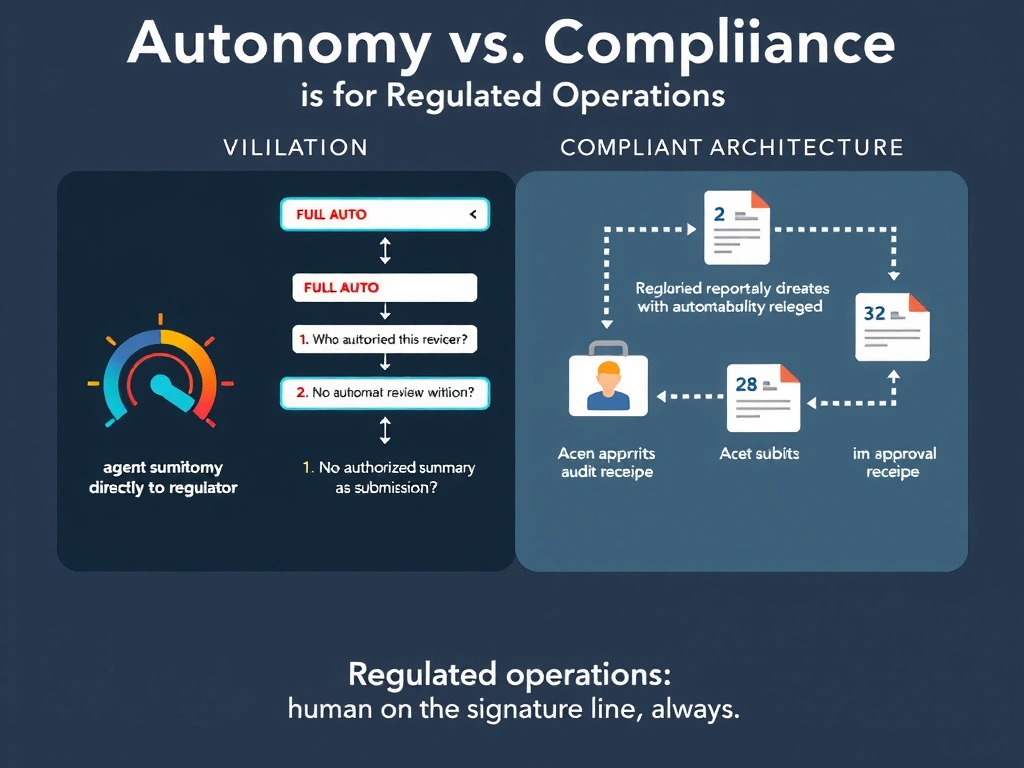
Regulators don't accept 'the AI submitted it' as an authorization trail. Full auto on compliance-sensitive operations is a governance time bomb: when something goes wrong — and it did — the company cannot show who approved what, which is often the regulatory violation that overshadows the original error. High-stakes regulated operations require a human on the signature line.
Full explanation below image
Full Explanation
Compliance-sensitive operations occupy a special category in the guardrail taxonomy: they are not merely high-risk in an operational sense, but are legally and regulatorily governed. Regulatory submissions typically require: (1) a designated responsible person who reviews and authorizes the submission; (2) a documented approval trail that demonstrates due diligence; and (3) accountability that can be traced to a specific human decision-maker.
'Full auto' autonomy for regulatory submissions eliminates all three requirements. The company cannot demonstrate that any human reviewed the reports (governance failure), cannot identify who authorized the submissions (accountability gap), and cannot defend itself if the regulator asks 'who signed off on this?' — which is a standard question in regulatory enforcement actions.
The correct architecture for compliance-sensitive agent operations includes: (1) the agent drafts the submission; (2) a designated human reviewer receives the draft with a structured summary of key figures and potential issues; (3) the human reviews, corrects if necessary, and provides explicit authorization (a recorded approval action with timestamp and identity); (4) only then does the agent submit; (5) the entire interaction — draft, review, authorization, submission — is logged in an immutable audit trail.
Option A (token permissions / rate limiting) addresses infrastructure security, not the governance and accountability failures described. Even with perfectly scoped tokens and rate limiting, the governance problem remains.
Option C (LLM model certification) is a consideration for some regulated industries, but model certification alone does not substitute for human review and authorization of individual submissions. The failure here is process, not model choice.
Option D (format rejection) contradicts the scenario statement — the submissions were accepted by the external authority's system. The problem is not format rejection but the absence of human authorization for what was submitted.
'Full auto' is incompatible with compliance-sensitive operations that require demonstrable human authorization.