
A security audit of your deployment pipeline agent reveals that the agent has been granted write access to all 47 repositories in the organization, admin access to CI/CD pipeline settings, and the ability to modify branch protection rules. However, the agent's actual task is only to read build logs and generate a daily summary report. What security principle has been violated, and what is the recommended remediation?
Select an answer to reveal the explanation.
Short Explanation and Infographic
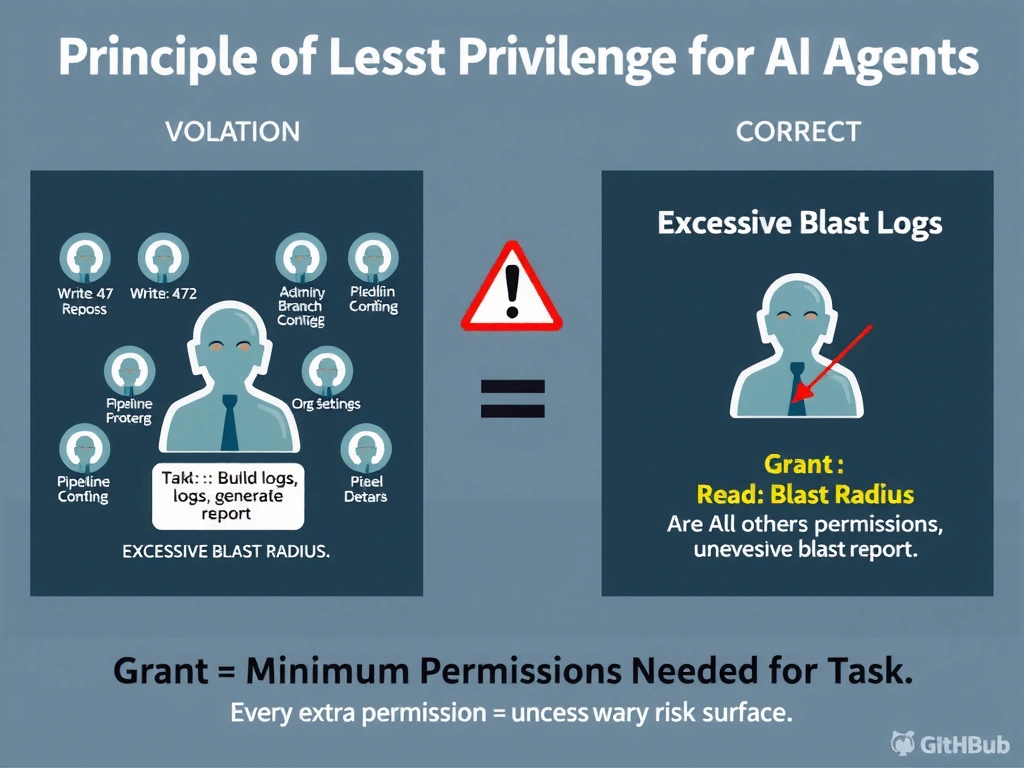
Giving a house-sitter a master key, the alarm codes, and a real estate license when they only need to water the plants — that's excessive privilege in a nutshell. If your agent only reads build logs to generate reports, it should have exactly read access to build logs. Every additional permission is an unnecessary attack surface and a scope creep risk. Least privilege means the minimum permissions needed to accomplish the task, nothing more. The exam tests whether you can identify and remediate privilege excess.
Full explanation below image
Full Explanation
This question tests your understanding of the principle of least privilege as applied to agentic AI systems — a foundational security guardrail requirement.
The correct answer is B. The principle of least privilege states that any entity — human user, service account, or AI agent — should be granted only the minimum permissions required to perform its intended function. The agent's function is to read build logs and generate summary reports. This requires exactly: read access to build log outputs. Every additional permission (write access to 47 repos, admin access to CI/CD settings, ability to modify branch protection rules) is a violation of least privilege that creates unnecessary risk in two ways: (1) if the agent is compromised or produces an unexpected reasoning error, the blast radius of potential damage is vastly larger than necessary; and (2) the agent can unintentionally act on permissions it wasn't supposed to use. Remediation is straightforward: audit the actual permissions required for the task, grant only those, and revoke everything else.
Option A is incorrect. Defense in depth is a multi-layer security strategy that adds protective layers around systems. A network firewall is one layer but does not address the excessive internal permission grant. Least privilege and defense in depth are complementary but distinct principles; this scenario primarily violates least privilege.
Option C is incorrect as the primary diagnosis. Separation of duties applies when a single entity has the ability to both authorize and execute a transaction — creating a conflict of interest. The issue here is not that the agent performs conflicting duties, but that it has permissions far exceeding its actual duties.
Option D is incorrect. Non-repudiation ensures that actions can be attributed to their actor and cannot be denied. While important for accountability, it does not address the excess permission grant and would not prevent the agent from exercising its excessive permissions.
Least privilege is the correct principle, and permission revocation is the correct remediation.