
A team reports that their automated release agent, once triggered, cannot be paused or redirected mid-task. When a critical vulnerability is discovered during a release run, the team has no way to stop the agent before it deploys to production. Which missing architectural feature is the direct cause of this problem?
Select an answer to reveal the explanation.
Short Explanation and Infographic
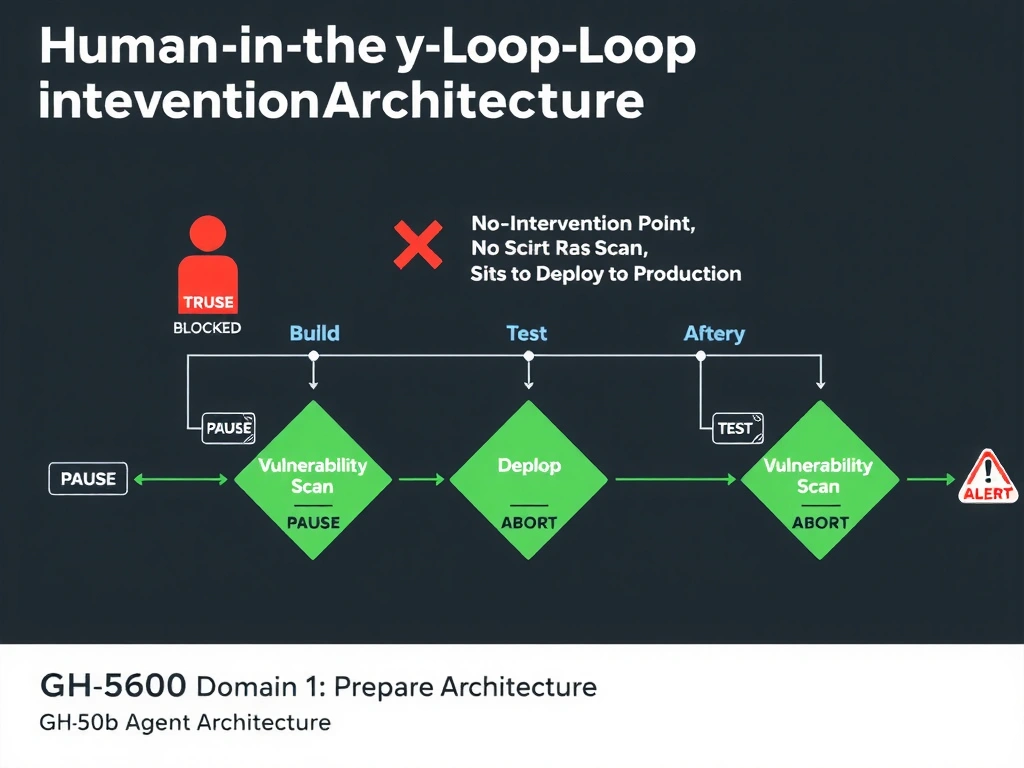
Every nuclear plant has an emergency SCRAM button — a hard interrupt that overrides everything and halts the reactor immediately. Your release agent has no SCRAM. Human-in-the-loop intervention isn't just a nice-to-have; it's a core safety requirement that lets humans override autonomous agents when something unexpected happens mid-run.
Full explanation below image
Full Explanation
Human intervention capability is a foundational requirement in responsible agentic system design. An agent that cannot be paused, redirected, or aborted once started is operating outside of human control — and in high-stakes environments like production deployments, that is a critical safety gap.
The correct answer is B. The release agent needs a human-in-the-loop intervention mechanism. This includes: (1) a pause/resume capability that suspends agent execution at a safe checkpoint; (2) an abort/cancel mechanism that stops the agent cleanly and can trigger compensating actions; and (3) an override capability that allows an operator to redirect the agent's next steps. These controls must be exposed through an operator interface (such as a GitHub Actions manual step, a webhook, or an operations dashboard) so that team members can act quickly when unexpected conditions arise like the vulnerability discovery described in the scenario.
Why the other options are wrong:
Option A — multi-model routing — allows the agent to use different models for different subtasks. This is a performance and capability optimization, not a safety control. Even if the agent escalated to a smarter model, humans still couldn't stop it.
Option C — containerization — is an infrastructure deployment choice. While containers do provide process isolation, killing a container is a blunt and disruptive instrument that is not the same as a graceful human intervention mechanism. More importantly, containerization does not give operators a controlled way to pause and resume mid-task.
Option D — retry logic — addresses what happens when steps fail; it is a resilience pattern. If anything, automatic retries would make the problem worse by continuing the deployment even after an operator tried to interrupt it. The scenario needs a stop mechanism, not a continuation mechanism.
For the exam: 'cannot be stopped,' 'no way to pause,' 'no override once started' all signal a missing human-in-the-loop intervention capability — one of the explicit Domain 1 objectives.