
An agent that automates dependency updates across multiple repositories is failing a compliance audit. Auditors report they cannot determine what reasoning the agent used, which packages it evaluated, or why it chose specific version upgrades. The agent completes its work but leaves no trace of its intermediate decision-making. What should be added to correct this?
Select an answer to reveal the explanation.
Short Explanation and Infographic
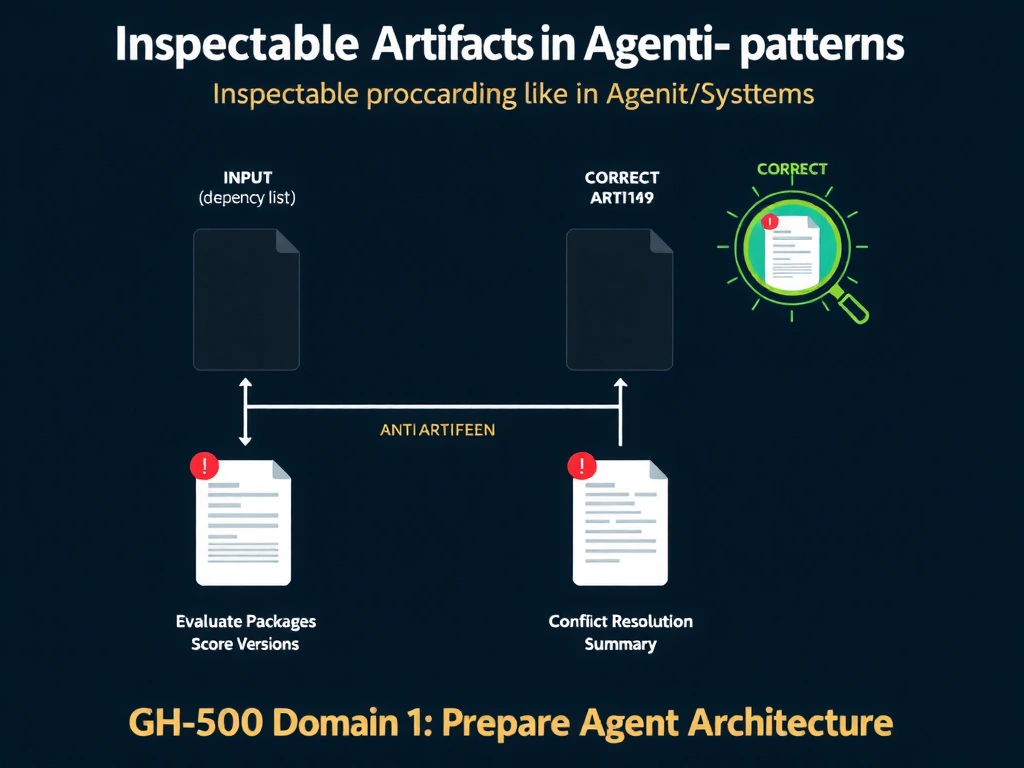
If a pilot's black box recorder only captured landings, you'd learn nothing useful after a crash. Your agent is only leaving behind the final pull request — there's no flight data recorder. Inspectable artifacts are the black boxes of agentic systems: they capture intermediate reasoning so humans can audit, debug, and trust the agent's decisions.
Full explanation below image
Full Explanation
Producing inspectable artifacts is a core requirement of responsible agent design, especially in regulated or compliance-sensitive environments. Inspectable artifacts include decision logs, intermediate evaluation reports, reasoning traces, and action summaries that capture not just what the agent did but why it made each decision. These artifacts enable human oversight, post-hoc auditing, debugging, and regulatory compliance.
The correct answer is B. The dependency-update agent is completing its task but producing only a finished pull request — no intermediate artifacts. Auditors need to see the agent's decision-making process: which packages were evaluated and why, what criteria were applied to version selection, and how conflicts were resolved. Adding structured inspectable artifacts (a decision log and evaluation report per repository) gives auditors exactly that paper trail.
Why the other options are wrong:
Option A — a Slack notification webhook — tells humans that the agent opened a PR, but it does not capture the reasoning behind which versions were chosen or how the agent evaluated competing options. Notifications provide presence awareness, not decision traceability.
Option C — a rollback mechanism — addresses what happens if the agent's changes are wrong, not whether auditors can understand how the agent arrived at its decisions. Rollback is a resilience feature, not a traceability feature.
Option D — API rate limiting — prevents the agent from overwhelming the GitHub API, which is an operational concern. It has nothing to do with the absence of decision-making artifacts or the compliance audit problem.
For the exam: when a question mentions 'cannot determine reasoning,' 'no trace of decisions,' 'auditors cannot verify,' or 'black box behavior,' the answer involves adding inspectable artifacts that document the agent's intermediate reasoning and outputs — not adding notifications or resilience mechanisms.