
After deploying an automated access-provisioning agent in a financial services organization, the compliance team flags it as a violation. The agent independently approves, provisions, and audits all access changes without any human review step. The organization's policy requires segregation of duties for access management. What is the most appropriate remediation?
Select an answer to reveal the explanation.
Short Explanation and Infographic
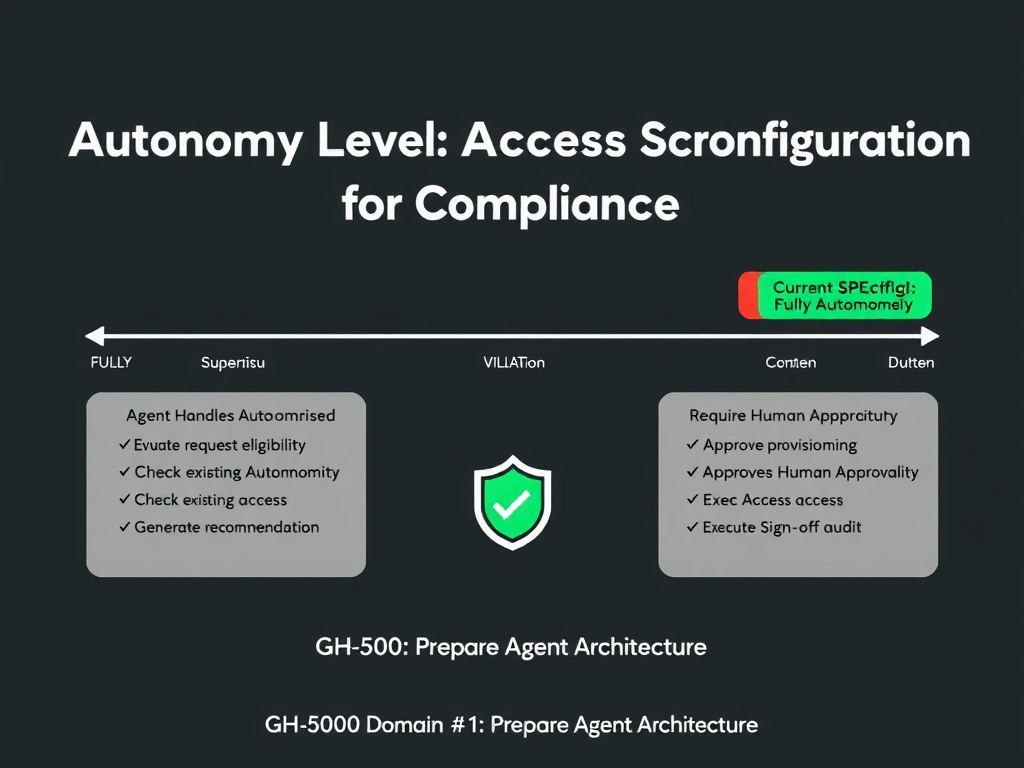
A bank teller who can approve their own wire transfers, execute them, and sign off on the audit is a compliance nightmare — that's why banks separate those duties. Your agent was essentially doing all three. The fix isn't to kill the agent; it's to dial back its autonomy level so humans own the approval step while the agent handles the routine groundwork.
Full explanation below image
Full Explanation
Autonomy level configuration is a deliberate architectural choice in agentic system design. Agents can operate across a spectrum: fully supervised (every action requires human approval), partially autonomous (routine actions are automatic, high-risk or sensitive actions require approval), or fully autonomous (no human checkpoints). The right level depends on the risk profile of the actions involved and the regulatory constraints of the operating environment.
The correct answer is B. In a regulated financial services environment, access provisioning is explicitly governed by segregation of duties policies — meaning the same entity cannot approve, execute, and audit access changes. The agent's autonomy level must be reconfigured to insert mandatory human approval checkpoints for provisioning decisions. Routine, low-risk read operations (like checking whether an account exists) can remain autonomous, but the actual provisioning decision must route through a human approver. This is not a failure of the technology; it is a misconfiguration of the autonomy level for the compliance context.
Why the other options are wrong:
Option A — replacing the agent with rule-based automation — is an overreaction. AI agents can absolutely be compliant in regulated industries; the problem is misconfiguration, not the technology itself. Well-configured agents with appropriate human checkpoints are widely used in financial services.
Option C — adding more detailed logging — improves post-hoc auditability but does not fix the segregation of duties violation. If the agent provisioned access without human approval, logging that fact more thoroughly doesn't make the provisioning compliant. Compliance requires procedural controls at decision time, not just records after the fact.
Option D — restricting the agent to read-only scopes — eliminates the compliance problem by eliminating the agent's usefulness. The goal is a properly configured agent that automates what is safe to automate, not a fully disabled one.
For the exam: 'too much autonomy,' 'no human review,' 'compliance violation,' and 'segregation of duties' all point to autonomy-level misconfiguration. The fix is targeted reduction of autonomy with human checkpoints, not elimination of the agent.