
After deploying a repository-migration agent, your team notices it begins executing file moves and branch deletions immediately after receiving a user request — before producing or reviewing any migration plan. Which principle of agent architecture is being violated?
Select an answer to reveal the explanation.
Short Explanation and Infographic
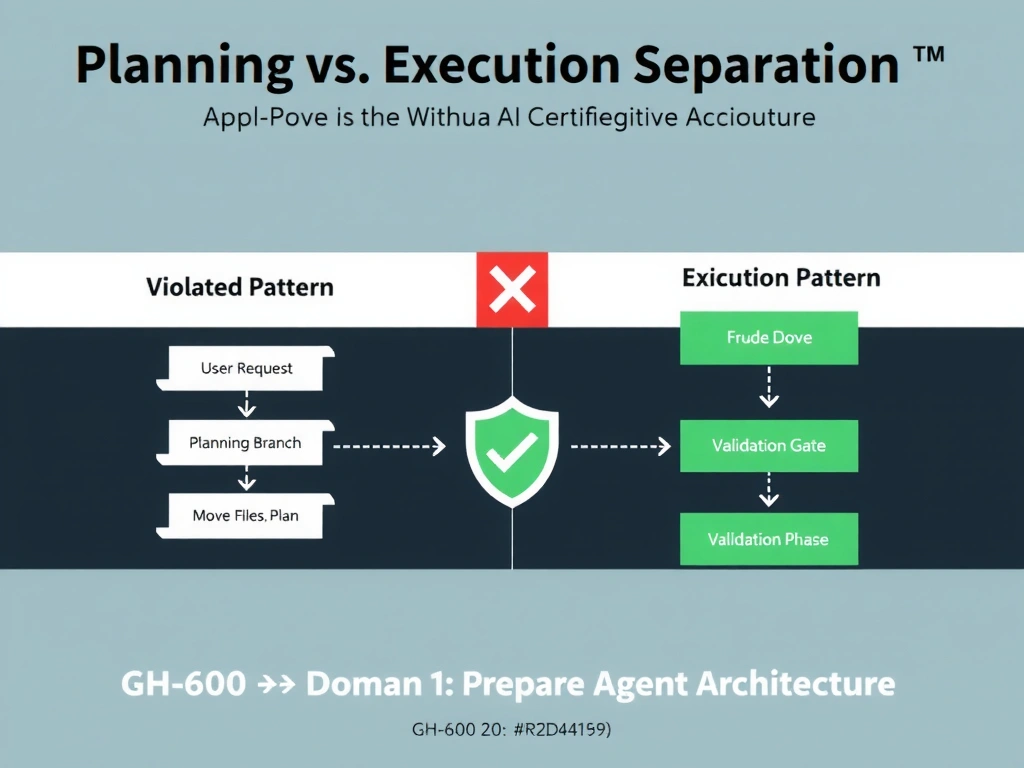
A good contractor doesn't start swinging a hammer the moment you describe the renovation — they draw up blueprints first. Your agent jumped straight from 'hear request' to 'start deleting branches' with no blueprint step. That's a violation of planning vs. execution separation, which is a core Domain 1 architectural principle.
Full explanation below image
Full Explanation
Agent architecture distinguishes between two fundamentally different modes: planning (reasoning about what to do) and execution (doing it). Healthy agents keep these modes separate, producing an inspectable plan artifact before any execution begins. The plan can then be validated — either programmatically against guardrails or by a human reviewer — before the agent is authorized to act.
The correct answer is B. The repository-migration agent is collapsing planning and execution into a single step, jumping directly from user input to file operations. This violates the planning-execution separation principle. The fix is to restructure the agent so that Phase 1 produces a migration plan (a list of proposed moves, deletions, and branch changes) and Phase 2 only begins after that plan has been reviewed and approved.
Why the other options are wrong:
Option A — least-privilege access — is about whether the agent has been granted permissions it shouldn't need. The scenario does not describe over-permissioning; the agent likely needs those permissions to do its job. The problem is when it uses them, not whether it has them.
Option C — idempotency — refers to whether an operation can be safely repeated without additional side effects. This is a real concern for migration agents, but the scenario is describing the agent acting before any plan exists, not what happens when it acts twice. Idempotency is about failure recovery, not about the planning-execution lifecycle.
Option D — observability — refers to logging and audit trails. While logging is important, the scenario says the agent is taking actions prematurely, not that it fails to log them. Observability helps you understand what happened; it does not prevent premature action from happening in the first place.
For the exam: 'acts immediately upon receiving a request,' 'no plan is produced,' and 'jumps to execution' are all signals pointing to violated planning-execution separation.