
What is the GitHub Actions 'runner group' and how are they used in enterprises?
Select an answer to reveal the explanation.
Short Explanation and Infographic
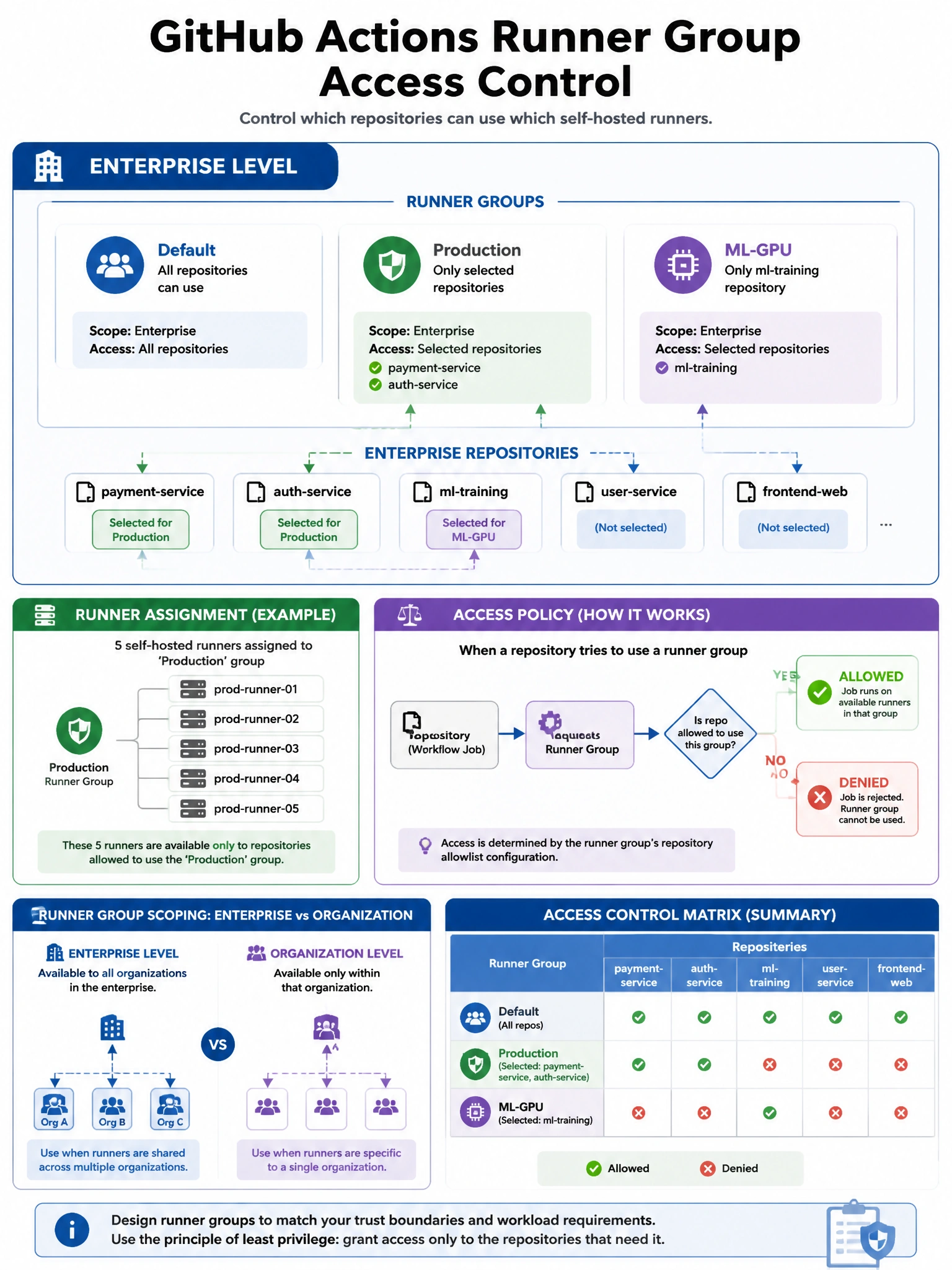
Runner groups are your access control layer for self-hosted runners. Create a group called 'Production-Runners,' put your hardened production runners in it, and only allow specific repositories to use that group. Dev workflows can't accidentally spin up on your prod infrastructure.
Full explanation below image
Full Explanation
GitHub Actions runner groups are organizational units for managing access to self-hosted runners at the enterprise or organization level. Key concepts: (1) Organization-level groups — runners in a group can be assigned to specific repositories within the organization. (2) Enterprise-level groups — runners can be assigned to specific organizations within the enterprise. (3) Access control — administrators determine which repositories (or all repos) can use runners from a specific group. (4) Default group — all self-hosted runners start in the 'Default' runner group. Use cases: dedicated production deployment runners accessible only to specific repositories, high-memory runners for specific build types, GPU runners for ML workloads accessible only to ML teams. Runner groups don't automatically distribute load — they just control access. Multiple runners in the same group are individually eligible for any job targeting that group.