
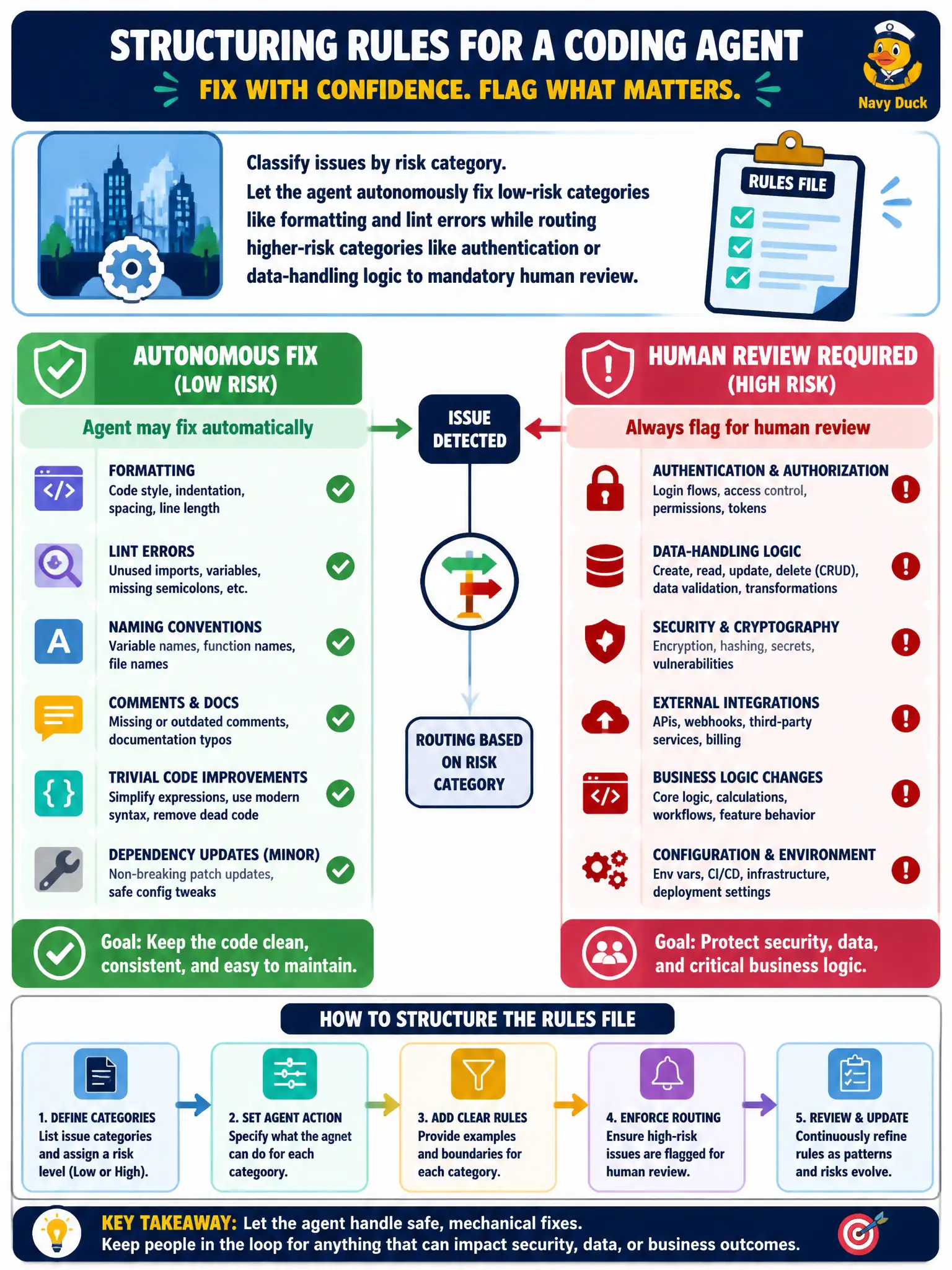
A city engineering team is drafting a rules file for its coding agent to distinguish which categories of issues it may fix automatically versus which must always be flagged for human review. How should the rules be structured?
Select an answer to reveal the explanation.
Short Explanation
Think of it like a triage nurse sorting a waiting room: a scraped knee gets handled on the spot, but chest pain goes straight to a doctor. A well-built rules file does the same sorting for the agent — low-risk categories like formatting or lint get fixed automatically, while anything touching authentication or sensitive data always gets routed to a person first. The point isn't to review everything or nothing; it's to match the level of scrutiny to the actual risk.
Full Explanation
Antigravity rules files let a team encode which categories of change an agent may act on autonomously and which must be escalated, and the effective pattern classifies by risk category — low-risk mechanical fixes like formatting or lint stay autonomous, while categories with real consequence, like authentication or data-handling code, always route to a human.
Listing every individual file rather than categorizing by risk doesn't scale and breaks the moment the codebase changes, since new files arrive with no classification at all. Letting the agent decide for itself which fixes it's capable of handling removes the predefined boundary the rules file exists to provide, making the actual risk threshold whatever the agent happens to judge in the moment. Requiring human review for everything technically satisfies safety but eliminates the efficiency gain of using a coding agent at all, turning the rules file into a log rather than a decision boundary.
Scope note: risk categories should be revisited as the codebase evolves, since a file that starts out low-risk can later gain authentication or data-handling responsibilities. Operational check: audit a sample of agent-authored fixes each quarter to confirm none touched a high-risk category without triggering review.