
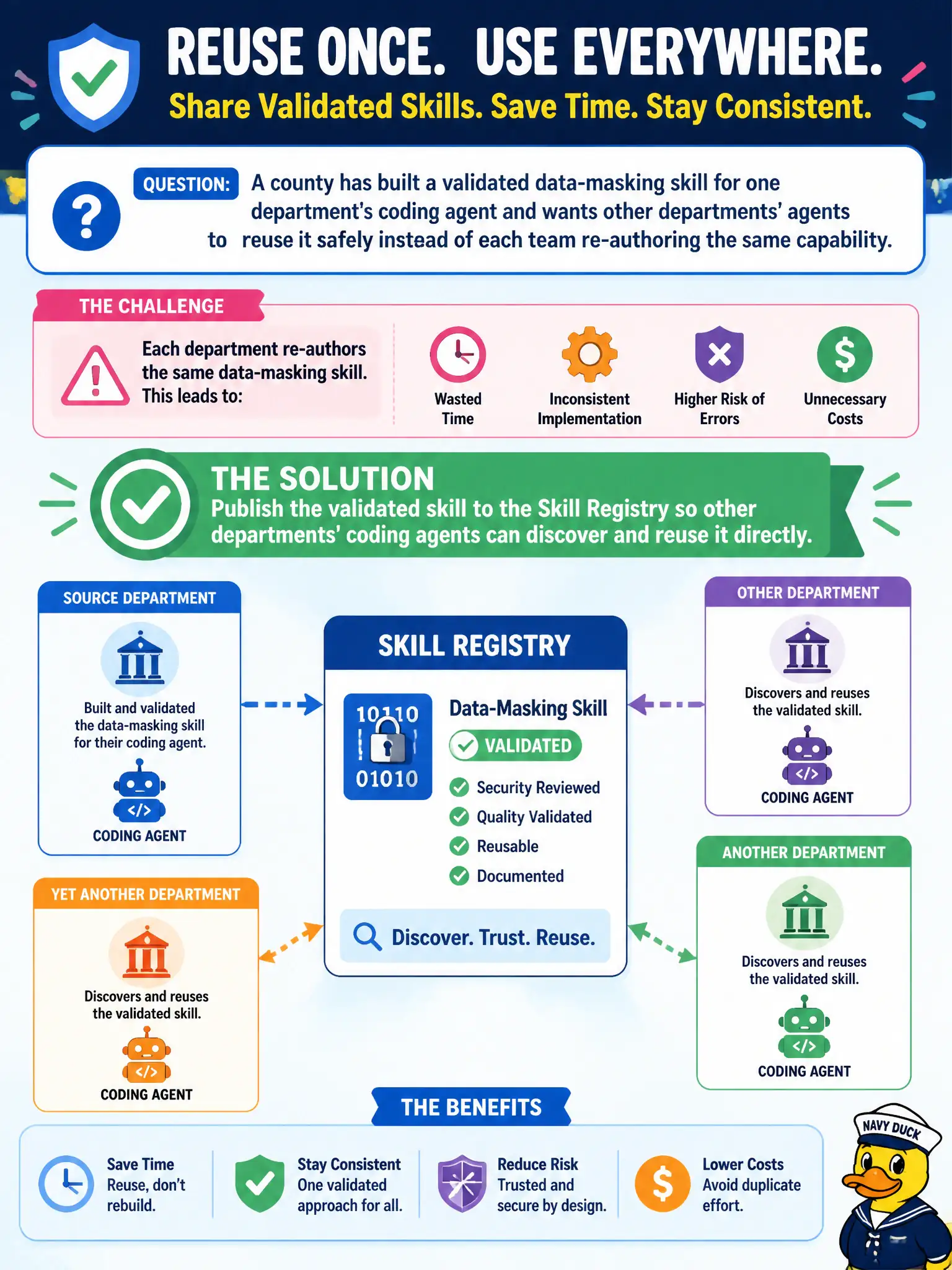
A county has built a validated data-masking skill for one department's coding agent and wants other departments' agents to reuse it safely instead of each team re-authoring the same capability. What should they use?
Select an answer to reveal the explanation.
Short Explanation
Think of it like a city's shared equipment yard instead of every department buying its own generator. Once the data-masking skill is validated, the Skill Registry is that shared yard — other departments' agents can check it out and use the exact same tested tool instead of everyone building their own version from scratch. A wiki page or a hand-copied file just means the next department is rebuilding the wheel with extra steps.
Full Explanation
The Skill Registry exists specifically to let a validated skill built for one deployment be discovered and reused by other agent deployments across an organization, without each team re-authoring the same capability from its own understanding of the requirements.
Manually copying the skill's code into each department's configuration creates independent forks that drift apart the moment either one is patched or improved, losing the benefit of having validated it once. Having each department redevelop an equivalent capability from scratch duplicates the validation effort and risks each version handling edge cases differently, which is exactly the inconsistency a shared registry prevents. Storing documentation on a wiki communicates intent but leaves the actual implementation work, and the risk of a flawed reimplementation, to every consuming team.
Scope note: registering a skill doesn't remove the need to review who has permission to invoke it once shared, since broader reuse means broader exposure to the underlying data-masking logic. Operational check: confirm a second department's agent can successfully invoke the registered skill end-to-end before retiring the original team's standalone version.