
A public-health department requires every agent-authored pull request to pass a governance review step before it can be merged into the production codebase. How should this be set up using Agents CLI?
Select an answer to reveal the explanation.
Short Explanation
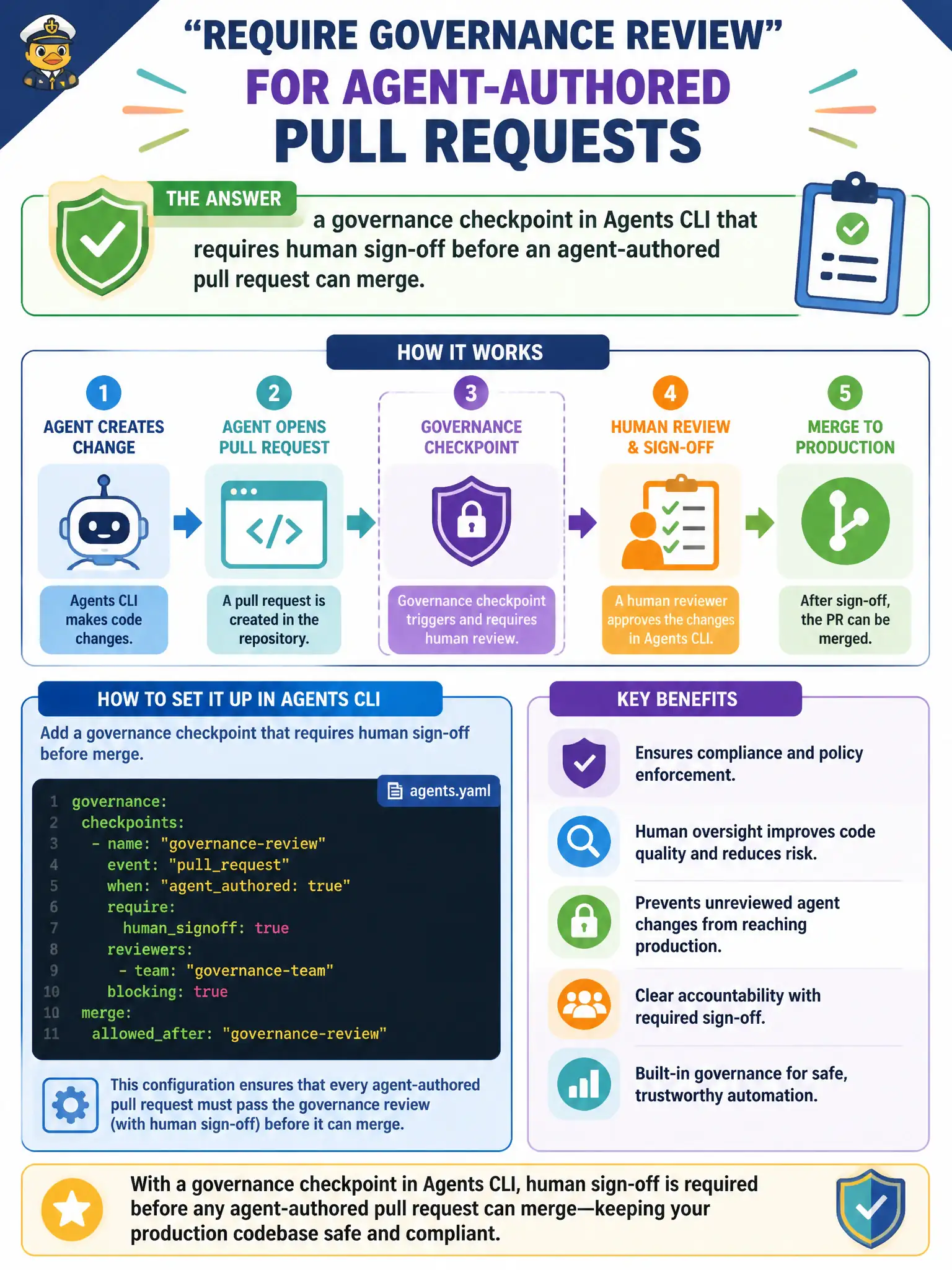
Think about a permit application that a computer can pre-fill but still needs a clerk's stamp before it's valid. Agents CLI's governance checkpoint is that stamp: it inserts a required human sign-off between the agent finishing its work and that work actually landing in production. A tidy self-review or a longer commit message might look thorough, but neither one is a person actually saying yes.
Full Explanation
Agents CLI is built to govern deployed agents across an organization, and one of its capabilities is inserting a review checkpoint that must be satisfied — specifically a human decision — before an agent-authored change merges. Configuring that checkpoint for the public-health department's pipeline is what turns "every PR gets reviewed" from a policy statement into an enforced gate.
An agent generating its own review summary is still the same actor evaluating its own work; it can surface useful context but it isn't an independent check, and nothing stops a flawed change from producing a confident-sounding summary anyway. Longer commit messages improve traceability after the fact but don't gate anything — a well-documented bad change still merges. Automated tests validate functional correctness against known cases, but passing tests doesn't substitute for a governance decision about whether a change should ship, especially for cases the test suite doesn't anticipate.
Scope note: a governance checkpoint slows every merge by the review turnaround time, so departments should size the requirement to the sensitivity of what's being merged. Operational check: submit a deliberately unreviewed test PR and confirm the pipeline actually blocks it from merging without sign-off.