
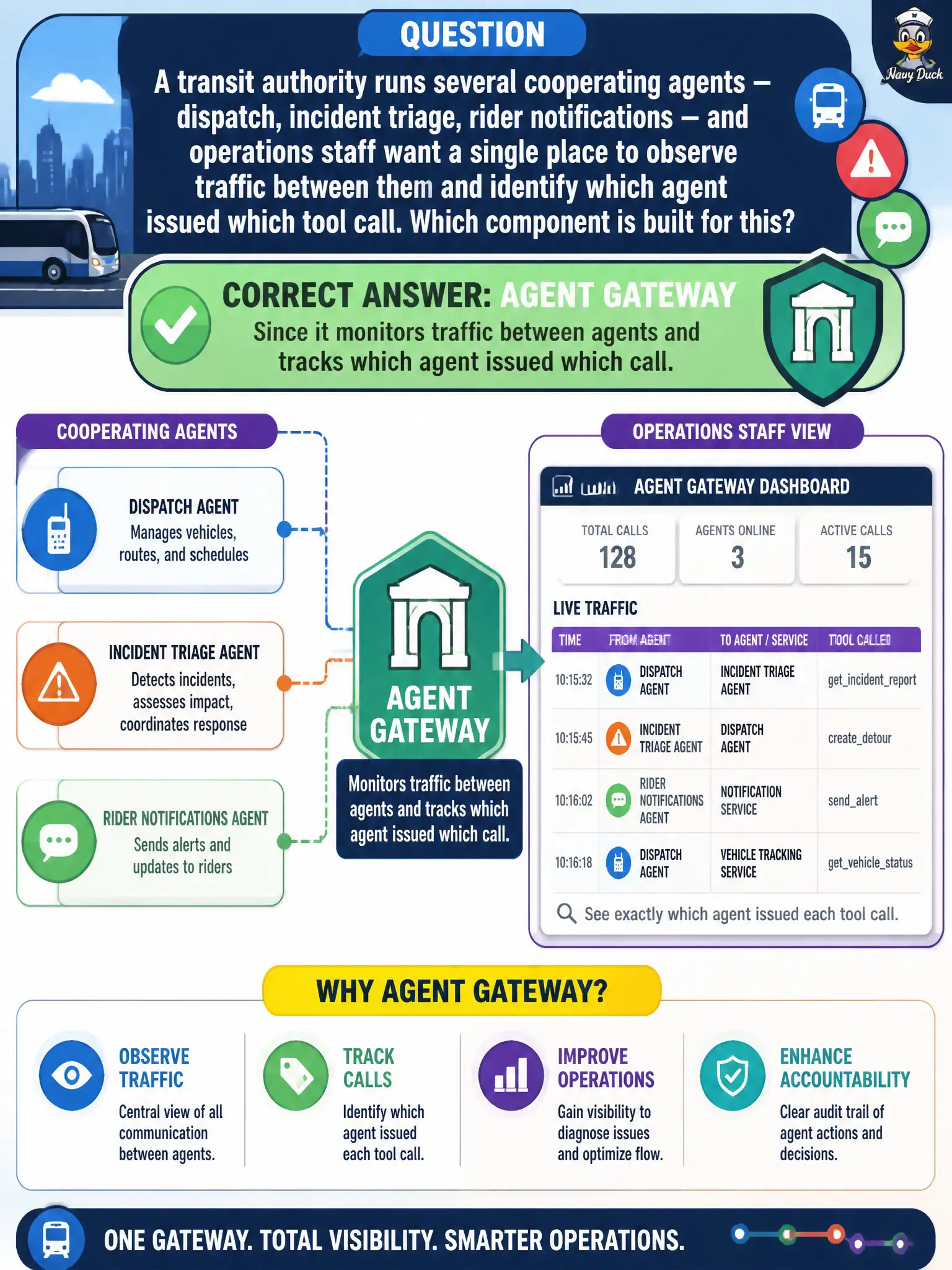
A transit authority runs several cooperating agents — dispatch, incident triage, rider notifications — and operations staff want a single place to observe traffic between them and identify which agent issued which tool call. Which component is built for this?
Select an answer to reveal the explanation.
Short Explanation
When several agents are all talking to each other and to tools, someone needs to stand at the crossroads and watch the traffic. That's Agent Gateway's job: one vantage point that shows which agent issued which call, instead of piecing it together from scattered sources. Trace, custom logs, and content screening each do a different job than that.
Full Explanation
Agent Gateway sits at the point where agent-to-agent and agent-to-tool traffic flows, giving operations staff a centralized view of that traffic and attributing each call to the specific agent that issued it, which is exactly the cross-agent visibility this multiagent transit scenario needs. Cloud Trace alone records span timing per request but isn't purpose-built to provide the centralized, agent-attributed traffic view across multiple cooperating agents that Agent Gateway offers. A custom logging layer built separately into each agent requires stitching together disparate sources after the fact instead of providing the single unified vantage point requested. Model Armor's role is inspecting content for unsafe or manipulative patterns, not attributing traffic to the agent that issued each call. Scope caveat: Agent Gateway's traffic visibility complements, rather than replaces, per-request tracing and logging, since teams typically still want span-level timing and step-level content detail alongside the gateway's traffic view. Operational check: from the Agent Gateway view, confirm that a specific tool call made during an incident-triage handoff can be traced back to the exact agent that issued it.