
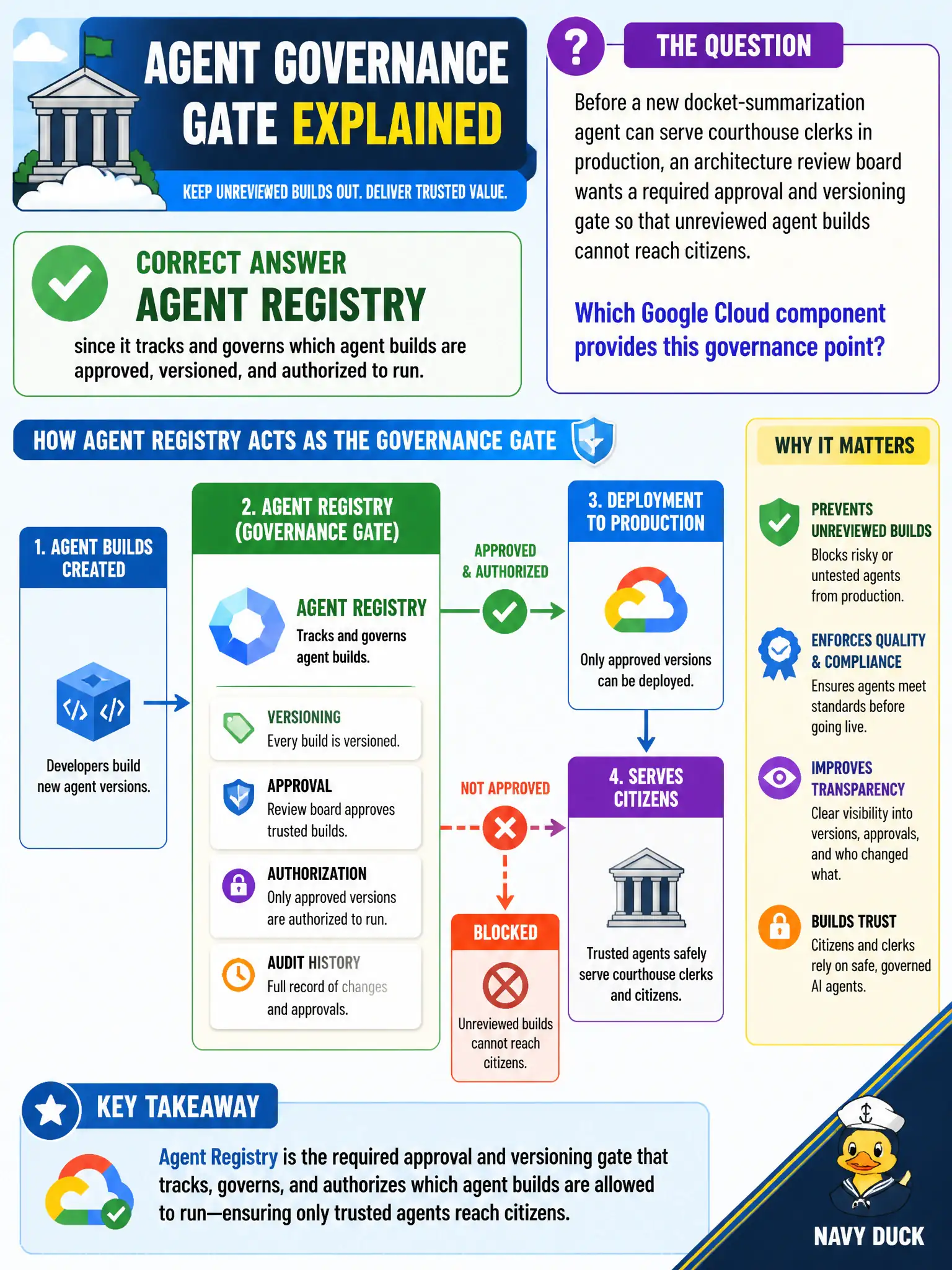
Before a new docket-summarization agent can serve courthouse clerks in production, an architecture review board wants a required approval and versioning gate so that unreviewed agent builds cannot reach citizens. Which Google Cloud component provides this governance point?
Select an answer to reveal the explanation.
Short Explanation
Think of it like a courthouse clerk's office that won't file a document without the right stamp of approval first. Agent Registry is that stamp for agent builds — it tracks versions and only lets authorized ones actually run. Monitoring traffic, screening content, and timing requests all happen after that gate, not instead of it.
Full Explanation
Agent Registry serves as the governance point where agent builds are tracked, versioned, and approved before they're authorized to run in production, giving a review board the required gate to prevent an unreviewed build from ever reaching citizen-facing traffic; this is distinct from monitoring or screening what happens once an approved agent is already live. Agent Gateway observes and manages traffic for agents that are already deployed and running, which happens downstream of the approval decision, not as the gate itself. Model Armor screens the content of requests and responses for unsafe patterns, a runtime safety control rather than a build-approval mechanism. Cloud Trace records timing data for requests already being served, which presumes the agent has already passed whatever gate exists. Scope caveat: a registry gate is only effective if the deployment pipeline actually enforces it, so teams should confirm unapproved builds are technically blocked from serving traffic, not just flagged. Operational check: attempt to deploy an unapproved build of the docket-summarization agent in a test environment and confirm Agent Registry blocks it from serving traffic.