
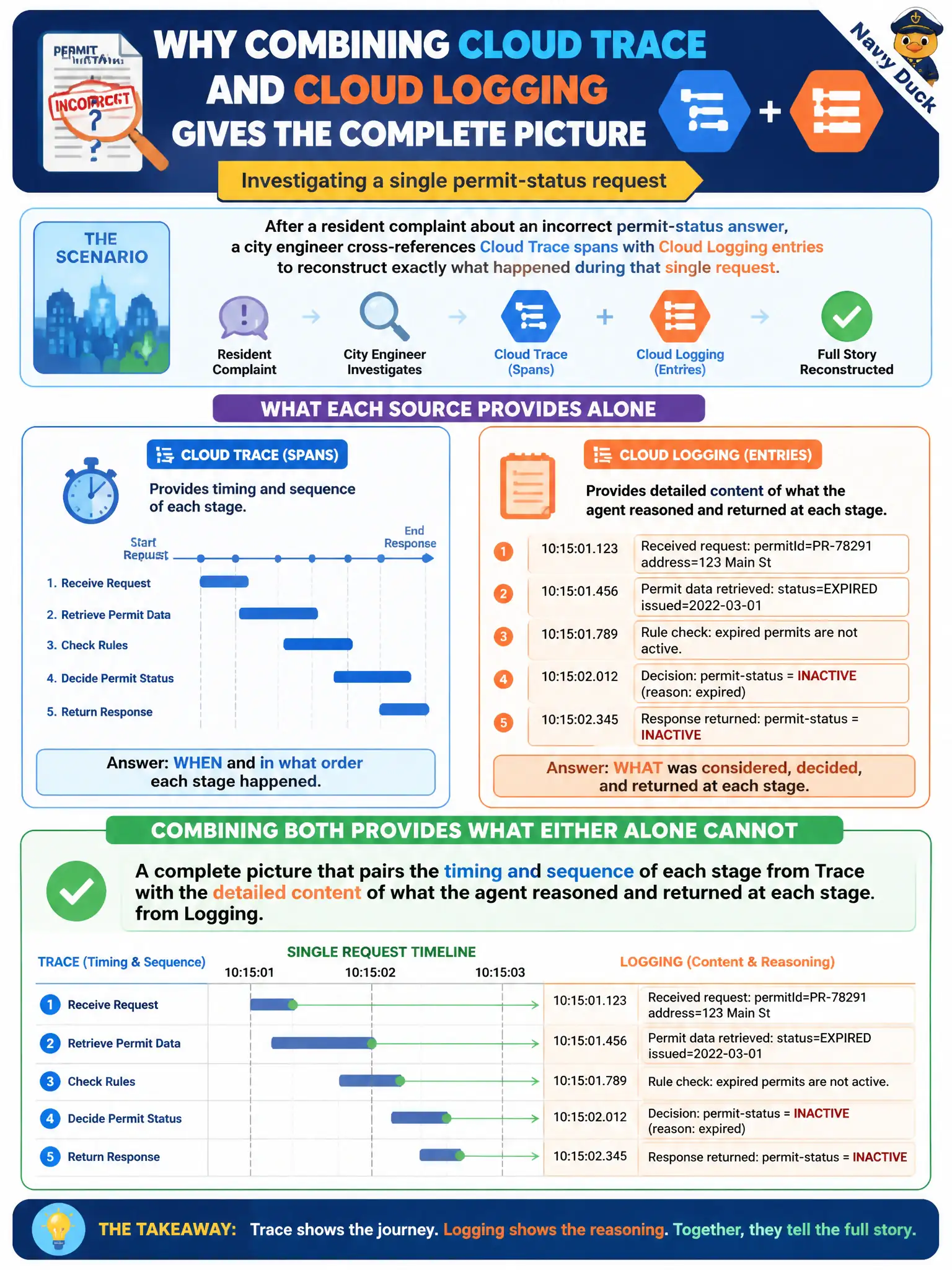
After a resident complaint about an incorrect permit-status answer, a city engineer cross-references Cloud Trace spans with Cloud Logging entries to reconstruct exactly what happened during that single request. What does combining the two sources provide that either alone would not?
Select an answer to reveal the explanation.
Short Explanation
Trace tells you the timeline, Logging tells you the story — together they give the whole scene. One shows how long each step took, the other shows what actually happened inside each step. For a single messy incident, both are usually needed to see the full picture.
Full Explanation
Cloud Trace shows the timing and sequence of spans across a request, establishing the structural timeline of which stage ran when and how long it took, while Cloud Logging carries the content-level detail — the actual reasoning and tool-call arguments and results — at each of those stages; cross-referencing the two lets an engineer walk through a single incident and see both when something happened and what actually occurred, which neither source alone fully provides. Confirming which agent version is authorized to run is a governance function handled by version tracking, not something trace-and-log correlation is used for. Which access boundary policy applied is a permissions record, unrelated to reconstructing the content and timing of a single request. Comparing a new version against the previous production version describes a deployment-validation activity like a canary, not incident reconstruction for one already-served request. Scope caveat: this kind of cross-referencing depends on both sources sharing a common request identifier, so teams should confirm trace and log entries correlate by ID before relying on this workflow. Operational check: pull the trace and logs for the specific complaint's request ID and confirm the Trace timeline matches the content details recorded in Logging.