
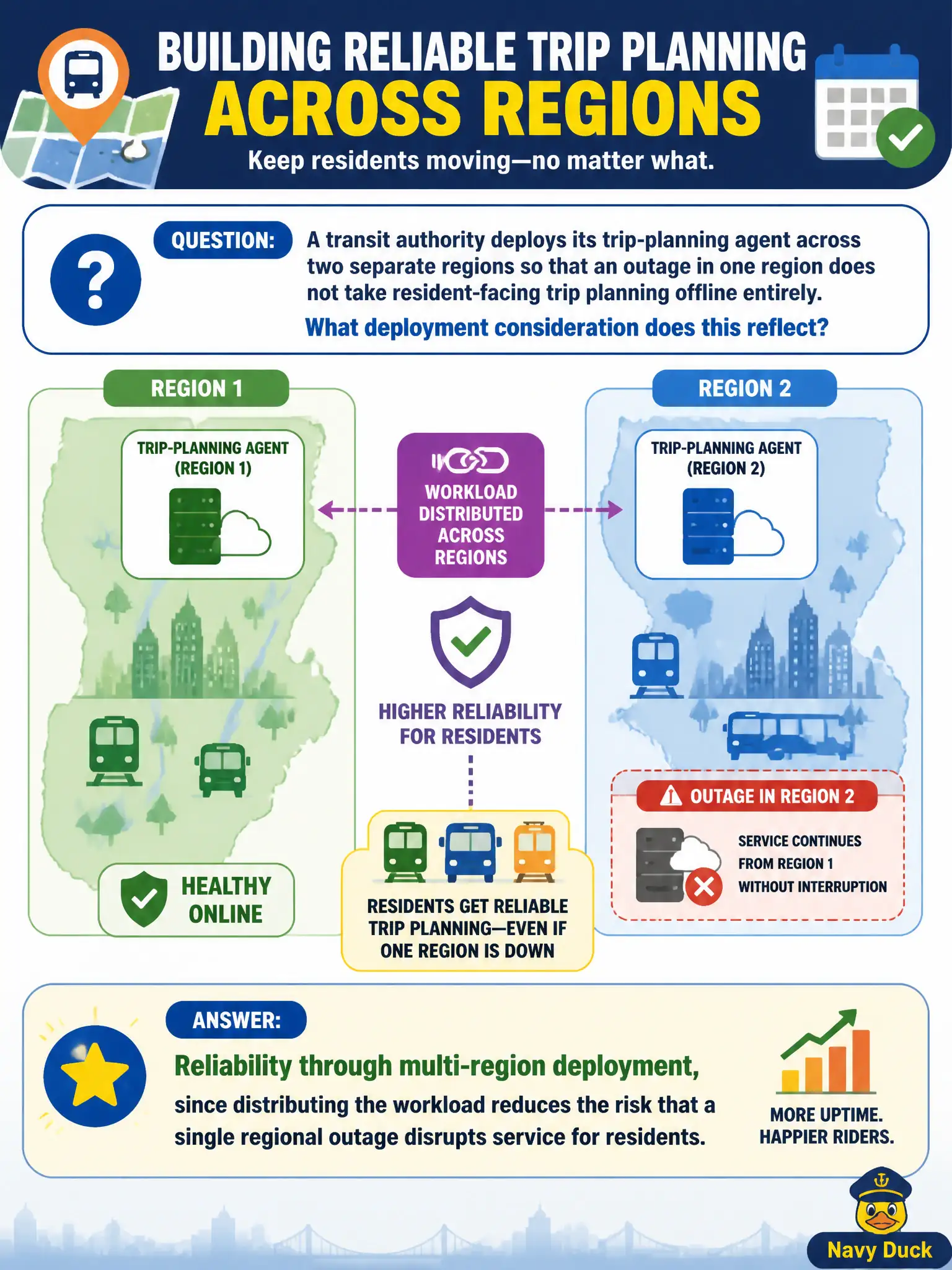
A transit authority deploys its trip-planning agent across two separate regions so that an outage in one region does not take resident-facing trip planning offline entirely. What deployment consideration does this reflect?
Select an answer to reveal the explanation.
Short Explanation
Keeping all the eggs in one basket works fine until the basket has a bad day. Running the trip-planning agent in two regions means a single regional outage doesn't take the whole service down with it. That redundancy is a reliability play, not a version comparison or a cost trick.
Full Explanation
Multi-region deployment distributes a workload's serving capacity across independent regions so that a failure isolated to one region doesn't eliminate service availability entirely, trading some added infrastructure complexity and cost for resilience against a regional outage; this is a standard reliability strategy for production workloads with high availability requirements, like resident-facing trip planning. Running in two regions typically adds cost rather than minimizing it, since more infrastructure is maintained concurrently. Canary validation compares two versions of the same software on a slice of traffic, unrelated to geographic redundancy. Principal access boundary scoping governs what resources an agent can access, not how many regions its serving infrastructure spans. Scope caveat: multi-region deployment only improves reliability if traffic can actually fail over between regions automatically, so redundancy without a working failover path provides little real protection. Operational check: periodically test regional failover by simulating one region's unavailability and confirming trip-planning requests continue to be served from the other.