
A county IT team uses latency figures observed during development-time evaluation runs to set realistic capacity and autoscaling targets before launching their permitting agent into production. What does this practice connect together?
Select an answer to reveal the explanation.
Short Explanation
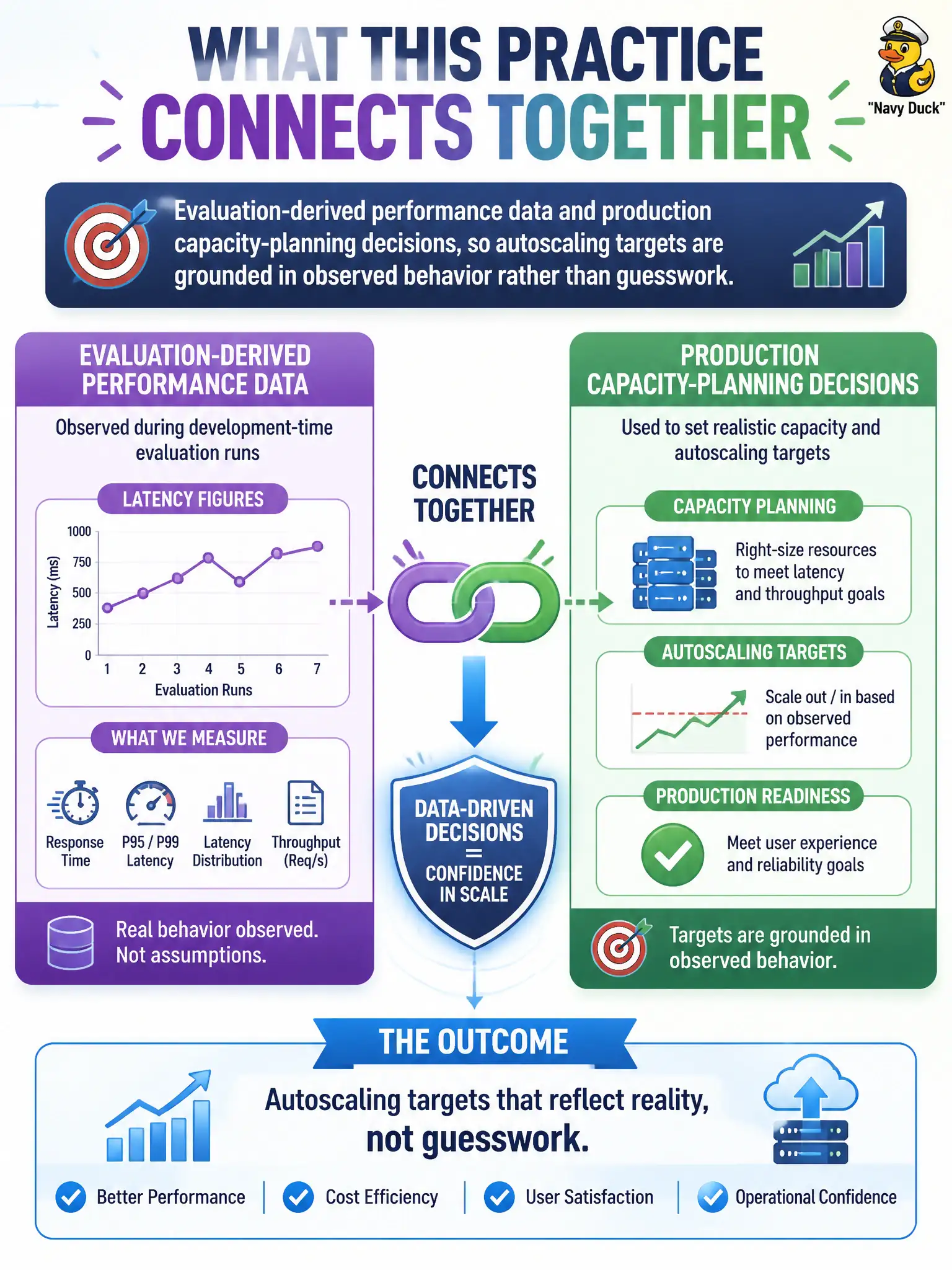
Guessing how much capacity is needed is a coin flip; using real latency numbers from evaluation runs is a plan. The team already watched how the agent behaves under evaluation, and now that observed reality is feeding directly into how production capacity gets sized. That's using what was learned before launch to avoid surprises after it.
Full Explanation
Development-time evaluation runs produce real latency measurements under realistic conditions, and feeding those figures into capacity and autoscaling planning grounds production sizing decisions in observed behavior rather than assumption, reducing the risk of under- or over-provisioning once the agent goes live; this connects two normally separate activities — evaluation and deployment planning — into one informed decision. Pairing a principal access boundary policy with networking configuration describes two unrelated security and infrastructure concerns, neither tied to using latency data for capacity sizing. Pairing the golden dataset with a prompt template describes how evaluation content is constructed, not how its results feed forward into deployment decisions. Connecting a canary rollout's results to a rollback decision describes a post-deployment validation loop, a different point in the lifecycle than pre-launch capacity planning. Scope caveat: evaluation-time latency is measured under evaluation conditions, so teams should sanity-check that evaluation traffic patterns and data volumes reasonably resemble expected production load before trusting the figures directly. Operational check: compare the autoscaling targets set from evaluation-time latency against actual observed production latency shortly after launch and adjust if they diverge.