
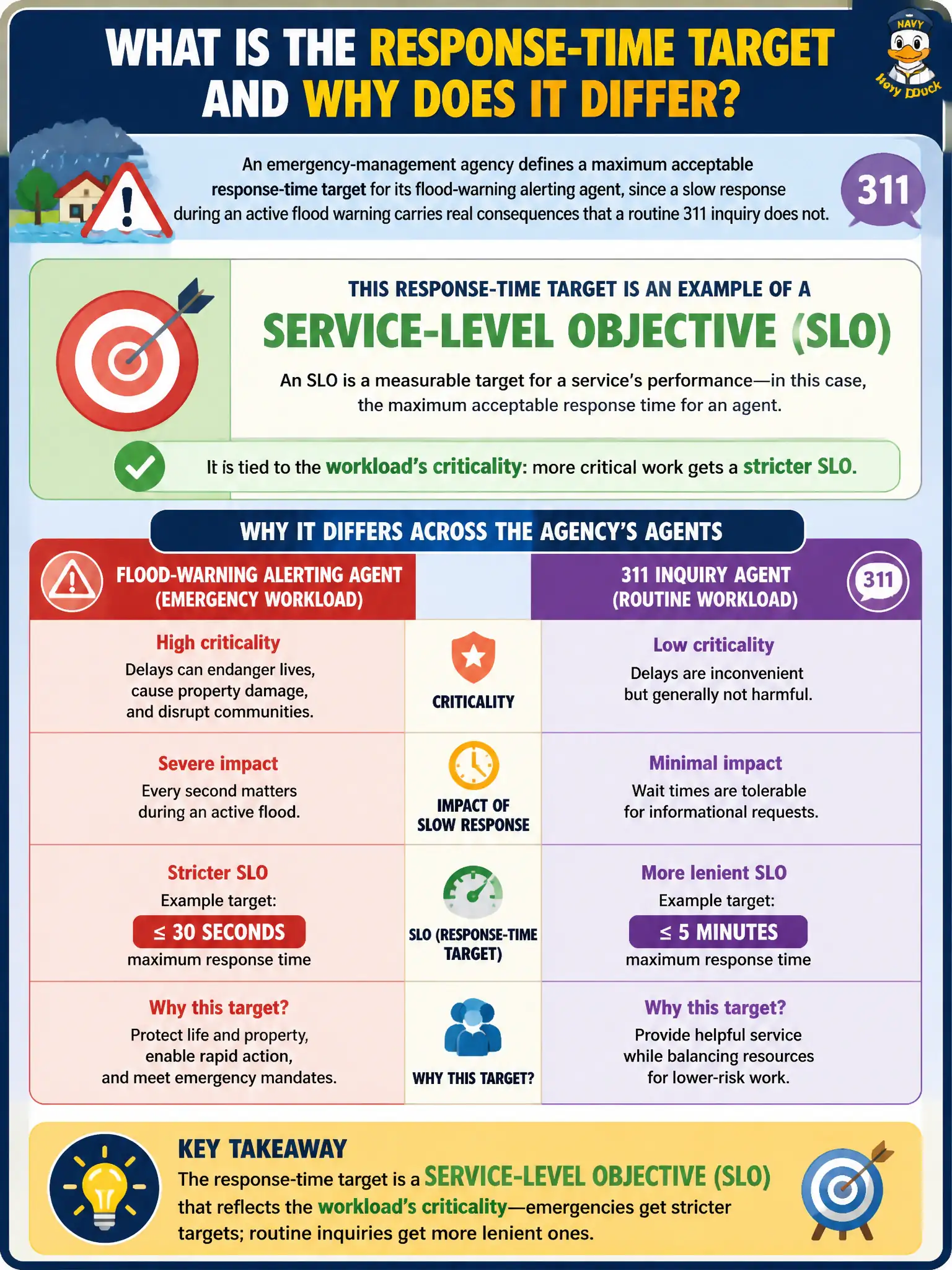
An emergency-management agency defines a maximum acceptable response-time target for its flood-warning alerting agent, since a slow response during an active flood warning carries real consequences that a routine 311 inquiry does not. What is this response-time target an example of, and why does it differ across the agency's agents?
Select an answer to reveal the explanation.
Short Explanation
Not every agent deserves the same stopwatch. A flood-warning agent needs a much tighter deadline than a "when's the library open" bot, because the cost of being slow is completely different for each one. Setting that target explicitly, based on how much a delay actually matters, is exactly what an SLO is for.
Full Explanation
A service-level objective defines a measurable target — here, maximum response time — calibrated to how critical the workload is, so agencies can hold different agents to different standards rather than applying one blanket target everywhere; a flood-warning alerting agent's SLO should be tighter than a routine 311 assistant's precisely because the consequence of a slow response differs so much between the two. A principal access boundary policy scopes data and resource access, an entirely separate governance concern from response-time targets. A canary rollout metric is used during a deployment comparison window, not as an ongoing operational target. Treating the target purely as a cost lever misreads the motivation, since the target here is driven by consequence and criticality, not primarily by compute spend, even though faster responses can carry a cost tradeoff. Scope caveat: setting an SLO is only useful paired with monitoring and alerting that actually measures performance against it, otherwise the target stays aspirational rather than enforced. Operational check: confirm the alerting agent's live response-time metrics are being measured against its defined SLO and that a breach triggers a notification.