
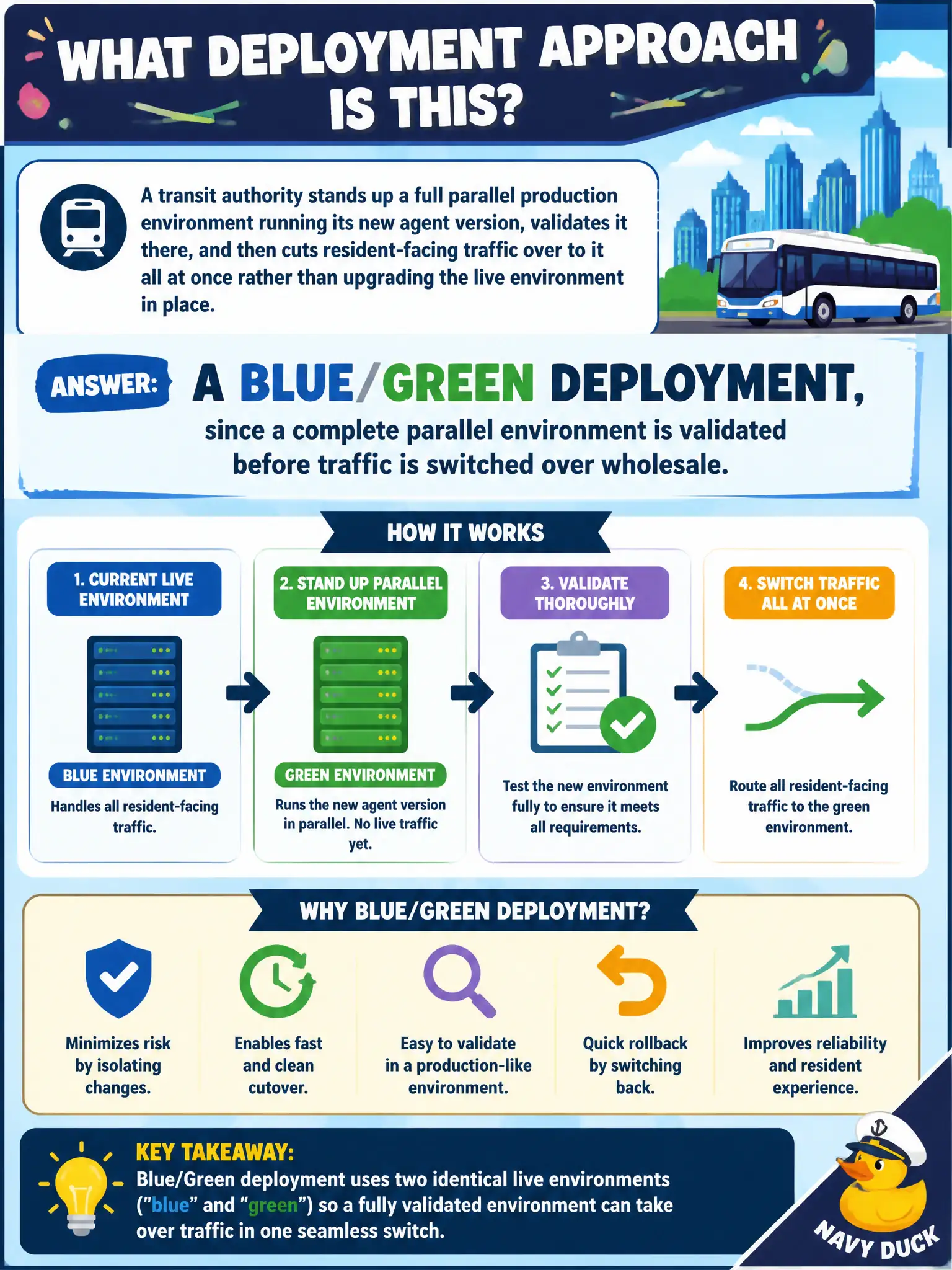
A transit authority stands up a full parallel production environment running its new agent version, validates it there, and then cuts resident-facing traffic over to it all at once rather than upgrading the live environment in place. What deployment approach is this?
Select an answer to reveal the explanation.
Short Explanation
Picture keeping two full kitchens running: the new one gets built and tested completely before the restaurant switches its whole dining room over to it in one move. That's blue/green — a full standby environment, then a wholesale cutover, not a slow trickle of a few orders. The old kitchen stays ready as a fallback if the new one has trouble.
Full Explanation
Blue/green deployment keeps two complete, independently running environments — the current "blue" and the new "green" — fully validates green in isolation, and then switches traffic over in one cutover once confidence is established, with blue available as an immediate fallback if green misbehaves; this differs from gradually increasing a percentage of live traffic during validation. A canary rollout validates using a small slice of live production traffic incrementally, rather than a fully separate environment cut over all at once. Rollback is a recovery action after a bad release, not the initial cutover strategy being described here. Autoscaling addresses varying request volume within a given version, not the process of validating and switching between two distinct versions. Scope caveat: blue/green requires provisioning and maintaining two full environments at once, a real infrastructure cost worth weighing against a canary approach's lighter-weight validation. Operational check: before cutover, confirm the green environment independently passes the same evaluation suite and health checks the blue environment currently meets.