
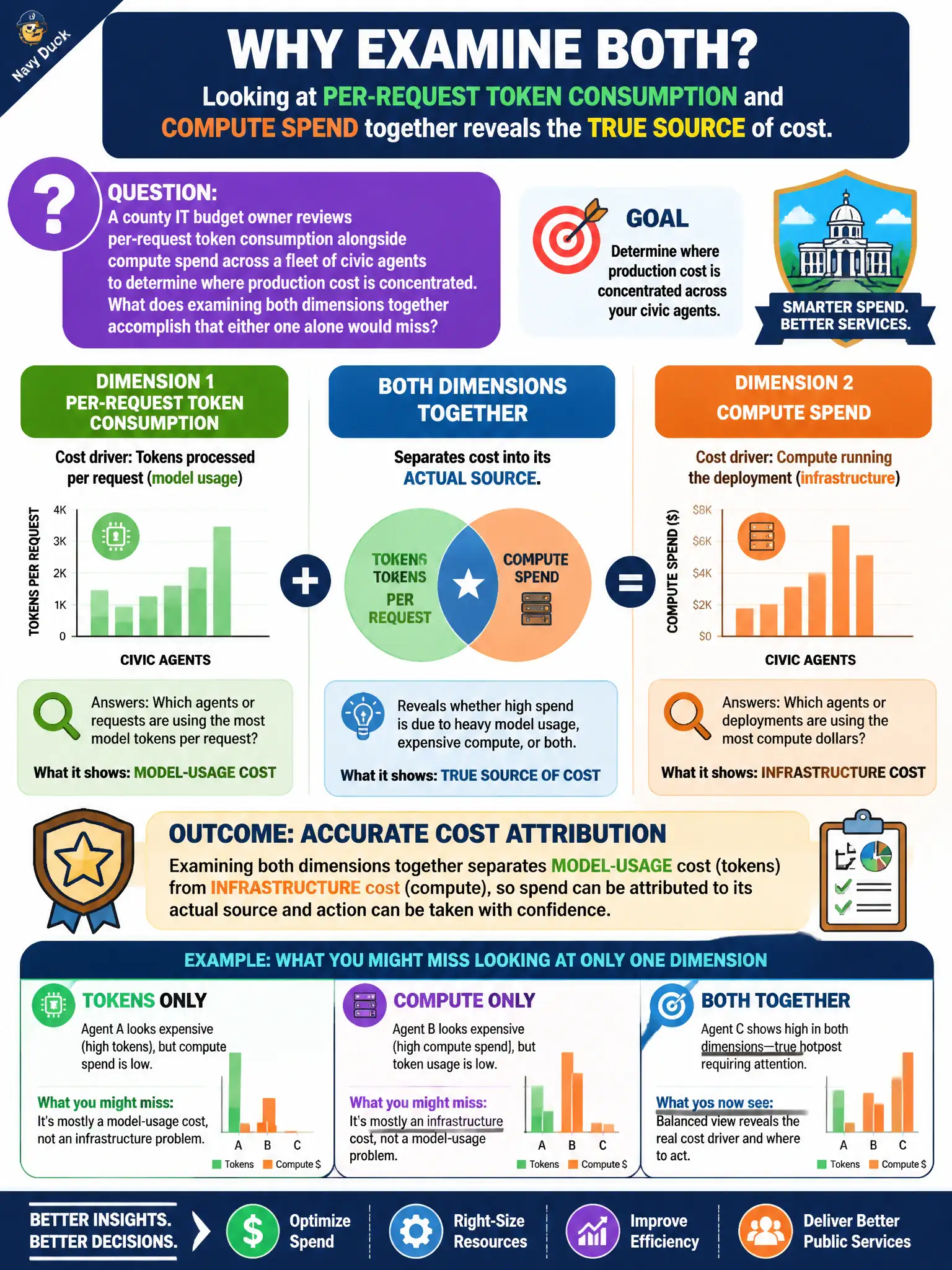
A county IT budget owner reviews per-request token consumption alongside compute spend across a fleet of civic agents to determine where production cost is concentrated. What does examining both dimensions together accomplish that either one alone would miss?
Select an answer to reveal the explanation.
Short Explanation
Token spend and compute spend are two different bills for two different things, like paying for ingredients versus paying rent on the kitchen. Looking at only one can hide where the real money is going. Reviewing both together shows whether an agent is expensive because it talks too much or because it's over-provisioned.
Full Explanation
Token consumption reflects model-usage cost — how much is processed per request, often tied to prompt length, context size, and output verbosity — while compute spend reflects infrastructure cost such as replica count and instance sizing for the deployment runtime; reviewing both together attributes overall spend to its actual driver, letting the budget owner target the right fix (trim prompts and context versus right-size the deployment) instead of cutting broadly. Accuracy on a golden dataset is an evaluation-quality metric, not a cost signal, and a highly accurate agent can still be expensive or cheap independent of its score. Which version is authorized to run is a governance question handled by version tracking, unrelated to spend attribution. A principal access boundary policy scopes what an agent can access, a security control with no direct bearing on the split between token and compute cost. Scope caveat: cost concentration can shift as traffic patterns change, so a one-time review should be treated as a snapshot rather than a permanent conclusion. Operational check: pull per-agent token usage and compute spend for the same billing period and confirm which dimension dominates before deciding where to optimize.