
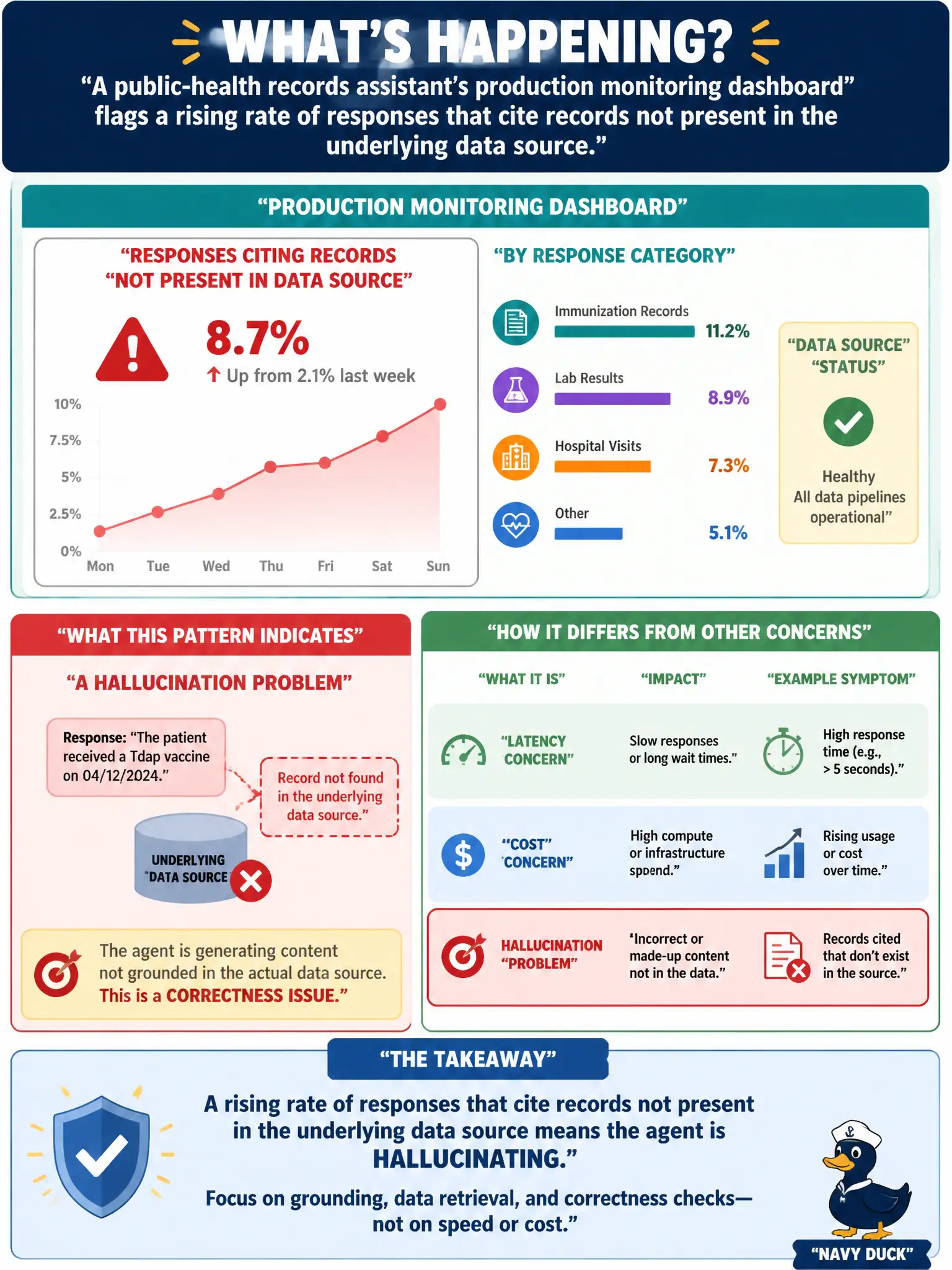
A public-health records assistant's production monitoring dashboard flags a rising rate of responses that cite records not present in the underlying data source. What production issue does this pattern indicate, and how does it differ from a latency or cost concern?
Select an answer to reveal the explanation.
Short Explanation
Picture someone confidently citing a document that was never filed — that's a hallucination, not a slow clerk or an expensive one. The signal here is about what the agent said, not how fast or how much it cost to say it. That distinction matters, because each one gets fixed differently.
Full Explanation
A rising rate of citations to records absent from the underlying data source is a grounding failure — the model is producing plausible-sounding but unsupported content — and production monitoring surfaces it by comparing cited references against the actual source or via automated groundedness checks, which is a correctness signal distinct from timing or spend metrics. Latency describes how long a response takes, not whether its content is accurate, and slow retrieval alone doesn't explain a fabricated citation appearing in a completed answer. Cost tracks token or compute spend, which is orthogonal to whether the content is grounded in real records. A reasoning loop describes non-terminating repeated tool calls, not a single confidently wrong citation appearing across many separate, otherwise-completed requests. Caveat: not every wrong citation is hallucination — confirm the record genuinely doesn't exist in the source rather than the retrieval step simply missing it. Operational check: sample a batch of flagged responses and verify against the source system whether the cited record truly doesn't exist, distinguishing a generation problem from a retrieval-coverage gap.