
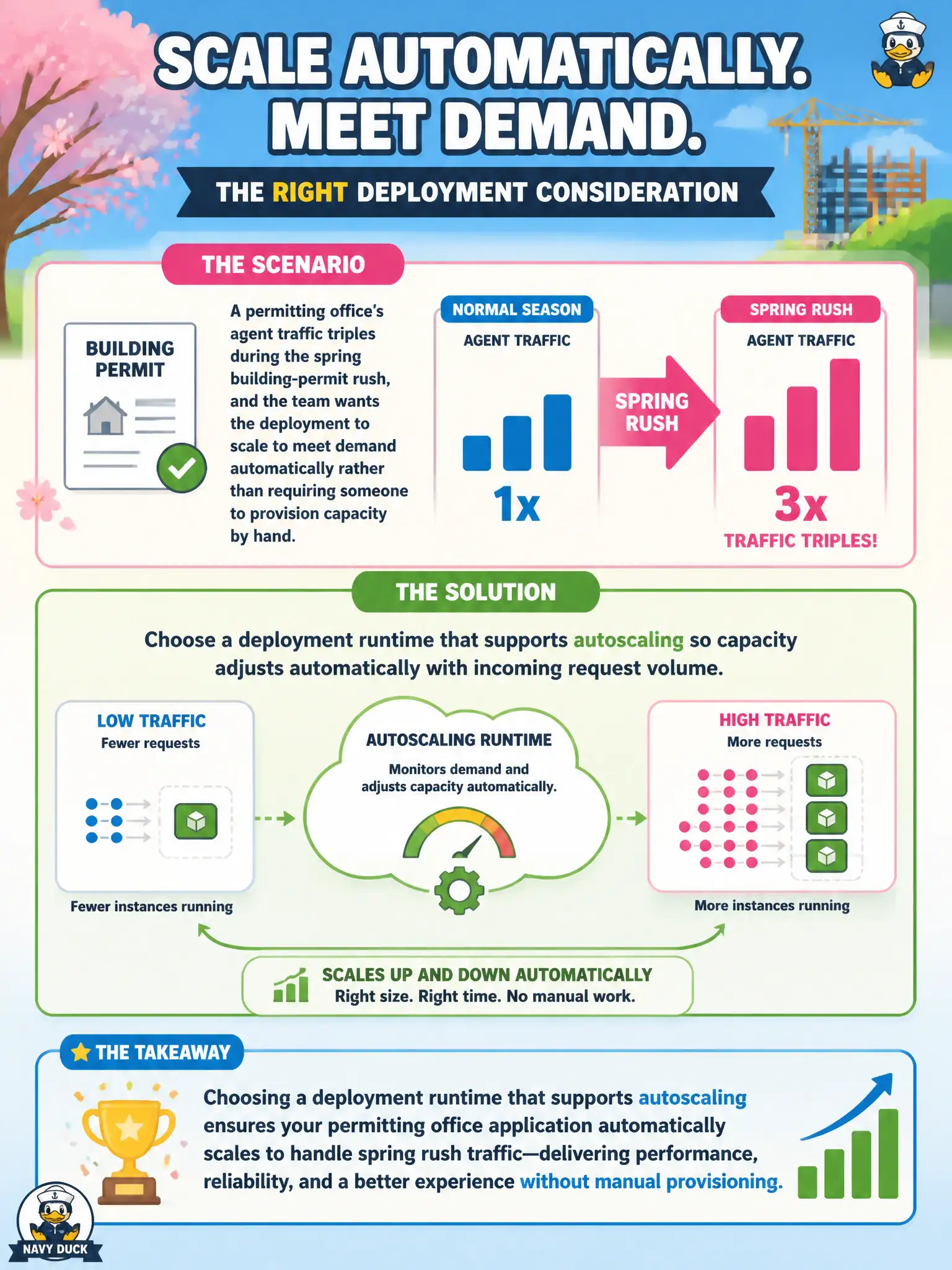
A permitting office's agent traffic triples during the spring building-permit rush, and the team wants the deployment to scale to meet demand automatically rather than requiring someone to provision capacity by hand. Which deployment consideration addresses this need?
Select an answer to reveal the explanation.
Short Explanation
Think of a permitting office needing extra tellers only during the spring rush, not year-round — that's autoscaling in a nutshell. The runtime needs to add capacity automatically when the rush hits and scale back down after, rather than someone manually flipping a switch. Ease of setup or a short config file doesn't help when the line out the door triples overnight.
Full Explanation
Seasonal demand spikes call for a deployment runtime whose scaling model responds to request volume without manual provisioning, so capacity grows during the rush and contracts afterward, avoiding both under-provisioned slowdowns and over-provisioned idle cost the rest of the year; this is a core factor in choosing between managed runtimes and self-managed infrastructure for a given workload. Ease of local development setup is a workflow convenience for engineers, unrelated to how production capacity responds to resident traffic. Lowest per-request token cost is a cost-optimization axis, not a capacity-elasticity one, and a cheap runtime that can't scale still falls over during the rush. Minimal configuration size is an operational-simplicity preference that says nothing about how the system behaves under load. Scope caveat: autoscaling has limits and warm-up behavior, so teams should validate the runtime's scaling ceiling and cold-start latency against the expected peak rather than assume infinite elasticity. Operational check: load-test the deployment at roughly triple expected baseline traffic before the season starts and confirm response times stay within target as capacity scales up.