
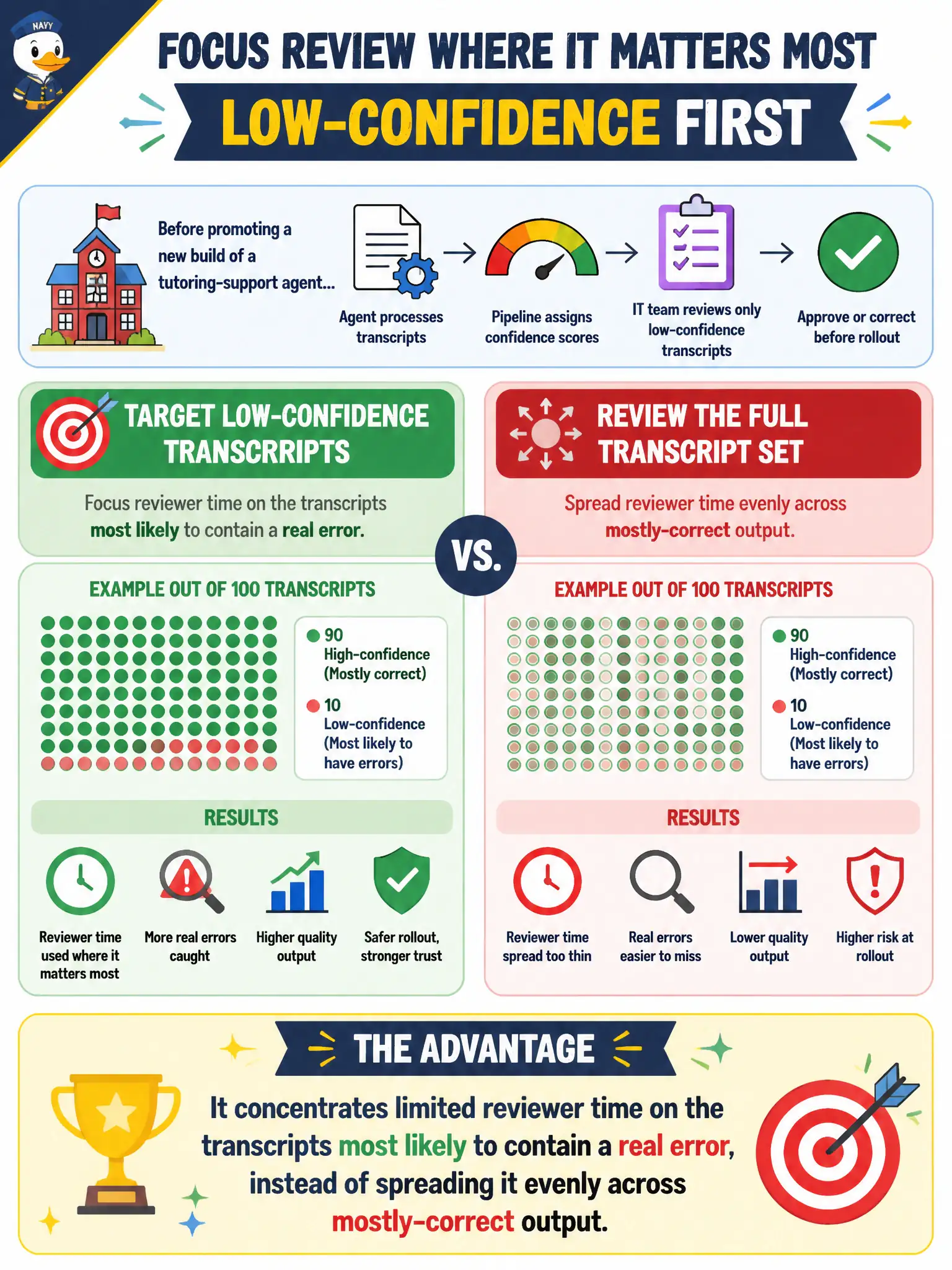
Before promoting a new build of a tutoring-support agent, a school-district IT team has staff review only the transcripts the pipeline flags as low-confidence, approving or correcting those before rollout rather than reading every transcript. What is the advantage of targeting review at low-confidence transcripts instead of reviewing the full transcript set?
Select an answer to reveal the explanation.
Short Explanation
Reading every transcript to find the few bad ones is like reading an entire haystack page by page for one needle. Sorting by confidence first is the metal detector — it points reviewers straight at the outputs most likely to be wrong, so their limited time goes where it actually catches problems.
Full Explanation
Confidence-targeted human-in-the-loop review works because confidence scores correlate, imperfectly but usefully, with the likelihood of an error, so directing reviewer attention there yields a higher error-catch rate per hour of review than spreading the same reviewer time evenly across a mostly-correct transcript set. That's the operational payoff of the design, and it scales to production volumes a full-transcript review could never keep up with. Claiming it guarantees zero errors overstates what confidence scoring can do — a confidently wrong answer, one the model produced with high certainty despite being incorrect, would slip past this filter entirely. Claiming it removes the need for a golden dataset conflates two different evaluation mechanisms; automated golden-dataset evaluation and human low-confidence review serve complementary purposes and neither substitutes for the other. Claiming it eliminates the need for confidence scoring gets the dependency backwards — the entire review-targeting strategy depends on a working confidence signal existing in the first place. Scope caveat: the confidence threshold that defines low-confidence needs periodic tuning, since a threshold set too high lets genuine errors through unreviewed. Operational check: periodically sample a batch of high-confidence transcripts anyway and confirm the error rate there stays low enough to justify skipping full review.