
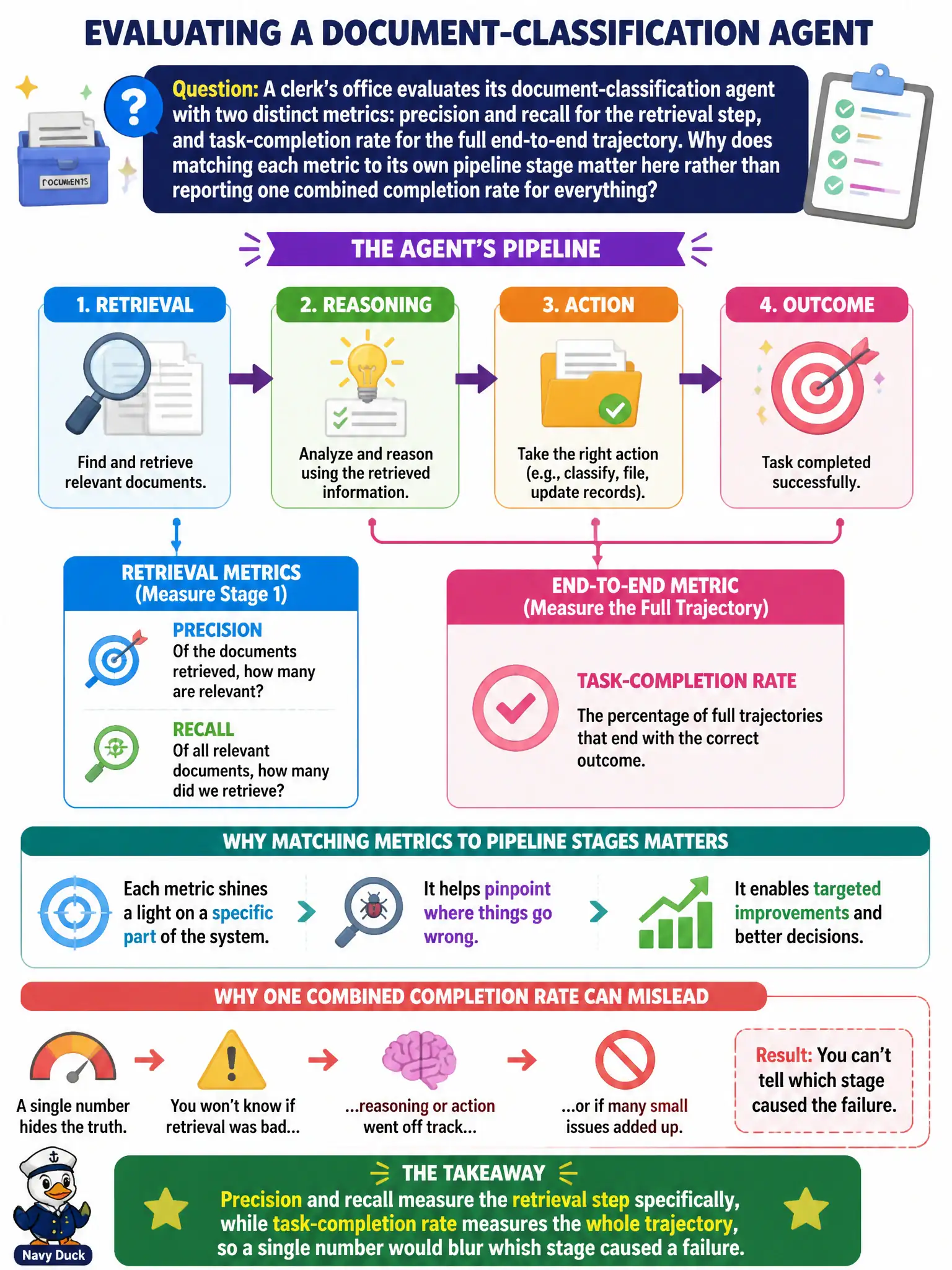
A clerk's office evaluates its document-classification agent with two distinct metrics: precision and recall for the retrieval step, and task-completion rate for the full end-to-end trajectory. Why does matching each metric to its own pipeline stage matter here rather than reporting one combined completion rate for everything?
Select an answer to reveal the explanation.
Short Explanation
Picture a relay race where the whole team gets one shared stopwatch time — you'd know the team was fast or slow, but not which runner cost them the race. Metrics matched to each stage are separate stopwatches per leg, so a dip in retrieval precision doesn't get buried inside an otherwise fine overall completion rate.
Full Explanation
Precision and recall are defined against a labeled set of relevant versus irrelevant documents, which is a retrieval-specific concept with no direct equivalent at the level of full end-to-end task success; task-completion rate, by contrast, asks whether the whole pipeline delivered the right outcome regardless of how it got there. Matching each metric to the stage it was designed to measure preserves diagnostic resolution: if completion rate drops, the office can check whether precision or recall dropped first, narrowing the fix to retrieval, or whether retrieval held steady and the failure sits downstream in classification logic. Collapsing everything into one completion number would still tell the office something went wrong, but not where, which defeats the purpose of instrumenting the pipeline in stages. Compute time is not the reason to separate these metrics — the choice is about what each number is capable of revealing, not how fast it runs. There's no dependency where completion rate requires precision and recall to be computed first; they're independent measurements over different data, and either could be computed alone. Scope caveat: per-stage metrics only help if the office actually reviews both together, since retrieval scores in isolation say nothing about whether the classification step used those retrieved documents correctly. Operational check: when completion rate dips, pull the retrieval precision and recall for that same run before assuming the fault lies downstream.