
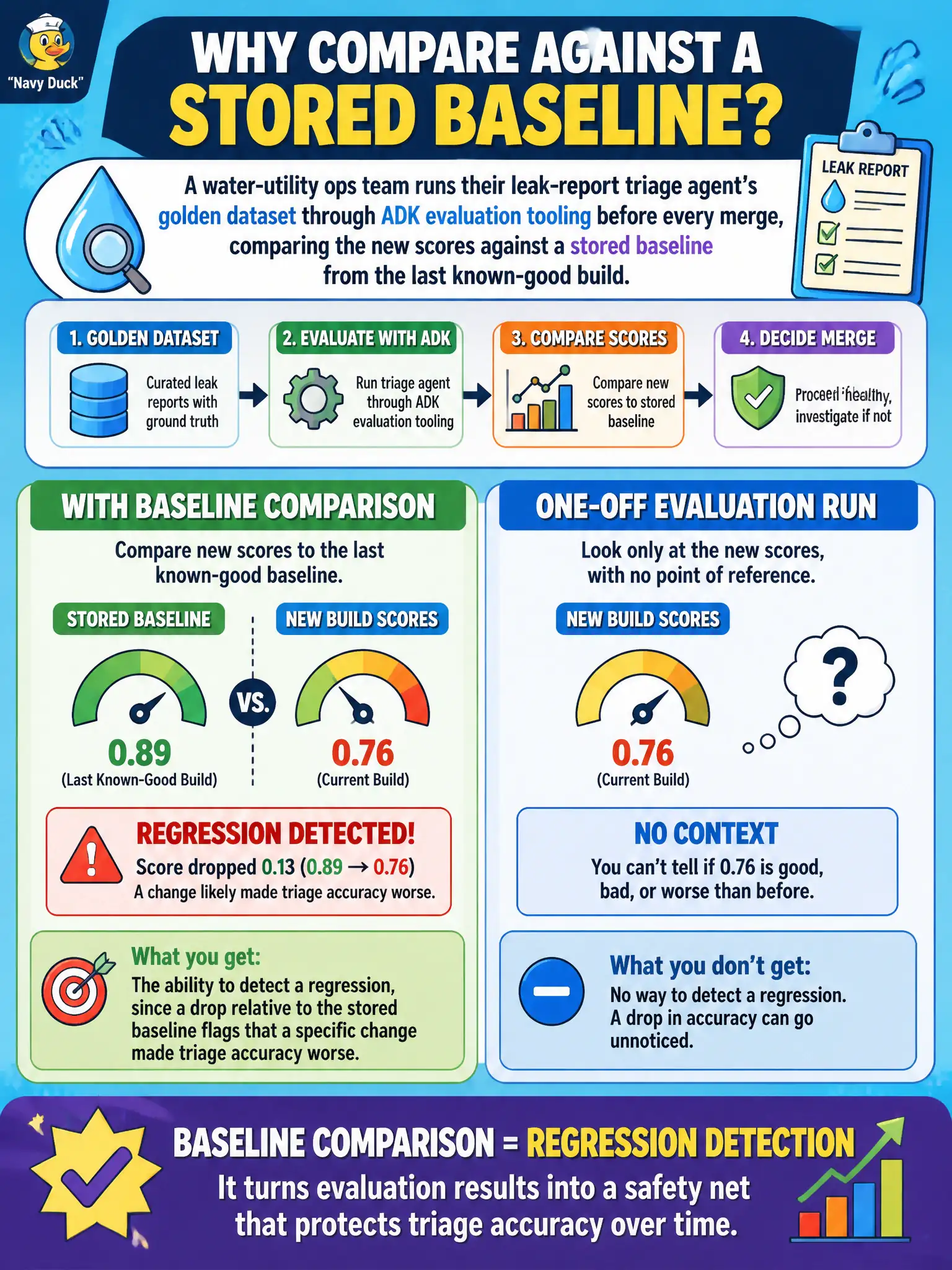
A water-utility ops team runs their leak-report triage agent's golden dataset through ADK evaluation tooling before every merge, comparing the new scores against a stored baseline from the last known-good build. What does comparing against a stored baseline give the team that a one-off evaluation run does not?
Select an answer to reveal the explanation.
Short Explanation
A one-off score tells you the agent got an 85 today, but an 85 means nothing on its own — was that always the score, or did it used to be a 95? Comparing against a stored baseline is what turns a snapshot into a trend line, so the team can catch the exact merge that made triage worse.
Full Explanation
A baseline comparison converts an evaluation run from a static measurement into a regression gate: by storing the scores from the last known-good build and diffing every new run against them, the team can attribute a drop directly to whatever changed since that baseline was captured, which a single isolated score can never do on its own. Response-schema formatting is a structural validity check independent of whether scores are compared historically — a one-off run can verify that just as well. Dataset size and statistical validity are properties of the golden dataset's construction, not of whether the run is compared to a prior baseline; a badly sized dataset stays badly sized whether or not you diff against history. Baseline comparison does not skip execution — the golden dataset still has to be run in full to produce the new score that gets compared, so it adds a comparison step rather than removing evaluation work. Scope caveat: a baseline needs periodic refreshing once intentional, approved changes shift expected scores, or the team ends up chasing phantom regressions against a stale target. Operational check: after a merge, confirm the CI output explicitly reports the delta from baseline, not just the raw new score.